

The Mound
The Mound expands an Oklahoma haunting into an account of an ancient underground civilization. A modern ethnologist discovers a sixteenth-century Spanish manuscript describing K’n-yan, where extraordinary technical powers coexist with captivity, exploitation and accelerating cruelty. His eventual descent beneath the mound tests the manuscript’s claims and reveals what became of the man who wrote it. The following account includes the ending.
12 min read · 2,326 words
Authorship, composition and publication
Lovecraft wrote the story for Zealia Bishop in December 1929 and early 1930. Its first magazine publication appeared in the November 1940 issue of Weird Tales, after Lovecraft’s death.
The distinction between the writer responsible for the narrative and the name under which a revision or collaboration appeared is important throughout this part of his bibliography. The Mound belongs with the substantial works associated with his paid revision activity, rather than with stories that can be adequately described as minor editorial corrections.
The H. P. Lovecraft Archive’s work page links to the surviving typed manuscript at Brown University and lists later editions. This article follows the electronic text linked there. The publication date in the facts panel refers to the first magazine appearance, not the year of the fictional investigation or the date claimed by the embedded manuscript.
Sources: H. P. Lovecraft Archive — fiction in composition order, H. P. Lovecraft Archive — fiction in publication order, The Mound — H. P. Lovecraft Archive data page, The Mound — original text
The investigation in Binger
The unnamed narrator recalls an incident in Oklahoma in 1928. An ethnologist interested in Indigenous traditions and settlers’ ghost stories, he visits Binger to investigate a mound near the town.
The reported haunting appears unusually regular. A male figure patrols the mound during the day; at night, a headless female figure carries a blue light. People who approach the place have disappeared, returned altered or suffered consequences that the community cannot explain.
Clyde Compton and his mother provide local accounts. The narrator learns that the apparent simplicity of the ghost story conceals a longer history of failed investigations. He initially hopes that careful observation will separate an actual cause from accumulated rumor.
The tale’s opening therefore establishes an investigative problem before introducing its wider mythology. The mound is visible from the town, the figures can be watched and the missing people have names. The mystery is not remote in space, but it has become socially isolated through repeated fear.
Sources: The Mound — original text
Grey Eagle’s warning and the talisman
The narrator consults Grey Eagle, an elderly Indigenous man who urges him to leave the mound alone. The warning describes beings below the surface whose long existence has brought them close to a condition between flesh and spirit.
Unable to dissuade him, Grey Eagle gives him a metal talisman inherited through his family. Its unfamiliar material and workmanship become significant during the excavation.
The narrator nevertheless treats the warning as something to investigate rather than obey. His professional interest and self-image as a determined explorer outweigh the practical advice of people familiar with the site.
The scene must be read as fictional representation. Its stylized speech and claims about ancient populations belong to Lovecraft’s invented narrative, and should not be reproduced as an authentic statement of an Indigenous religion or oral tradition.
Sources: The Mound — original text
The first excavation
On the mound, the investigator notices that dense vegetation seems inconsistent with the daily pacing he has observed from a distance. He also feels resistance from the air, as though invisible forces were interfering with his work.
The talisman reacts to something beneath the soil. Digging at the point of attraction, he discovers a cylinder made from the same unusual magnetic substance. Its exterior carries unfamiliar designs, but the document inside is written in Spanish.
The manuscript identifies its writer as Pánfilo de Zamacona y Nuñez, a gentleman from Luarca in Asturias, and claims to describe the underground world of Xinaián. The date given is 1545.
This discovery changes the kind of investigation required. An object can be examined, but its real significance depends on reading a long testimony. The modern narrator spends the night translating and taking notes, while the story shifts into the earlier traveler’s experience.
Sources: The Mound — original text
Zamacona leaves Coronado’s expedition
Zamacona is a fictional participant in the expedition led by the historical Francisco Vásquez de Coronado. He hears from Charging Buffalo about an entrance into a hidden world and decides that a private venture may bring greater wealth and distinction than remaining with the larger party.
He leaves the Spanish camp in October 1541. His guide takes him to a concealed opening in a ravine and supplies information and provisions, but refuses to accompany him underground.
The traveler agrees to meet Charging Buffalo again after the exploration. He never keeps that appointment. At the moment of departure, however, he regards the risk as part of an opportunity to become a discoverer of extraordinary importance.
The descent proceeds through a mixture of constructed passages and natural caverns. The familiar pattern of an expedition for wealth gradually gives way to an environment whose scale and history cannot be understood through the ambitions that brought him there.
Sources: The Mound — original text
Arrival in the blue-lit world
The passage finally opens on a mountainside above a vast plain filled with bluish light. The illumination resembles an atmospheric phenomenon, but it exists within the Earth. Zamacona caches supplies for the return and proceeds downward.
He encounters traces of roads, strange tracks, old settlements and gold-rich architecture. These discoveries seem at first to confirm the promise of a hidden civilization whose resources might transform his position on the surface.
The region is not wholly abandoned. A group of inhabitants reaches him after animals have reported his presence. Attempts at spoken communication fail until he begins to understand their use of directed thought.
Their first exchange provides both welcome and warning. They want his knowledge of the outer world, but they expect him to remain below for the rest of his life. The invitation to learn everything is inseparable from the refusal to let him carry that knowledge away.
Sources: The Mound — original text
The civilization of K’n-yan
The inhabitants describe a history extending beyond ordinary human chronology. Their traditions connect their ancestors with the stars, Tulu and ancient surface civilizations, but the narrative marks parts of this origin story as inherited legend.
Their demonstrable abilities are extraordinary enough: they regulate age, communicate mentally, reanimate bodies and alter the material state of objects. Such powers make the surface narrator’s earlier experiences with invisible resistance and apparently spectral figures newly intelligible.
The society has concentrated around Tsath, leaving earlier cities deserted. Mechanical abundance has reduced the need for many older industries, while enslaved people and altered organisms perform much of the necessary work.
The account therefore refuses a simple equation between technical advancement and humane conduct. The free inhabitants’ comfort depends on distinctions that permit other beings to be used as labor, food, instruments or entertainment.
Sources: The Mound — original text
Tsath: privileged captivity
Zamacona enters a metropolis of immense towers, ornate streets and elaborate domestic equipment. The authorities provide an apartment, servants, transport, instruction and access to libraries. He joins a social group whose arrangements differ from the family structures he knows.
He is useful because he can describe a surface world that has changed while K’n-yan remained isolated. The same information creates anxiety: the expanding presence of European explorers could eventually expose the entrances and attract invasion.
His privileged treatment thus has a conditional basis. As long as he offers valuable information and accepts residence, he is welcomed. He begins to fear what will happen when the scholars conclude that he has nothing more to tell.
The narrative makes captivity more complex than confinement in a cell. Zamacona can travel, study and enjoy material comfort while lacking the one freedom that matters most to him: the ability to leave.
Sources: The Mound — original text
Yoth, N’kai and the limits of exploration
Zamacona visits the red-lit world of Yoth and studies its older ruins. He also learns of the black realm of N’kai, where an earlier expedition encountered shapeless beings worshipping images of Tsathoggua.
The report explains why that cult was suppressed in K’n-yan. Later explorers could not rediscover the sealed gate, and disagreement about N’kai’s existence became entangled with religious authority.
Zamacona’s curiosity leads him to seek the missing route and experiment with projected or dematerialized states. The dreams he reports disturb influential figures, but his main manuscript withholds their detailed content.
That omission matters. The reader does not receive a complete direct visit to N’kai disguised as a brief reference. The story deliberately creates information that the manuscript’s author either cannot securely explain or chooses to record elsewhere.
Sources: The Mound — original text
The first failed departure
An attempt to escape through the route by which he entered fails. Zamacona realizes that known passages are guarded by forces he cannot safely overcome.
He begins drafting his account partly to sustain a connection with home. Writing Spanish and using the familiar alphabet preserve something of his earlier identity inside a society whose ordinary communication bypasses speech.
The metal container is chosen as evidence as well as protection. If the manuscript reaches the surface, its material might make the extraordinary account harder to dismiss.
Meanwhile, his position becomes less secure. The inhabitants’ appetite for novelty and increasing distrust of the surface make him both interesting and potentially threatening. He responds by suggesting that he still possesses knowledge he has not fully disclosed.
Sources: The Mound — original text
T’la-yub and the forgotten passage
T’la-yub, a woman in his social group, develops a particular attachment to him. Her family preserves knowledge of a passage overlooked when communication with the surface was restricted.
Zamacona promises that she can accompany him. His private plans are less generous: he considers ways of separating from her after escape and imagines a socially acceptable marriage elsewhere. The manuscript exposes his willingness to use her assistance without fully honoring the future she expects.
The fugitives leave in disguise with beasts carrying gold. At an obstructed portion of the route, T’la-yub uses her abilities to bring them through by dematerializing and restoring their bodies.
Their dependence on the beasts proves disastrous. One that resisted the journey returns and gives the alarm. Pursuers catch the party near the surface, transforming a nearly successful departure into evidence of betrayal.
Sources: The Mound — original text
Unequal punishment
Zamacona and T’la-yub are brought before the authorities. His continuing value as a source of information earns him another conditional reprieve. Her inherited connection to the gate makes her offense especially serious in their eyes.
She is condemned to the arena and then to service as a reanimated guard. Zamacona learns that she has become the headless night sentinel on the mound, whose blue light warns approaching outsiders.
The daytime figure is a separate living man serving a disciplinary posting. The apparently simple ghost story has now acquired a specific institutional explanation: the figures are elements of a guarded border maintained by the civilization below.
Zamacona is warned that another attempt will result in a comparable or worse fate. The threat is not merely death. It is continued use of his remains as a public instrument of punishment after ordinary life has ended.
Sources: The Mound — original text
The final manuscript entry
Despite the warning, Zamacona continues studying dematerialization. He hopes to move through the guarded route without becoming visible or tangible long enough to be stopped.
This time he abandons the plan to carry treasure. Escape and the preservation of his account become the principal objectives. He intends to take the manuscript cylinder with him, although altering its material state adds another demand on his imperfect skill.
The final entry announces urgency but does not describe the outcome. The document ends before its author can report whether he maintained control all the way to freedom.
The modern reader of the manuscript must therefore infer from the cylinder’s position that Zamacona reached very near the surface. It does not follow that he escaped safely. The missing ending is reserved for the narrator’s own descent.
Sources: The Mound — original text
The return beneath the mound
After reading, the ethnologist tries to persuade himself and the townspeople that the manuscript is an elaborate hoax. Yet the account explains too many otherwise disconnected details to be easily discarded.
He returns with the cylinder and descends through the entrance. Objects connected with earlier missing visitors and the architecture described by Zamacona strengthen the impression that the document is genuine.
In the guard chamber, he recognizes his own tools, which disappeared from the mound. Their ordinary familiarity is more convincing than the exotic surroundings: someone has moved them into this supposedly inaccessible place.
He also perceives partly material figures and feels the continuing attempts to interfere with his talisman. The old account’s distinction between ordinary bodies and altered states becomes an immediate threat rather than a theoretical explanation.
Sources: The Mound — original text
The ending and Zamacona’s fate
A mutilated, reanimated human body approaches as a sentinel. The narrator connects it with Zamacona and with an earlier visitor’s traumatized account of what had been done to a white man below the mound.
An inscription in awkward Spanish associates the punishment with seizure by K’n-yan’s will and with T’la-yub’s headless body. The narrative makes the punitive parallel unmistakable, while the precise mechanics of the inscription’s wording should not be expanded into an unsupported theory of transferred souls.
The investigator flees, leaving the manuscript and equipment behind. He reaches the surface in a shattered state and leaves Binger, unable to offer the town a full explanation.
The conclusion supplies the missing outcome through a living—or mechanically continuing—piece of evidence. Zamacona’s testimony has survived, but the attempt to free its writer has ended in the very form of perpetual servitude he feared.
Sources: The Mound — original text
Interpretive themes and cautions
The story’s central reversal concerns the meaning of a hidden civilization. Wealth, long life and mastery of nature initially promise fulfillment; closer knowledge reveals a society whose capacities magnify its cruelty and protect its isolation.
The narrative also makes documents active objects. The manuscript changes the investigator’s decisions, while the strange metal provides a physical connection between its account and the modern setting. Its final loss preserves testimony while removing the strongest recoverable proof.
Colonial ambition is present on both narrative levels. Zamacona seeks wealth and status, while the ethnologist trusts his own courage and methods over local warnings. Their perspective is nevertheless saturated with racial and cultural hierarchies, including pseudoscientific assertions that should be treated critically rather than adopted.
Within the Mythos, The Mound is especially valuable for its differentiated underground geography, its account of Tsathoggua’s cult and its treatment of altered material states. It supplies a densely imagined social world, but one reached through narrators whose knowledge, motives and omissions remain part of the evidence.
Sources: The Mound — original text
Related music
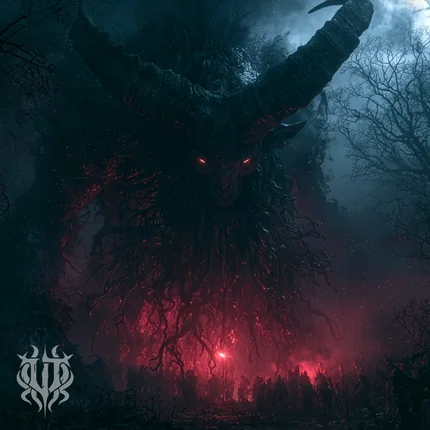
The Black Goat of The Woods is a dark metal tribute to Shub-Niggurath, the ancient woodland deity whose forgotten cults gather beneath twisted trees and indifferent stars.
References
- H. P. Lovecraft Archive — fiction in composition order
Composition dates; question marks and ranges retain the source uncertainty.
- H. P. Lovecraft Archive — fiction in publication order
First publication dates and venues; issue dates can differ from actual release dates.
- The Mound — H. P. Lovecraft Archive data page
Publication records and manuscript repository link; consulted 22 September 2026.
- The Mound — original text
The fictional narrative is evidence for what the story says, not proof of events in the real world.
At a glance
H. P. Lovecraft; Zealia Bishop
December 1929–early 1930
1940, November
Weird Tales, 35, No. 6
Fiction