

Serpent people
Serpent people are intelligent reptilian beings whose influential early portrayal appears in Robert E. Howard’s The Shadow Kingdom. There they survive within ancient Valusia by disguising themselves as humans, occupying religious and political institutions and replacing the people who exercise royal authority. Later Mythos fiction and games develop additional histories that must be identified by source.
6 min read · 1,186 words
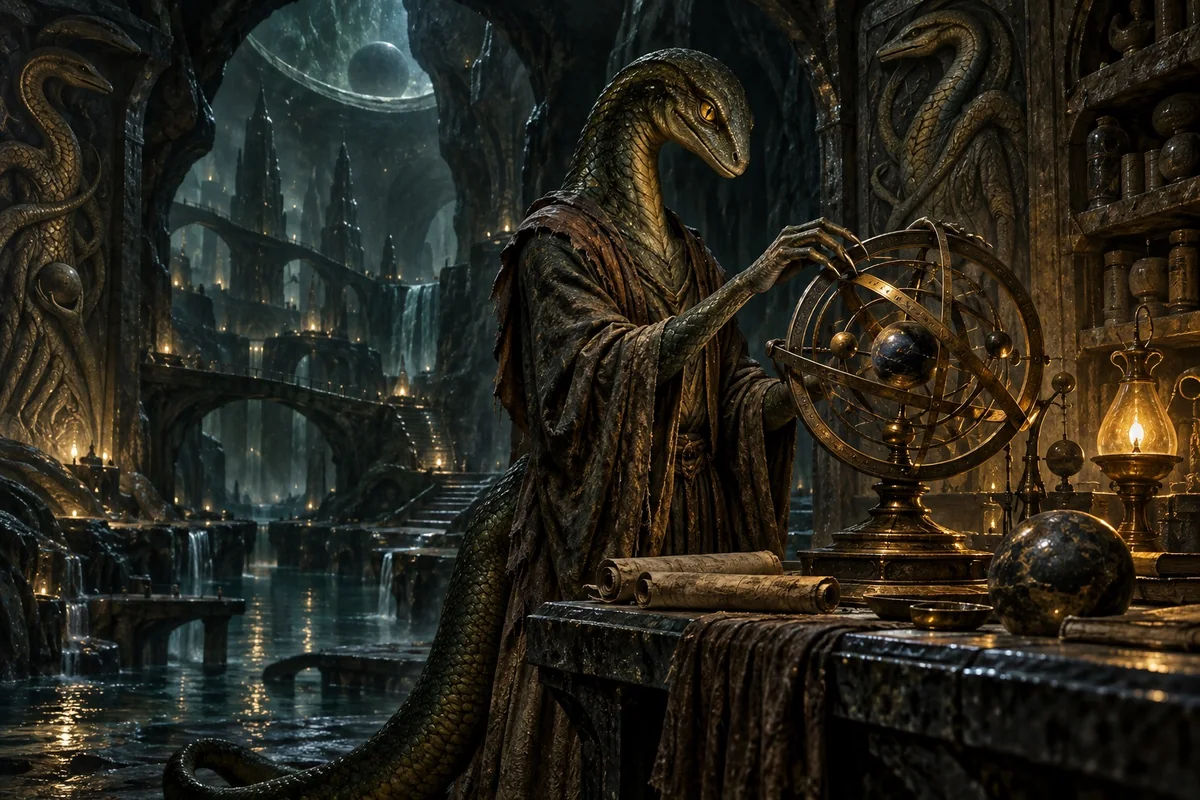
The beings behind human faces
In The Shadow Kingdom, death reveals a serpent head above a body broadly resembling a human one. The disguise can reproduce a particular individual closely enough to deceive people who know that person. Guards, a councillor, Brule and Kull himself all have apparent doubles during the conspiracy.
Brule describes the deception as a glamour. The story concentrates on what the victims see and how the false appearance collapses, rather than giving a technical account of bodily transformation. Illustrations can show the exposed reptilian head, but a precise universal anatomy beyond the described form would add material the tale does not establish.
The contrast between the hidden head and the recognizable body makes the revelation especially disturbing. The being has already participated in ordinary human interactions before its identity becomes visible.
Antiquity and survival
Brule’s account places the serpent people among nonhuman powers that preceded or contested humanity’s rise. Earlier conflicts drove them from open dominance, but survival through concealment allowed them to retain influence within later human societies.
The history is delivered as knowledge held by a character. It supplies the explanation Kull needs to understand his immediate danger, while remaining embedded in Howard’s invented prehistory. The account’s other strange races are not proof that every creature mentioned in a different author’s work belongs to the same ancient war.
Within Valusia, the essential continuity is institutional. A people apparently defeated long ago can endure through a priesthood, secret knowledge and the replacement of individuals. Their power depends on maintaining structures that humans believe are their own.
The temple and political infiltration
The Temple of the Serpent provides a religious center associated with the hidden enemy. Ka-nu’s possession of a jewel stolen from it helps him demonstrate the seriousness of his approach to Kull. Revealing the theft exposes the ambassador to retaliation.
The conspiracy reaches beyond isolated assassins. False guards preserve the appearance of security, a false councillor exploits personal access, and a false king attempts to occupy the highest office. Human allies can participate in the broader intrigue as well.
These methods allow the serpent people to work through existing authority. They do not need every human in the palace to know the truth. Indeed, the uncertainty of the real guards when two Kulls appear demonstrates how obedience to appearances can temporarily protect the replacement.
The spoken test
Brule uses a short formula whose sounds the serpent people cannot pronounce. Its original meaning is lost, but the physical limitation of their mouths makes it useful as a test. Kull later applies it to guards and an assembled council.
The test introduces a revealing asymmetry. The beings can create an extraordinarily convincing visual impression while remaining unable to perform one apparently simple vocal action. Their deception is powerful but incomplete.
It is a practical device within this story’s world. Later works may give serpent people different abilities, and a game may represent detection through its own rules. Those later versions do not change how Brule’s test functions in the original encounter.
The dragon armlet
Brule carries a gold armlet formed as a winged dragon, with three coils and ruby horns. Ka-nu shows Kull the object beforehand so that it can assist recognition when the Pict arrives at night.
The dragon also has an older significance in Brule’s explanation of the serpent people’s enemies. Its use joins a personal token to a survival from the imagined remote past. The object helps establish trust, although the appearance of a false Brule shows why Kull cannot simply stop paying attention once he thinks he recognizes his ally.
The armlet’s importance is therefore partly social and partly symbolic. The tale does not present it as a weapon that automatically destroys every serpent being brought near it.
Illusion applied to a room
The conspiracy also deceives Kull about his surroundings. He enters an apparent council chamber that proves to be the Accursed Room, occupied by serpent people wearing the faces of officials.
This extends their power from the imitation of persons to the manipulation of an architectural setting. The palace can no longer be understood solely through its familiar routes and public functions. Hidden passages and deceptive appearances give the conspirators a second use for the same building.
Brule’s knowledge of the concealed routes counters that advantage. The conflict therefore involves control of space and information before it becomes a direct exchange of sword blows.
Eallal and the threat after death
The apparition of Eallal, a king from roughly a thousand years earlier, gives the serpent people’s former successes a visible representative. Kull recognizes him from a statue, connecting the palace’s official commemoration with a hidden history of murder.
Brule explains that a victim killed by the serpent people may remain enslaved after death. The companions’ response is to promise that neither will allow the other to fall helplessly into their hands. The threat transforms assassination into the possibility of continuing subjection.
The story shows the apparition and reports Brule’s explanation. It does not supply an exhaustive system governing every death or every spirit in Howard’s world.
Limits exposed by Kull and Brule
The impostors can be killed, and their human appearances fail after death. In the Accursed Room they are vulnerable to the combined attack of Kull and Brule. Surprise and concealment serve them better than an open fight against prepared opponents.
The false king also depends on delaying recognition. Once Kull kills his double before the genuine officials, the exposed corpse gives the conspiracy’s opponents evidence that can be shown publicly.
Kull’s final vow promises a wider campaign against the surviving serpent people. The narrative ends before such a campaign is carried out. The destruction of the palace group should not be mistaken for a demonstrated extinction of the entire race.
The Valusian serpent-men in Lovecraft
The Haunter of the Dark explicitly mentions the serpent-men of Valusia in its account of the Shining Trapezohedron. According to the history Blake deciphers, they recovered the object from the ruins of the Antarctic beings before it passed into later human possession.
This is a direct textual connection between Lovecraft’s artifact history and Howard’s imagined civilization. It supplies a particular act of recovery, not a complete account of the serpent people’s religion, migrations or relationship with every other reptilian creature. The reference is nevertheless more specific than a later resemblance inferred from appearance alone.
Relationship to other Mythos creatures
Later roleplaying presentations place serpent people within an expanded Mythos bestiary. That is a useful record of their subsequent reception, but it is a different evidentiary layer from Howard’s Valusian conspiracy.
The reptilian inhabitants of Lovecraft’s The Nameless City have their own anatomy, ruins and narrated history. Yig’s connection with snakes likewise does not establish that every serpent-associated being belongs to Howard’s species. Similar visual motifs create useful comparisons without proving a common biological or political identity.
The Shadow Kingdom itself does not explicitly name the Serpent’s god as Yig or Set. Source-specific names and relationships should remain visible when moving between the original story, later fiction and game settings.
Sources: Chaosium — Mythos Monsters, The Nameless City — original text, Robert E. Howard — The Shadow Kingdom
References
- Robert E. Howard — The Shadow Kingdom
Weird Tales, August 1929; public-domain text supplied by Project Gutenberg.
- Chaosium — Mythos Monsters
Descriptions belong to the roleplaying game; they are not automatically facts in Lovecraft’s original stories.
- The Nameless City — original text
The fictional narrative is evidence for what the story says, not proof of events in the real world.
- The Haunter of the Dark — Unspeakable Tales ebook
The fictional narrative is evidence for what the story says, not proof of events in the real world.
At a glance
The Shadow Kingdom, Robert E. Howard
Weird Tales, August 1929
Valusia in Howard’s Kull fiction
Serpent head; broadly humanlike body
Glamour and impersonation of specific humans
Cannot pronounce Brule’s testing formula
Kull; Brule; Ka-nu
The Serpent; neither Set nor Yig is explicitly named