

The Nameless City
The nameless city is an immensely ancient settlement in the Arabian desert whose low architecture and underground records preserve the history of a nonhuman civilization. An unnamed explorer discovers that the reptilian figures in its art are not merely symbolic representations of human inhabitants. The city’s ruins, passages and luminous abyss turn archaeology into a confrontation with a past that has not become safely extinct.
5 min read · 1,050 words
A place older than its surviving legends
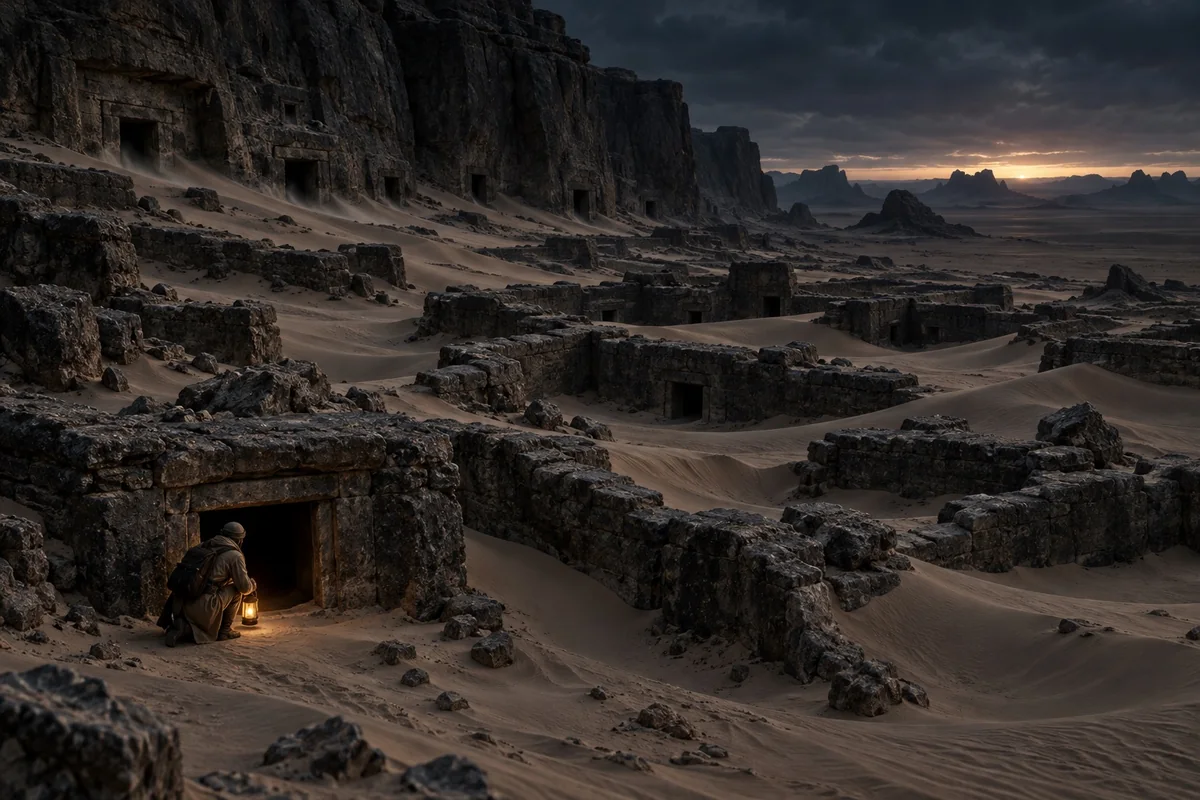
The city stands in a desert valley, its remaining walls and foundations almost buried by sand. The explorer places its age beyond the beginnings of the familiar ancient civilizations of Egypt and Mesopotamia. Even the traditions surrounding it cannot supply its name.
Local people avoid the site, and the narrator deliberately travels beyond their warnings with a camel and excavation tools. His initial triumph at finding it is immediately qualified by the impression that the ruins repel intrusion.
The story gives no recoverable coordinates. Its placement in the Arabian desert and its comparisons with named ancient places establish an imaginative geography rather than a modern archaeological location.
Sources: The Nameless City — original text
The surface ruins
The first remains consist of shapeless foundations and nearly vanished streets. Excavation yields no convenient inscription identifying the builders. The scale and proportions of the structures trouble the explorer before he can explain why.
A low cliff interrupts the sandy terrain. Several entrances have been cut into its face, giving access to temples or chambers sheltered from the destruction above. Clearing the sand reveals spaces with altars, pillars, niches and deliberately shaped symbolic stones.
Most of these chambers are too low for a human to stand in. The explorer repeatedly accounts for their dimensions through supposed ritual requirements, delaying recognition that the builders may have had bodies unlike his own.
Sources: The Nameless City — original text
The temple that breathes wind
Localized currents of cold air appear near sunrise and sunset. They stir sand within the city while the wider desert remains still, making them difficult to attribute to an ordinary passing wind.
The explorer eventually traces a current to a larger cliff temple. Once the gust subsides, he enters and discovers an artificial opening leading deeper into the rock. The apparently atmospheric oddity has become a guide to hidden architecture.
The temple itself is high enough for him to stand, but its fixtures remain low. This contrast adds another clue: a larger natural or engineered space has still been equipped for inhabitants whose practical needs differ from those of humans.
Sources: The Nameless City — original text
The descending route
The passage contains very small, steep steps. Some sections require the visitor to move feet first, and one stretch is too low even for kneeling. The journey continues until his torch dies and the distance from the surface becomes impossible for him to estimate.
The route is not merely a ceremonial room in which worshippers might choose to crawl. Its inconvenient dimensions extend into practical infrastructure. This eventually weakens the narrator’s attempt to explain the entire city as a human culture honoring reptilian gods.
The descent also changes how he knows the place. Sight gives way to touch and bodily strain. He feels walls, cases and changes in slope before a distant glow allows visual examination again.
Sources: The Nameless City — original text
The preserved inhabitants
A long corridor contains glass-fronted cases made from an unfamiliar golden wood. Within them lie preserved reptilian bodies, many dressed in rich fabrics and ornaments.
Their size is compared with that of a small human, but their overall form suggests crawling animals rather than upright people. Flexible forefeet resemble hands. Horns, a high forehead, a noseless face and an alligator-like jaw resist the narrator’s attempts to find one familiar comparison.
The clothing and display indicate cultural status, while the surrounding art repeatedly places similar beings in cities and gardens proportioned for them. The explorer initially calls the figures allegorical, but the material evidence increasingly points toward their having been the actual citizens.
Sources: The Nameless City — original text
The history in the murals
The painted record depicts an old coastal metropolis whose environment changes as the sea retreats and desert advances. Its inhabitants fight wars, preserve institutions and eventually cut a route through the rock toward another realm.
The murals show attachment to the abandoned city alongside images of the new country below. Later scenes become more disturbing, presenting a diminished population and growing hostility toward the surface world. One depicts a human being killed by the older inhabitants.
The account of duration comes from the narrator’s interpretation of these images. The claim that the civilization endured for millions of years is part of the story’s imagined deep history, not a chronology established through external scientific evidence.
Sources: The Nameless City — original text
The brass door and luminous gulf
The corridor ends at a huge open brass door. Beyond lies a seemingly boundless radiance like illuminated mist. A stairway descends into it, disappearing from view after a short distance.
The murals suggest that cities and landscapes lie below, but the explorer never reaches them. His direct observation is of the gateway, steps and luminous abyss, not a surveyed subterranean kingdom.
The door is too heavy for him to move. Its position becomes crucial when the returning wind drives toward the gulf and figures emerge against the light beyond it.
Sources: The Nameless City — original text
The returning inhabitants
Near dawn, a powerful current pours down from the surface. At first the explorer treats it as another instance of the wind he has already observed. Its force then threatens to carry him through the gateway.
Against the abyss’s illumination he sees a rushing company of partly transparent reptilian figures resembling the preserved inhabitants and their portraits. Their voices and hostile expressions make the apparent wind into a passage of active beings.
The brass door closes behind the last of them with the metallic sound previously heard at sunrise. The repeated surface phenomena now have a hidden counterpart underground. The narrator survives to write, but the mechanics of his escape are not supplied.
Sources: The Nameless City — original text
Connections and distinctions
The opening associates the city with a dream of Abdul Alhazred and a couplet about survival beyond ordinary death. The story does not yet identify the Necronomicon by name. Later literary connections should not overwrite that difference.
The narrator also thinks of Sarnath and Ib while imagining the city’s antiquity. Those references connect the tale with Lovecraft’s earlier invented past, but do not place all three settlements on one explicitly mapped continent.
The reptilian inhabitants likewise require care. This story does not identify them as Robert E. Howard’s serpent people or assign them the disguising abilities of that separate tradition. Their own architecture, artwork and final spectral appearance provide the relevant evidence.
Sources: The Nameless City — original text
References
- The Nameless City — original text
The fictional narrative is evidence for what the story says, not proof of events in the real world.
At a glance
The Nameless City
An unnamed valley in the Arabian desert
An ancient reptilian civilization
Low chambers, small steps, cliff temples and a long decorated corridor
A brass gateway above a luminous abyss
Not supplied