

Ubbo-Sathla
Ubbo-Sathla is the primordial source of terrestrial life in Clark Ashton Smith’s story of the same name. A vast, unformed being in the earliest marshes of Earth, it produces the first patterns of living things and stands among tablets preserving the wisdom of prehuman gods. The attempt to reach that wisdom turns a modern reader’s investigation into a retreat through identity, ancestry and the origins of life.
6 min read · 1,078 words
Before the familiar gods
The story opens with a passage attributed to the Book of Eibon. It places Ubbo-Sathla on the young Earth before the arrival of the named star-born powers Zhothaqquah, Yok-Zothoth and Kthulhut. The passage also anticipates the eventual return of earthly life to its source.
This creates a cycle rather than a conventional history of divine rulers. Ubbo-Sathla matters as a beginning and an ultimate destination for life. The entity is not introduced through a priesthood that governs a human kingdom, nor through a war in which it seeks a throne.
The chronology belongs to Smith's fictional account. It gives a distinct position to terrestrial generation while acknowledging powers from beyond Earth; it need not be turned into a universally binding family tree for every author's Mythos.
Form and environment
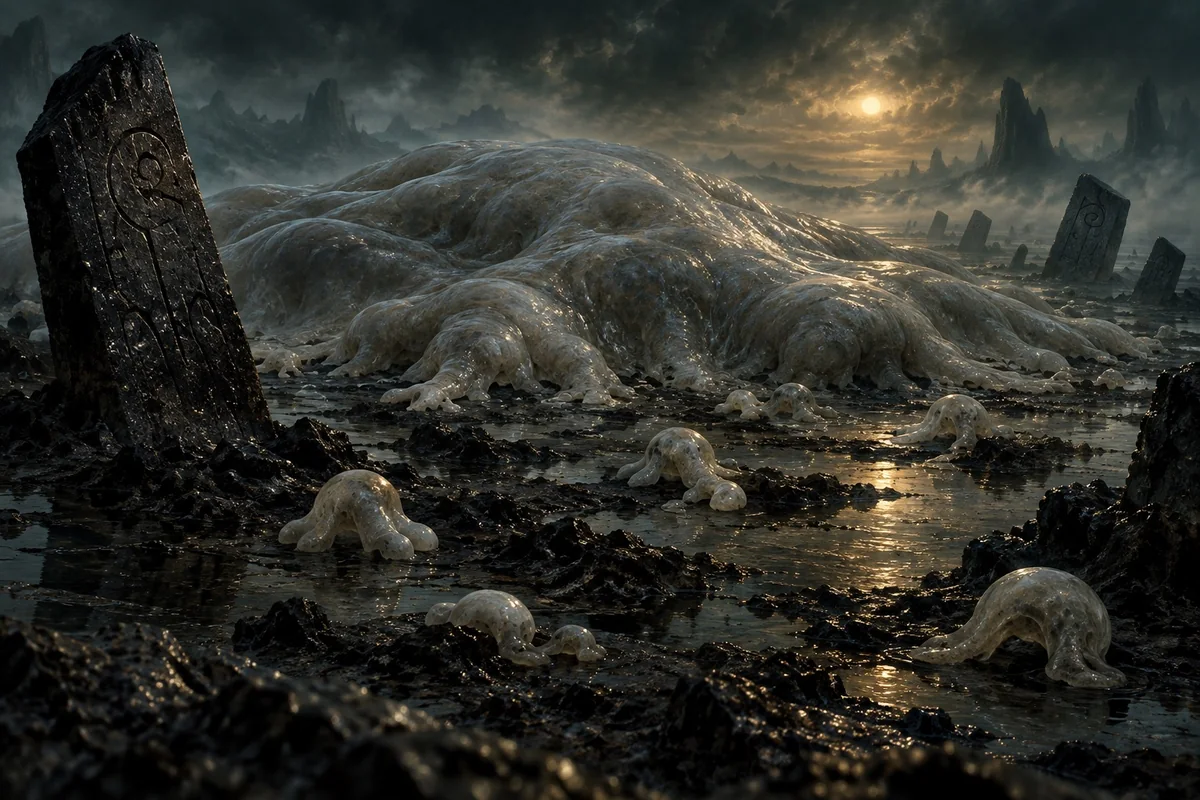
At the limit of the visionary journey, Ubbo-Sathla appears as an immense protoplasmic presence in a primordial marsh. It has no head, no recognizable organs and no differentiated limbs. Its body continually produces amoeboid forms that become early patterns of earthly life.
The surrounding world is muddy, steaming and unfinished. Stone tablets stand or lie in the mire around the being. The material setting combines biological emergence with a surviving intelligence older than the life now beginning there.
This description is unusually important for visual interpretation. A fixed humanoid body, a crowned face or a monster with a stable arrangement of limbs would shift the image away from the story's emphasis on undifferentiated existence.
The tablets of the elder gods
The tablets preserve knowledge left by gods who died before Earth's human history. Their stone is associated with the stars. Zon Mezzamalech believes that reading them would disclose primordial secrets beyond the achievements of later magicians.
Ubbo-Sathla is associated with their keeping, but the final scene does not show a speaking guardian negotiating admission. The tablets are physically present in the marsh, accessible to the creature that the seeker has become.
The obstacle is therefore not simply a locked chamber or a stronger adversary. The journey that brings the seeker to the writings removes the mental capacities needed to understand them. Access and comprehension become tragically incompatible.
Paul Tregardis and the crystal
The narrative begins its modern action with Paul Tregardis in London in 1932. He buys a cloudy crystal from a dealer in curiosities. The dealer associates it with Greenland and describes its discovery in ancient geological strata; this account reaches the reader as a claim accompanying the sale.
Tregardis owns a medieval French manuscript of the Book of Eibon. He notices a resemblance between the newly purchased object and a crystal described in the book's account of the Hyperborean magician Zon Mezzamalech.
Looking into the stone, he sees a room in remote Mhu Thulan and begins to identify with its occupant. A collector's comparison of objects and manuscripts becomes direct participation in the past.
The ambitions of Zon Mezzamalech
Zon possesses the crystal in Hyperborea and uses it to look backward through time. He wishes to reach the period of Ubbo-Sathla and recover the wisdom of the tablets. The Book of Eibon reports that he and the crystal disappeared, but does not explain the outcome in advance of Tregardis's experience.
At first, the modern and ancient identities alternate. Tregardis can return to London, while the Hyperborean room and magician increasingly displace his sense of ordinary reality. Repeated experiments weaken the distinction between observer and predecessor.
The story presents this relationship through shifting consciousness rather than through a simple, independently demonstrated family genealogy. Zon is the identity through which the deeper journey occurs; the two men should not be reduced to an established biological relationship that the narrative does not supply.
From human memory to prehuman existence
The final exploration proceeds beyond the magician's personal history. Successive modes of life replace one another as the voyager retreats through human and prehuman existence. Kings, warriors, women and other human lives give way to forms that no longer possess human faculties.
The descent passes through animal and more primitive stages toward the beginning of life. Its sequence belongs to a fantastic vision of ancestry, not a modern scientific reconstruction of evolution. What remains consistent is the progressive loss of the complex mind that originally wanted knowledge.
The crystal does more than display historical pictures. Its use changes the identity and capacities of the seeker. The distance traveled is simultaneously temporal, biological and psychological.
The encounter and the failed reading
At the earliest marsh, the voyager reaches the place that Zon intended to find. Ubbo-Sathla and the tablets are there. Yet the traveler now exists as a primitive creature, moving without the reflective understanding that gave the expedition its purpose.
It crawls across the tablets without reading them. This is the central reversal: the coveted objects have not proved imaginary, and the journey has not stopped just short of success. The physical objective is achieved after the intellectual objective has become impossible.
The episode links cosmic horror to the conditions of knowledge itself. A human mind cannot simply carry its present identity intact to every point from which life and consciousness emerged.
Disappearance and the surviving account
The modern frame records Tregardis's disappearance, while the ancient record had already preserved the disappearance of Zon Mezzamalech. The stone is no longer available to resolve the mystery through another ordinary inspection.
What survives for later readers is a narrative and a fragmentary book tradition. That structure resembles other Mythos investigations in which records outlast the people who understood their immediate significance.
The story does not follow Ubbo-Sathla into an attack on modern London, supply a defeated cult or show a successful rescue. The catastrophe is the absorption of the investigator into a past from which his conscious identity cannot return.
Ubbo-Sathla and Abhoth
Smith also imagines Abhoth, a generating mass encountered beneath Hyperborea in The Seven Geases. The resemblance can tempt a reader to merge the two, but their narrative roles differ.
Ubbo-Sathla belongs to the first emergence of earthly life and the unreachable wisdom of the tablets. Abhoth inhabits an underworld visited by a living Hyperborean, produces variable offspring, inspects the visitor and communicates a refusal to eat him.
Treating each through its own story preserves the differences between an origin beyond human consciousness and an articulate, grotesquely fertile inhabitant of the subterranean world.
Sources: Clark Ashton Smith — Ubbo-Sathla (1933), Clark Ashton Smith — The Seven Geases (1934)
References
- Clark Ashton Smith — Ubbo-Sathla (1933)
Original story; the host identifies these texts as believed to be in the public domain.
- Clark Ashton Smith — The Seven Geases (1934)
Original story; the host identifies these texts as believed to be in the public domain.
At a glance
Clark Ashton Smith
Ubbo-Sathla
Weird Tales, July 1933
Headless, organless protoplasmic source of life
Tablets of primordial wisdom; the viewing crystal
Paul Tregardis / Zon Mezzamalech