

Abhoth
Abhoth is the endlessly generating being encountered near the end of Clark Ashton Smith’s The Seven Geases. A gray mass occupying a subterranean pool, it sheds varied offspring and consumes those that fail to escape. Its encounter with Ralibar Vooz reveals intelligence, curiosity and selective appetite beneath a form that initially appears to be uncontrolled biological production.
5 min read · 1,033 words
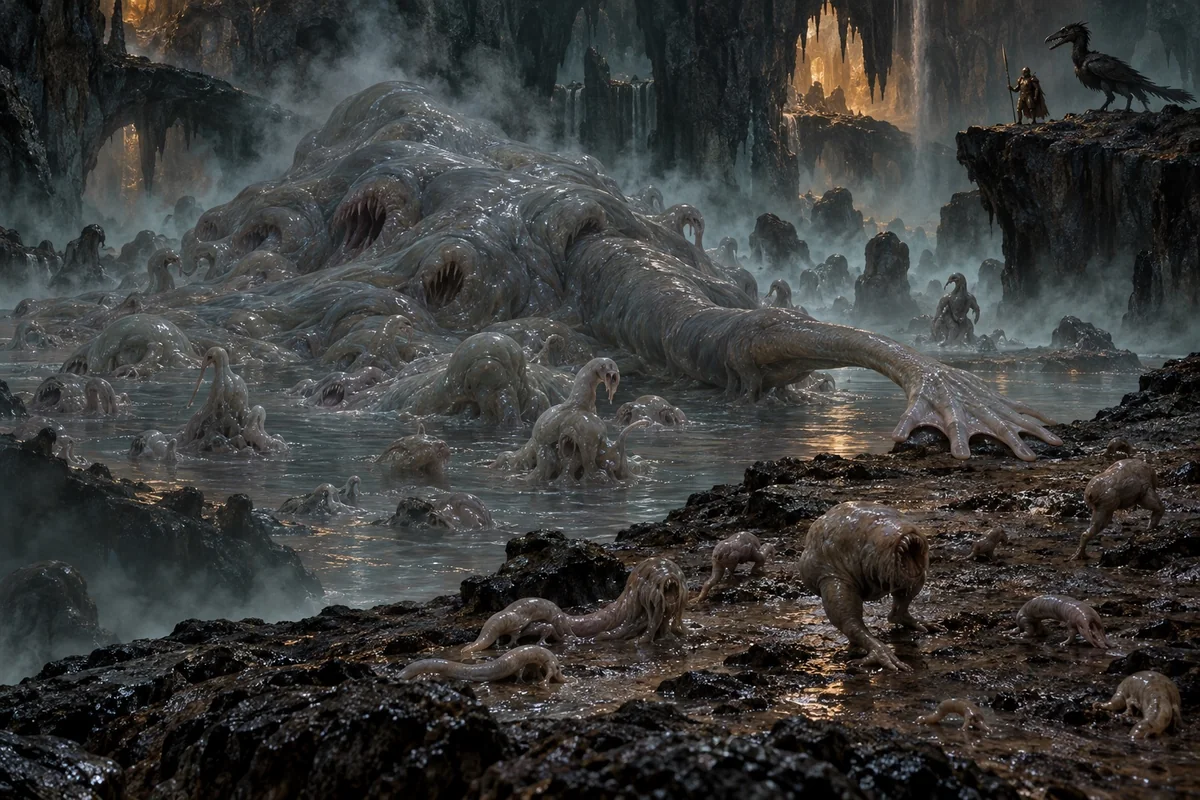
The final destination of the descent
Ralibar Vooz reaches Abhoth after a chain of imposed journeys. The human Archetypes reject him as a distorted example of their form and send him to the source of miscreation, suggesting that Abhoth may mistake him for one of its children and eat him.
Sources: [1]
The hunter's guide, Raphtontis, leads him to another cavern on approximately the same level as the Cavern of the Archetypes. The narrator allows that it may be an annex to that region, but does not firmly settle the arrangement.
The proximity brings together two different kinds of origin: idealized or preliminary patterns of life in one region, and prolific malformed bodies in the other. The story does not resolve those origins into a single biological system.
Approaching the pool
The ground becomes firmer than the unstable surfaces of the Archetypes' cavern. That improvement is offset by a procession of repellent creatures moving through the dark. Ralibar Vooz must push and kick them away as he advances.
Some resemble one-legged toads, worms with many tails or distorted lizards. Their forms vary continuously. They are materially solid, unlike the hazy dinosaurs that had tried unsuccessfully to contain the hunter in the preceding region.
The creatures become smaller as he approaches their source. Hot vapor thickens the air and leaves a slimy deposit on his exposed skin and armor. By the time the pool becomes visible, the scene has established Abhoth through its offspring and physical effects as well as its own body.
Sources: [1]
The generating body
Abhoth nearly fills its pool. Its gray bulk swells, trembles and divides, continually producing new anatomies. The offspring include incomplete-looking arrangements and combinations of parts rather than members of one uniform species.
Mouths open in the parent mass and devour those that do not reach the edge quickly enough. Production and consumption occur together, making the pool both a birthplace and an immediate danger to what is born there.
This active relationship distinguishes Abhoth from an inert substance that accidentally supports life. The parent body can form structures, take in food and respond to an unfamiliar visitor, although much of its visible activity has the appearance of ceaseless organic proliferation.
Sources: [1]
Growth of the offspring
The progeny increase in size as they move away from Abhoth. This is observed first in reverse during the approach, when the hunter encounters progressively smaller forms nearer the pool. It becomes a direct threat during his later attempt to leave.
No fixed catalogue can encompass the variations described. The story uses examples to suggest an ongoing process capable of producing many different configurations.
The term offspring is therefore more useful here than the name of a single standardized monster species. They share an origin and a pattern of growth, but not one stable silhouette, number of limbs or method of movement.
Sources: [1]
Inspection of a stranger
When Ralibar Vooz announces his arrival, Abhoth grows a long appendage that develops into a flat, webbed hand. The hand passes over the visitor from foot to head, examining him at close range.
Once the examination is finished, the appendage separates from the parent mass and moves away with the other offspring. A temporary organ has become another independent creature.
Abhoth then communicates without an audible voice. The hunter experiences something like speech within his mind, and the narrative renders its meaning in human language. The encounter establishes an intelligence capable of comparing the stranger with familiar forms rather than merely reacting to contact.
Sources: [1]
Why Abhoth refuses to eat him
Abhoth says that it does not recognize Ralibar Vooz as a child or relative, despite some biological resemblance. It regards the Archetypes' recommendation as questionable and declines to risk its digestion on unfamiliar food.
The refusal continues the story's pattern of the hunter being found unsuitable for one use after another. He is too inconvenient, insufficiently novel, anatomically disappointing or biologically uncertain for the beings he meets.
Abhoth's decision should not be mistaken for kindness. Its concern is the interruption of its own fertile existence and the possible consequences of eating something outside its experience. The human survives the meeting because he is rejected.
Sources: [1]
The seventh geas
Abhoth orders the visitor to seek the Outer World, a place it knows only through vague reports and imagines as bleak and undesirable. From the human point of view this destination means the surface world from which the journey began.
The command becomes the seventh geas. Before attempting the return, Raphtontis allows the exhausted hunter to sleep in a dry recess near an exit. The bird guards him from wandering progeny and later supplies food.
Abhoth's description reverses the expected geography of horror. What a human would call ordinary life becomes the obscure, inhospitable elsewhere imagined by a being at home in the subterranean pool.
Sources: [1]
The offspring on the return route
Raphtontis leads Ralibar Vooz away by a route that bypasses the laboratories of the serpent-people, the Archetypes and Haon-Dor's palace. Some offspring of Abhoth follow him and continue to grow, eventually reaching the size of large predatory animals.
Their pursuit contributes directly to his fatal haste when he reaches a web bridge of Atlach-Nacha. A previous heavy traveler has weakened the structure, but the hunter rushes across to escape the creatures behind him. The web breaks and he falls.
The account does not show Abhoth ordering a coordinated hunt or observing the fall. The progeny can be a consequence of its fecundity without every action being the parent's deliberate plan.
Sources: [1]
Relation to the other primordial beings
Abhoth describes itself as contemporary with the oldest gods. The story gives it considerable antiquity without establishing an exact creation date or a complete parentage.
Its place near the Archetypes and its production of life invite comparison with Ubbo-Sathla. The latter belongs to a separate story of temporal regression, the first life of Earth and tablets of prehuman wisdom. Abhoth's articulated refusal of a meal belongs to a grotesque underworld encounter.
The comparison is useful for understanding Smith's recurring fascination with origins, bodily form and human self-importance. It should preserve the separate names, locations and actions of the two beings.
References
- Clark Ashton Smith — The Seven Geases (1934)
Original story; the host identifies these texts as believed to be in the public domain.
- Clark Ashton Smith — Ubbo-Sathla (1933)
Original story; the host identifies these texts as believed to be in the public domain.
At a glance
Clark Ashton Smith
The Seven Geases
Weird Tales, October 1934
Gray generating mass in a pool
Meaning conveyed directly to the visitor’s mind
Seek the Outer World