

Ex Oblivione
Ex Oblivione follows an unnamed speaker who seeks refuge from an intolerable waking life in increasingly beautiful dream landscapes. A bronze gate promises a realm from which there is no return, and a dream manuscript gives conflicting accounts of what lies beyond. The ending reveals the desired destination as oblivion rather than another inhabited paradise.
3 min read · 566 words
Dreaming as relief
The speaker begins near the end of life, wearied by its repetitions and small torments. Sleep offers beauty absent from waking experience: old gardens, unfamiliar stars, subterranean water and a world of purple twilight.
These changing scenes establish the attraction of dreaming before the narrative concentrates on one place. The speaker's aim gradually shifts from temporary relief to permanent departure from ordinary existence.
The valley, grove and bronze gate
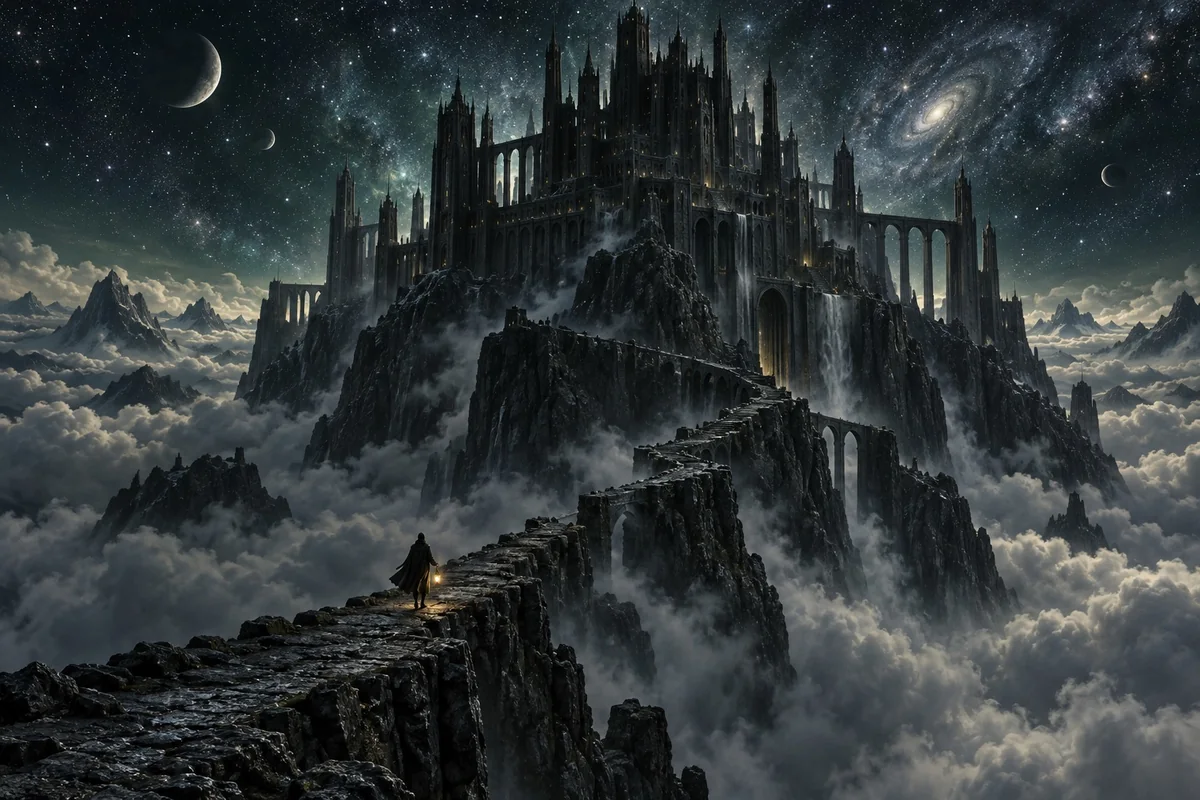
A golden valley leads into a shadowed grove with traces of buried temples. At its end stands an ancient vine-covered wall pierced by a small bronze gate.
Repeated visits increase the speaker's fascination. The barrier suggests a destination more lasting and beautiful than the scenes already available, but its latch remains inaccessible. The speaker's confidence in what lies beyond is initially a product of desire rather than knowledge.
The papyrus in Zakarion
In the dream-city of Zakarion, the speaker finds a papyrus attributed to ancient dream sages. It describes the valley, grove and gate, supplying a textual connection to the previously encountered landscape.
The sages disagree about the destination. Some describe wonders, while others promise disappointment and horror. The speaker cannot resolve the disagreement, yet treats uncertainty as an additional attraction.
The text also mentions a drug that permits passage. Lovecraft supplies neither its name nor a usable composition. It is a fictional device enabling the final threshold, not an identifiable substance whose effects the story documents.
The passage and its reversal
After taking the unnamed drug, the speaker returns in dream and finds the gate open. Light from beyond seems to confirm the expectation of a marvelous country.
Crossing instead reveals a boundless white emptiness without land, sea or inhabitants. The supposed new landscape dissolves into the end of all sights and forms. The speaker nevertheless presents this as a happiness greater than the anticipated paradise.
The reversal depends on the difference between wanting an improved world and wanting release from the condition of experiencing worlds at all. The final preference belongs to this particular literary speaker and should not be treated as advice about living or dying.
Language and philosophical reading
Life is personified as the power that briefly called the speaker out of an original infinity of oblivion. The ending accordingly imagines dissolution as a return rather than a journey to a populated afterlife.
The beautiful descriptions are not simply discarded as false. They draw the speaker onward while exposing the inadequacy of even extraordinary scenery to satisfy the final desire. The piece moves from aesthetic longing to an imagined absence of the self that longs.
This reading describes the work's structure. The story does not establish a factual cosmology of death or give an independently reliable account of an afterlife.
Connections with other dream narratives
Carter's pursuit of a sunset city and Kuranes's dissatisfaction with his dream kingdom provide useful contrasts. Those narratives explore the relationship between imagined beauty and remembered attachment; Ex Oblivione carries dissatisfaction toward the abandonment of experience itself.
The bronze gate is not explicitly identified with Carter's Gate of Deeper Slumber or the Silver Key's passages. Similar imagery of thresholds does not make these objects identical. Zakarion likewise receives no complete geographical placement within a shared map here.
Sources: Ex Oblivione — Unspeakable Tales ebook, The Dream-Quest of Unknown Kadath — original text
References
- Ex Oblivione — Unspeakable Tales ebook
The fictional narrative is evidence for what the story says, not proof of events in the real world.
- The Dream-Quest of Unknown Kadath — original text
The fictional narrative is evidence for what the story says, not proof of events in the real world.
At a glance
H. P. Lovecraft
1920/21
1921, March
The United Amateur, 20, No. 4
Fiction