

The Silver Key
The Silver Key follows Randolph Carter’s loss of access to the dream worlds of his youth and his attempt to recover them through memory, ancestry and an inherited key. Its return to childhood is both an emotional quest and an apparent disruption of time. The ending leaves ordinary investigators with abandoned objects while a sympathetic dreamer proposes a very different destination.
7 min read · 1,346 words
Composition and place in the sequence
Lovecraft wrote The Silver Key in 1926, and it appeared in Weird Tales in January 1929. The story recalls earlier experiences associated with Carter, including a cemetery expedition with a southern scholar, while giving his dissatisfaction a much broader narrative of adulthood.
The later Through the Gates of the Silver Key, written with E. Hoffmann Price, continues the disappearance and explains further stages of the key’s use. Those explanations are not all present here. The first story’s own ending must be understood before the sequel’s more elaborate cosmology is added.
The opening loss of the key to dreams is initially figurative. Only later does a material silver key enter the plot. The transition gives an emotional problem a concrete object without making the initial phrase simply a report that Carter misplaced a household possession.
Sources: H. P. Lovecraft Archive — fiction in composition order, H. P. Lovecraft Archive — fiction in publication order, The Silver Key — Unspeakable Tales ebook, Through the Gates of the Silver Key — original text
The loss of dream at thirty
Carter begins losing access to his imaginative journeys at thirty. His remembered destinations include Oukranos, Thran, Kled and Narath: places valued for beauty, atmosphere and associations that ordinary life cannot replace.
The narration attributes the loss partly to social instruction. People urge Carter to value measurable reality, ordinary emotion and recognized practical purposes. Explanation drains wonder from what it describes, while Carter becomes ashamed of pleasures he once accepted without defense.
The story’s argument is polemical rather than neutral psychology. Its narrator favors Carter’s aesthetic perspective and repeatedly contrasts it with other people’s allegedly inferior priorities. The reader is being offered a philosophy of imaginative value, not a demonstrated clinical explanation of why a particular person stops dreaming.
Religion, modernity and aesthetic allegiance
Carter first turns toward inherited religion, hoping that its ritual and associations might provide another route beyond everyday life. He is alienated by demands that mythology be treated as literal fact. Yet those who reject inherited beliefs also disappoint him when they claim new moral or social ideals as if those possessed an absolute basis.
The narrative’s central claim is that an indifferent cosmos supplies no final standard that makes ordinary ambition inherently more meaningful than dream. Carter therefore continues to seek beauty through forms shaped by memory and cultural inheritance.
This position is entangled with elitist language about class, culture and supposedly finer sensibilities. A critical account should not repeat those hierarchies as objective measures of human worth. They are part of the story’s argumentative voice and of the limitations within its defense of imaginative freedom.
Travel, war, writing and occult disappointment
Travel and friendship fail to restore what Carter wants. Even service in the French Foreign Legion during the Great War does not supply the missing sense of reality. He resumes writing, but irony and assumptions about what serious fiction should address undermine the imaginative work he values.
His newer books succeed commercially. He nevertheless burns them because he sees their sophistication and social accommodation as evidence of failure. The contrast makes popularity an unreliable measure within the narrator’s aesthetic system.
Carter then experiments with surroundings designed to produce particular moods and seeks occult knowledge. Popular doctrines disappoint him as rigid and intellectually weak. More disturbing studies bring genuine horror, including the loss of a southern companion in a cemetery, but horror at the edge of ordinary reality is still not the dream country he wants.
The return of remembered rooms
At fifty, Carter has largely abandoned hope of satisfaction. He considers ending his life, then delays. He removes the elaborate mood-setting decorations from his house and restores the familiar furnishings and appearance of his early childhood.
That return makes the present feel less binding. Dreams acquire new clarity, initially through small remembered details rather than a sudden recovery of the great imaginary cities. Long-dead family members become vivid presences in sleep.
The sequence makes ordinary memory a threshold. The desired world does not return through novelty or the accumulation of more exotic experiences. Familiar rooms and associations begin to loosen the authority of the present.
The grandfather’s direction and the box
A dream of his grandfather points Carter toward an ancestral box and key. The account invokes earlier Carters associated with crusading, Elizabethan magic and escape from the Salem witchcraft danger. Edmund Carter is said to have placed the inherited key in the box.
Carter finds the oak container in an attic chest. It bears alarming Gothic carvings and rusty iron bindings and gives off a strange scent. A servant opens it, revealing a large tarnished silver key wrapped in parchment covered with unfamiliar characters.
The key carries cryptic ornament, but the parchment supplies no explanation Carter can read. He recognizes its writing from a scroll associated with the vanished southern scholar. That recognition links the object with earlier dangerous learning while leaving its operation uncertain.
The ancestral road and the changed evening
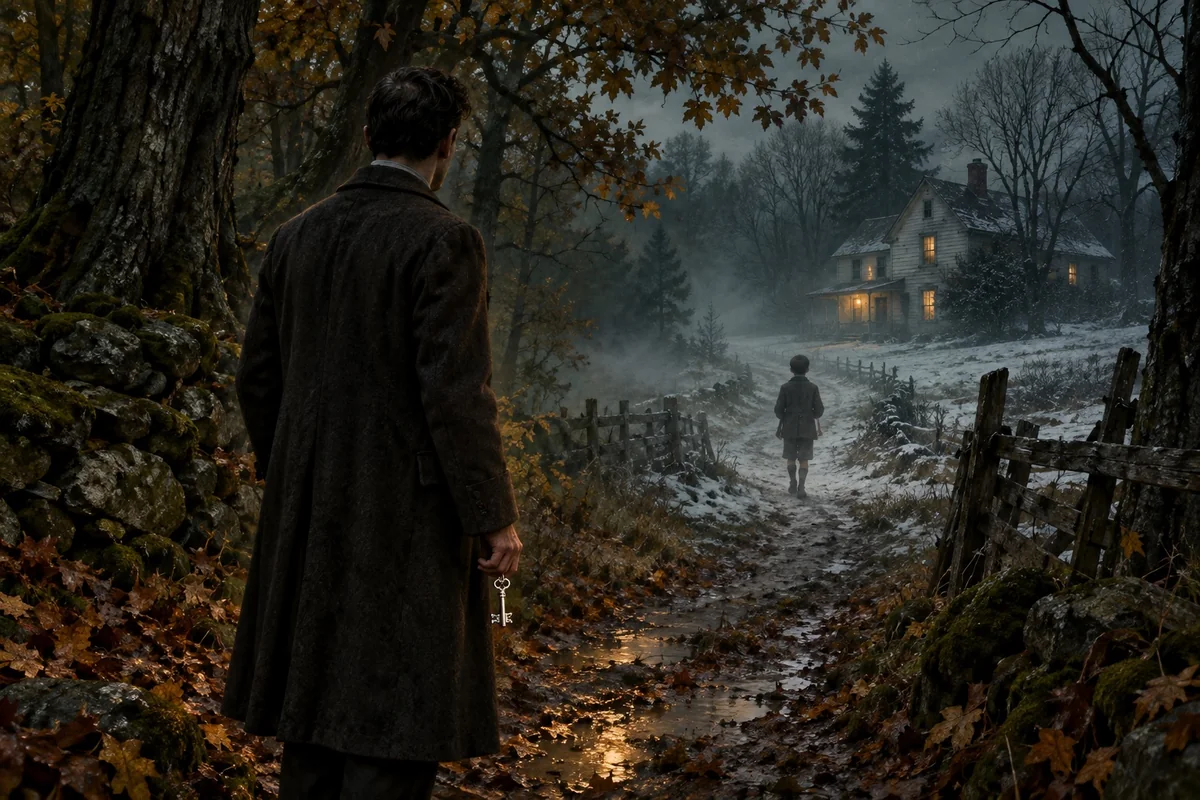
Carter drives toward the old family country near Arkham in autumn. The route passes landscapes charged with family stories, including a grove where an ancestor vanished and the home of Goody Fowler. The remembered geography is both attractive and ominous.
He leaves the car when it seems incompatible with the place he seeks and continues on foot with the key. A glimpse of a Kingsport church becomes troubling because he knows the building has been demolished. Then he hears Benijah Corey, his great-uncle’s hired man, calling him home.
The narrative shifts into a child’s understanding. Carter worries that he is late, feels for his pocket telescope and instead finds the key. Memories of obtaining it become confused with a boy’s dealings with the household servant. The change is experienced from within rather than announced through a technical account of time travel.
The Snake-Den
Benijah brings the boy to Uncle Christopher and Aunt Martha. Carter eats and sleeps in the household of his childhood, then goes out the next morning toward the forbidden cave known as the Snake-Den.
He knows a narrow opening beyond the apparent end of the cave. It leads into a larger chamber whose stonework seems to suggest deliberate shaping. He approaches its far wall and draws out the key with a confidence he cannot fully explain.
The story does not narrate the entire action beyond that moment. It next describes the boy’s changed imagination and unusual anticipations of future events. The sequel will return to this gap and turn it into the beginning of a more extensive journey.
Prophecy and two ways of reading a life
Relatives remember a change in Carter after the autumn of 1883, during his tenth year. Remarks and reactions made long before particular events later appear meaningful. One example concerns Belloy-en-Santerre: his earlier distress at the name is remembered after he is nearly killed there during the war in 1916.
The implication is that the boy’s apparent foresight may be connected with experiences belonging to his future adult life. The narrative does not simply erase the adulthood already described. It makes the relation between remembered childhood and later events circular and difficult to place in one sequence.
Ernest Aspinwall, an older cousin, contributes to the family recollections. Those memories form one kind of evidence, distinct from the physical objects left after the adult disappearance and from the final narrator’s interpretation.
The abandoned car and the dreamer’s conclusion
Searchers find Carter’s car on the way toward the ruined family property. The box and unread parchment remain in it; the key is missing. Rain has erased possible tracks. Disturbances among the ruined timbers and an unidentified handkerchief supply only uncertain clues.
The concluding narrator resists division of Carter’s estate because he does not believe Carter is dead. He expects to meet him in dream and connects rumors of a new king at Ilek-Vad with the disappearance. The city’s opal throne and glass cliffs offer a possible fulfillment of Carter’s longing.
That conclusion is a belief supported by the narrator’s own dream experience, not a public identification of Carter’s body or a confirmed return. Through the Gates later identifies this sympathetic writer as Ward Phillips and revises the completeness of his explanation. The two endings belong to different stages in the sequence’s development.
Sources: The Silver Key — Unspeakable Tales ebook, Through the Gates of the Silver Key — original text
References
- H. P. Lovecraft Archive — fiction in composition order
Composition dates; question marks and ranges retain the source uncertainty.
- H. P. Lovecraft Archive — fiction in publication order
First publication dates and venues; issue dates can differ from actual release dates.
- The Silver Key — Unspeakable Tales ebook
The fictional narrative is evidence for what the story says, not proof of events in the real world.
- Through the Gates of the Silver Key — original text
The fictional narrative is evidence for what the story says, not proof of events in the real world.
At a glance
H. P. Lovecraft
1926
January 1929
Weird Tales, 13, No. 1
Randolph Carter
Inherited silver key and an unread parchment
Autumn 1883
Through the Gates of the Silver Key, with E. Hoffmann Price