

Polaris
An unnamed man believes that his apparent waking life is a dream preventing him from returning to an endangered northern city. In Polaris, repeated visions become a recovered identity and a military duty, while the Pole Star seems to encourage the sleep that betrays both. The compact narrative ends without resolving which existence deserves to be called real.
5 min read · 844 words
Composition and publication
The fiction catalog dates composition to May? 1918. The first publication is recorded as 1920, December, in The Philosopher, 1, No. 1.
The title identifies the Pole Star, whose apparently fixed position becomes an oppressive point of continuity between two worlds. The narrator speaks from his room after the experience, still convinced that he has not reached his true waking life.
Sources: H. P. Lovecraft Archive — fiction in composition order, H. P. Lovecraft Archive — fiction in publication order, Polaris — Unspeakable Tales ebook
The room and the watching star
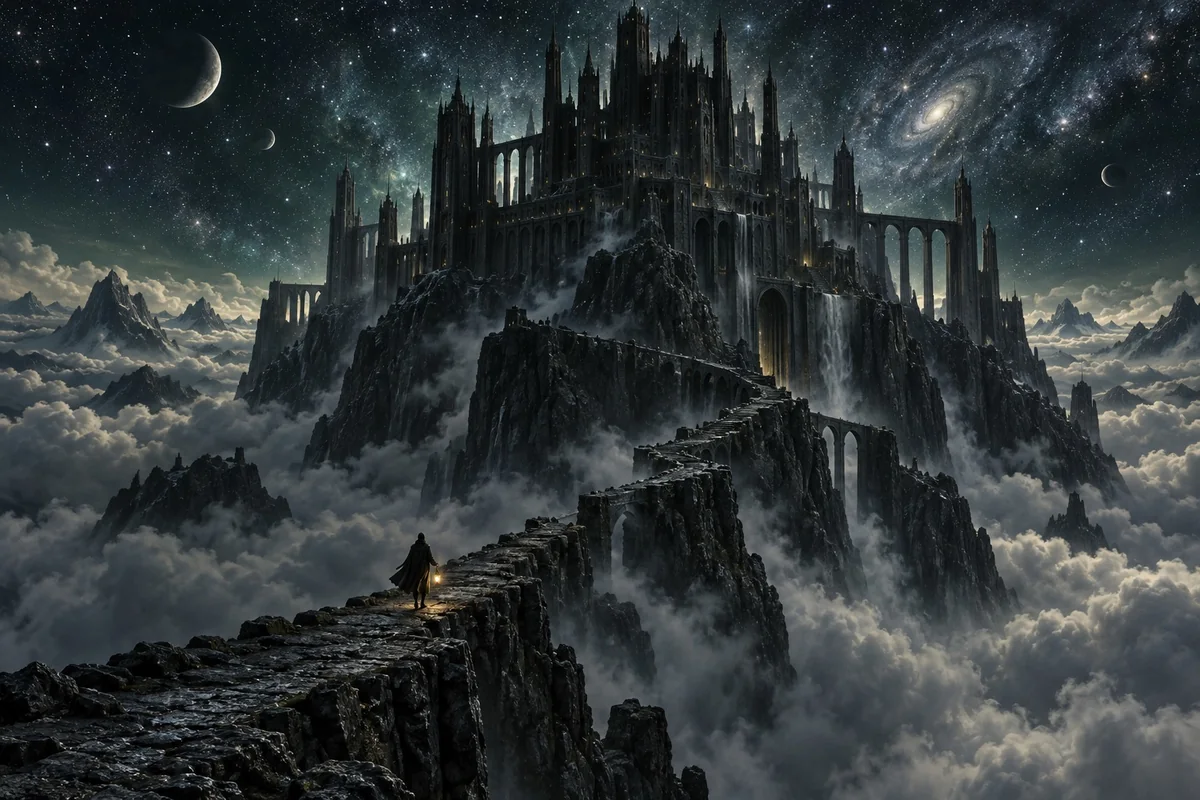
The narrator’s northern window looks toward a swamp and a cemetery. Constellations move across the sky while Polaris seems to remain in place, suggesting an eye that has forgotten a message it once wanted to communicate.
Clouds sometimes conceal the star and allow him to sleep. After an aurora and subsequent cloud cover, he first sees the distant city. The movement between worlds is associated with ordinary sleep but rapidly exceeds what he is willing to dismiss as a passing dream.
Sources: Polaris — Unspeakable Tales ebook
The recurring city
The city stands on a plateau between mountain peaks. Its walls, streets and public buildings are marble, and its inhabitants wear unfamiliar clothes. They speak a language the narrator understands without knowing how he learned it.
He initially watches as a disembodied observer. Repeated visits create a sense of belonging stronger than his attachment to the room from which he seems to dream. He begins questioning why that other life should possess any greater claim to reality.
Eventually he acquires a body in the vision. The city is Olathoë in Lomar, and the people are no longer strangers. His identity has become situated within its institutions, friendships and immediate danger.
Sources: Polaris — Unspeakable Tales ebook
Alos and the military emergency
Alos, the narrator’s friend, commands the forces defending the plateau. The enemy has taken Daikos and opened a route toward the remaining cities. His speech calls on the Lomarians to preserve the achievements of their ancestors.
That ancestral story includes flight from Zobna before an advancing ice sheet and a victory over the Gnophkehs. The current war is therefore placed inside a longer pattern of migration and threatened continuity.
The narrator cannot take an ordinary warrior’s role because physical strain brings weakness and fainting. Alos nevertheless values his keen sight and assigns him a task essential to the defense.
Sources: Polaris — Unspeakable Tales ebook
The duty at Thapnen
From the watchtower of Thapnen, the narrator must observe the pass behind Noton. If the enemy uses it to approach the citadel, he is to send a fire signal to the waiting soldiers.
He climbs alone because stronger men are needed elsewhere. Excitement, exhaustion and prolonged lack of sleep place his resolve under pressure. The distinction between bodily weakness and moral intention is clear: he wants to carry out the task even though he is poorly equipped to remain awake.
Through the tower’s opening he again sees Polaris. The star seems to promise a long sleep through an astronomical cycle, after which memory will return. Its apparent invitation transforms a remote celestial body into an intimate tempter.
Sources: Polaris — Unspeakable Tales ebook
The awakening that feels like captivity
He loses the struggle against drowsiness and finds himself back in the familiar room. Instead of understanding this as waking from a dream, he believes he has fallen into one while his homeland remains in immediate danger.
Those around him insist that Lomar exists only in his nocturnal imagination. Their reassurance becomes persecution from his viewpoint because every moment spent listening could permit the enemy to pass unseen.
The story never shows the attack occurring. The narrator’s guilt concerns a duty he believes remains urgent, producing a permanent present of anticipated betrayal rather than a completed, objectively witnessed disaster.
Sources: Polaris — Unspeakable Tales ebook
Time and the unresolved double life
The star’s promise links the personal lapse with an immense cycle of the heavens. A night’s failure might be separated from the apparent modern world by a span beyond ordinary human memory.
The narrative does not establish a single mechanism such as confirmed reincarnation, time travel or an externally verified alternate world. These are possible ways of organizing its implications, but the direct evidence remains the narrator’s competing experiences.
Its emotional structure is more definite than its cosmology. He loves the distant community, remembers a responsibility and experiences his present circumstances as an obstruction to both. The unresolved reality question intensifies a guilt that no reassurance can remove.
Sources: Polaris — Unspeakable Tales ebook
Racial ideology and literary connections
The narration idealizes the people of Lomar through inherited nobility and physical traits while demonizing the invaders through racialized description. Its final use of a period label for Inuit and related Arctic peoples connects that invented hostility with a real-world prejudice.
This framing is integral to the image of a besieged homeland and requires explicit recognition. It should not be reproduced as neutral historical information about the Arctic.
The Pnakotic Manuscripts and Lomar later reappear in The Dream-Quest of Unknown Kadath, where the lost northern country contributes to the transmission of lore into Ulthar. That reuse gives Polaris a place in Lovecraft’s wider network while leaving its own uncertain ending intact.
Sources: Polaris — Unspeakable Tales ebook, The Dream-Quest of Unknown Kadath — original text
References
- H. P. Lovecraft Archive — fiction in composition order
Composition dates; question marks and ranges retain the source uncertainty.
- H. P. Lovecraft Archive — fiction in publication order
First publication dates and venues; issue dates can differ from actual release dates.
- Polaris — Unspeakable Tales ebook
The fictional narrative is evidence for what the story says, not proof of events in the real world.
- The Dream-Quest of Unknown Kadath — original text
The fictional narrative is evidence for what the story says, not proof of events in the real world.
At a glance
H. P. Lovecraft
May? 1918
1920, December
The Philosopher, 1, No. 1
Fiction