

Lomar
Lomar is the northern country remembered or dreamed by the narrator of Polaris. Its marble city Olathoë faces an invasion while its people preserve traditions of an earlier migration before advancing ice. The Dream-Quest of Unknown Kadath later associates Lomar with the transmission of the Pnakotic Manuscripts into dreamland. These accounts overlap without supplying one fully consistent historical atlas.
4 min read · 660 words
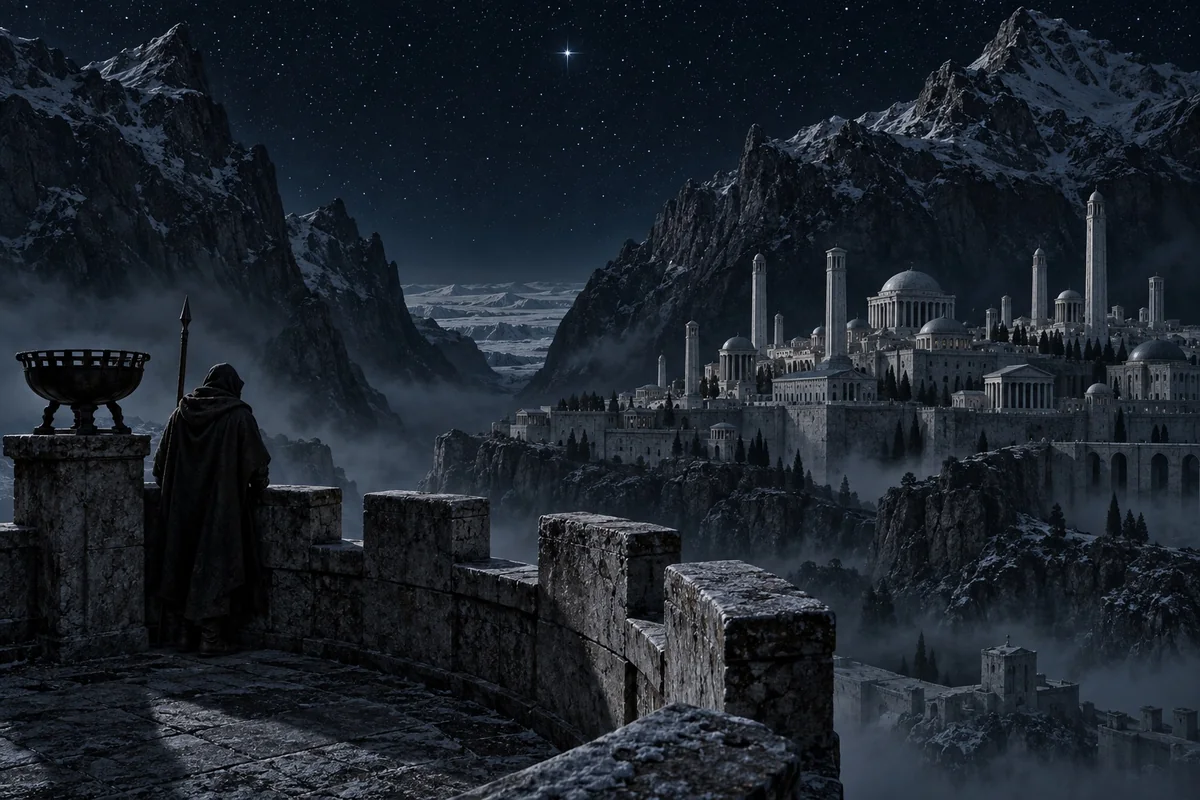
The country in Polaris
The narrator comes to know Lomar through recurring visions that acquire the force of personal memory. At first he observes its city without a body; later he recognizes himself as one of its inhabitants and understands his place in its threatened society.
Sources: [1]
People around him in the apparent waking world deny that Lomar exists outside his dreams. He reverses their interpretation, treating his modern room as the dream from which he must escape to fulfill a duty in the northern city.
The story supplies no independent observer who can settle the dispute. Lomar’s reality is intensely felt by its narrator while remaining part of the tale’s conflict between rival experiences.
Olathoë and the plateau of Sarkis
Olathoë stands on the plateau of Sarkis between the peaks Noton and Kadiphonek. Marble walls, towers, domes, columns and pavements shape its appearance. Carved pillars carry the images of solemn bearded men.
Its inhabitants gather in public spaces to discuss matters in a language the narrator understands despite not recognizing it from his other life. Familiarity is therefore emotional and linguistic before it is explained by a recovered identity.
The Pole Star appears high overhead, while other celestial movements and the low circling sun emphasize a far northern environment. These details place the imagined city within an astronomical experience rather than supplying modern latitude and longitude.
Sources: [1]
Zobna and the advancing ice
Lomarian tradition recalls an earlier home in Zobna. Advancing ice forced the ancestors southward, where they overcame the Gnophkehs before settling their later country.
The speech reported in Polaris anticipates that descendants may eventually need to abandon Lomar for the same reason. The current homeland is therefore one stage in a longer history of retreat rather than an eternally secure place.
Its libraries preserve the wisdom of the Zobnarian Fathers and the Pnakotic Manuscripts. Memory, scholarship and military pride become related means of maintaining continuity after geographical loss.
Sources: [1]
The invasion and the watchtower
The Inutos have taken Daikos and threaten the remaining plateau settlements. Alos commands the defenders. A narrow pass behind Noton presents a possible route by which the attackers could surprise the citadel.
The narrator is considered physically unsuitable for fighting but has unusually keen vision. Alos sends him to the watchtower of Thapnen, where he must signal an approaching enemy with fire.
His subsequent lapse into the apparent modern world is experienced as a failure of that duty. The reader does not witness the city’s actual capture. The catastrophe remains an urgent possibility within the narrator’s guilt.
Sources: [1]
Lomar in The Dream-Quest of Unknown Kadath
A zoog tells Carter that manuscripts from forgotten northern kingdoms reached dreamland after the Gnophkehs overcame Olathoë and destroyed the heroes of Lomar. The last copy is said to survive in Ulthar.
This gives the lost country a role in the movement of knowledge between waking history and the land of dreams. It also differs from Polaris, where the Gnophkehs belong to the ancestors’ earlier conquests and the immediate threat comes from the Inutos.
The two passages can be reported together without inventing an unseen campaign that harmonizes them. Their difference is part of the way Lovecraft reused names and historical suggestions across separate narratives.
The politics of the lost homeland
Polaris idealizes the Lomarians while describing their enemies through racial caricature. The final references connect the hostile image with real Arctic peoples in a prejudicial fashion.
An account of Lomar should identify that construction instead of adopting the narrator’s hierarchy of noble defenders and inherently degraded enemies. The civilization is fictional; the racial language belongs to the story’s historical prejudices.
Its emotional power nevertheless depends on recognizable experiences of displacement, loyalty and fear of failing a community. Those experiences can be analyzed without treating the exclusionary terms of the narrative as facts about real populations.
Sources: [1]
References
- Polaris — Unspeakable Tales ebook
The fictional narrative is evidence for what the story says, not proof of events in the real world.
- The Dream-Quest of Unknown Kadath — original text
The fictional narrative is evidence for what the story says, not proof of events in the real world.
At a glance
Polaris
Olathoë
Sarkis
Noton and Kadiphonek
Zobna
Transmission of the Pnakotic Manuscripts to Ulthar