

The Burrowers Beneath
The Burrowers Beneath begins Brian Lumley’s Titus Crow novel sequence with an investigation of subterranean disturbances and a developing campaign against the beings responsible. Its mixture of documentary clues, occult knowledge and organized resistance turns inherited Mythos material toward adventure horror.
4 min read · 709 words
Publication and series position
Lumley's official bibliography records the first publication as a DAW Books paperback in 1974. The Transition of Titus Crow followed in 1975, and The Clock of Dreams in 1978. Those dates identify separate novels rather than the contents of a single original 1974 volume.
Later editions complicate casual catalog searches. Tor issued the first two novels together as Titus Crow, Volume I, reviewed in late 1996 for a January 1997 release. The Macmillan page for the later digital listing carries a 1999 on-sale date and material from that omnibus. None of these dates replaces 1974 as the novel's first publication.
The title therefore needs two levels of identification: the original novel and the particular edition a reader has obtained. Pagination and included sequels can vary without changing the first-publication record.
Sources: Brian Lumley — Bibliography: first publications, Publishers Weekly — Titus Crow, Volume I, Kirkus Reviews — Titus Crow, Volume I, Tor / Macmillan — The Burrowers Beneath, description and opening excerpt
Letters, tremors and the mine
The publisher's opening excerpt presents material from Crow's files. He commissions press cuttings on earthquakes and subsidence, seeks an obscure story connected with the missing Wendy-Smiths, and corresponds with mine inspector Raymond Bentham.
Bentham describes strangely smooth tunnels, carvings and objects he calls cave-pearls. Crow recognizes danger in their removal and urgently asks him to relinquish them. The excerpt thus establishes an uneven distribution of knowledge: the witness possesses objects he cannot interpret, while the investigator understands enough to fear them.
The use of dated correspondence allows ordinary professional transactions to accumulate an extraordinary implication. Mining observations and literary research enter the same file before the wider confrontation is explained.
Sources: Tor / Macmillan — The Burrowers Beneath, description and opening excerpt
Crow, de Marigny and organized resistance
Titus Crow's companion Henri-Laurent de Marigny participates in an investigation that develops beyond the resources of two individuals. Kirkus describes their alliance with a secret organization opposing the underground creatures and their use of the enemies' vulnerabilities to water and radiation.
This gives practical consequence to investigation. Knowledge is valuable because it may support a countermeasure, not solely because it reveals how little humanity matters. The narrative can still expose its protagonists to overwhelming danger while allowing planning, cooperation and intervention.
The ending leads into the next novel through a time-travel transition. Accounts of the omnibus must distinguish that bridge from later developments, including Crow's subsequent reconstruction and journeys. Those belong to The Transition of Titus Crow and should not all be folded backward into this book's synopsis.
Cthonians and a named opposition
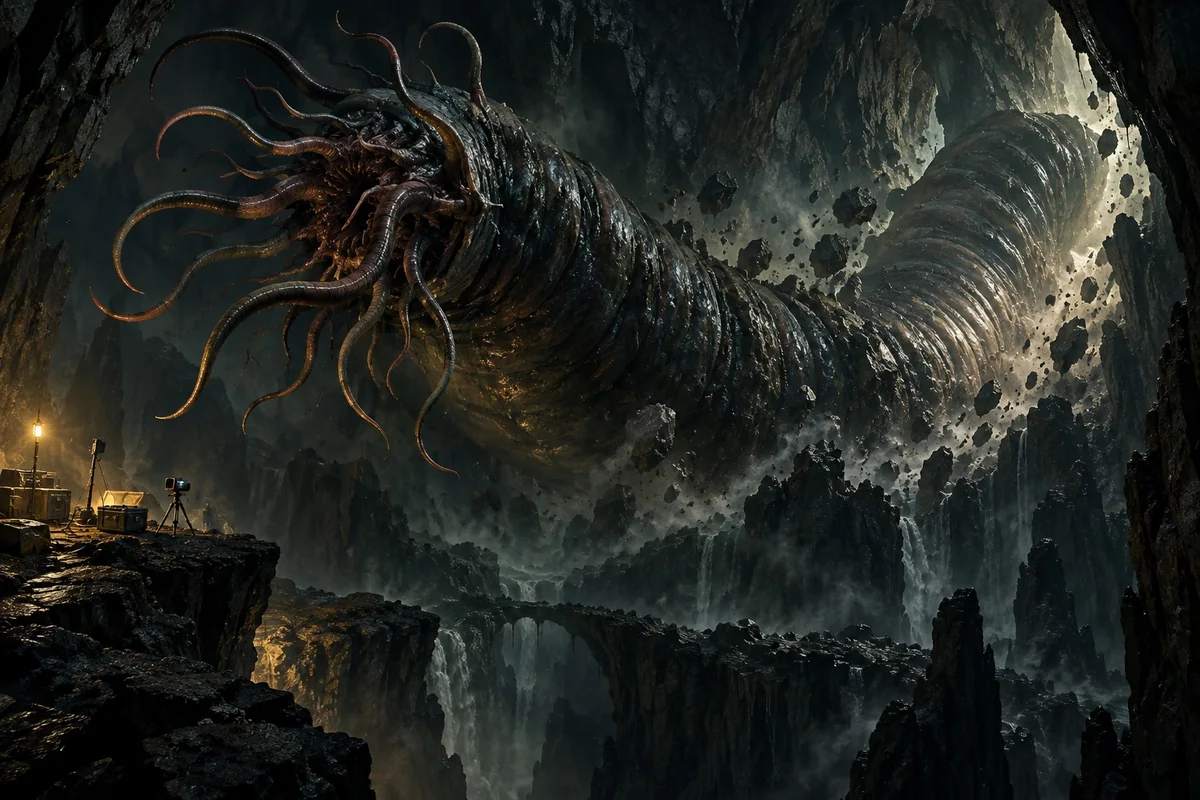
The central underground menace involves the Cthonians and Shudde-M'ell. The Wilmarth Foundation gives the struggle an institutional dimension, while extensive references situate the immediate threat within a wider supernatural system.
These are Lumley's developments of the shared tradition. The Foundation should not be mistaken for an organization established in Lovecraft's own fiction merely because its name recalls Albert N. Wilmarth. Likewise, an entry on Cthonians needs Lumley-specific sources rather than a generic citation to The Call of Cthulhu.
Form and divided reception
Publishers Weekly welcomed the omnibus's old-fashioned pulp energy, pairing its eerie settings with the protagonists' determination. Its review uses the detective-and-companion relationship to characterize Crow and de Marigny, and draws attention to the transition from occult investigation toward travel through time and space.
The Nightscape review takes a less favorable view of this novel's exposition. It argues that explanations and catalogs of Mythos names interrupt suspense and that the organization increasingly supplies the means of action. These are critical judgments about narrative effect, not disagreements over whether the named organization exists in the story.
Read together, the assessments identify a useful tension: the explanatory richness that can appeal to readers of an interconnected mythology may frustrate readers seeking uncertainty and a tightly concentrated threat.
Sources: Publishers Weekly — Titus Crow, Volume I, Nightscape Series — The Burrowers Beneath review
Comparison with Lovecraft’s investigators
In The Call of Cthulhu, an investigator combines documents whose implications threaten his confidence in human security. In The Dunwich Horror, scholarly interpretation also contributes to an attempt at resistance. Those two examples already caution against describing every Lovecraft protagonist as wholly inactive.
Lumley's distinctive emphasis lies in making recurrent heroes and an organized campaign central to an extended series. The comparison is therefore about narrative emphasis and continuity, not an absolute rule that Lovecraft forbids action. Reading the works separately preserves both their shared documentary methods and their different expectations of what a successful investigation can accomplish.
Sources: The Call of Cthulhu — Unspeakable Tales ebook, The Dunwich Horror — Unspeakable Tales ebook, Publishers Weekly — Titus Crow, Volume I, Kirkus Reviews — Titus Crow, Volume I
References
- Brian Lumley — Bibliography: first publications
- Publishers Weekly — Titus Crow, Volume I
- Kirkus Reviews — Titus Crow, Volume I
- Tor / Macmillan — The Burrowers Beneath, description and opening excerpt
- Nightscape Series — The Burrowers Beneath review
Critical judgments are attributed to the review rather than presented as neutral facts.
- The Call of Cthulhu — Unspeakable Tales ebook
The fictional narrative is evidence for what the story says, not proof of events in the real world.
- The Dunwich Horror — Unspeakable Tales ebook
The fictional narrative is evidence for what the story says, not proof of events in the real world.
At a glance
Brian Lumley
1974
Novel
DAW Books