

The Dunwich Horror
The Whateley family raises an unnaturally fast-growing child while concealing a second, much larger presence inside its farmhouse. When Wilbur’s search for a missing book passage ends in his death, three Miskatonic scholars must decipher what the family intended and confront the invisible being left behind.
11 min read · 2,192 words
Publication and the shape of the story
Lovecraft wrote The Dunwich Horror in the summer of 1928, and Weird Tales published it in April 1929. The principal events inside the fiction culminate in 1928, but the narrative begins much earlier with Wilbur Whateley’s birth in 1913. The long preliminary history allows the reader to recognize changes whose purpose the local witnesses cannot understand.
The story uses a third-person narrator with access to community observation, private documents and the scholars’ investigation. It differs from a single survivor’s confession: information can move from the Whateley farm to the library and back to the frightened countryside without being limited to one person’s continuous presence.
Its title ultimately refers most directly to Wilbur’s brother, the being released from confinement after Wilbur dies. Wilbur himself is a principal agent and an extraordinary organism, but the two should not be merged. The delayed revelation of the twin relationship explains both the house’s alterations and the difference between the visible child and the concealed growth.
Sources: H. P. Lovecraft Archive — fiction in composition order, H. P. Lovecraft Archive — fiction in publication order, The Dunwich Horror — Unspeakable Tales ebook
Dunwich and its inherited atmosphere
The opening approaches Dunwich through a landscape of hills, old roads, ravines, abandoned houses and unusually imposing stone formations. The village is associated with isolation and economic decline. Local accounts attach unsettling sounds and traditions to the hills, especially the stone table on Sentinel Hill.
The narrative presents the community through strong prejudices about rural poverty, ancestry and degeneration. Those judgments help create its atmosphere but should not be adopted as neutral social description. The inhabitants are not all interchangeable: different Whateley branches are distinguished, and particular residents become witnesses, victims or sources of practical help.
The landscape later acquires a tactical role. Cold Spring Glen provides concealment, paths record the invisible creature’s movement, and Sentinel Hill becomes the final site of confrontation. The opening’s apparently picturesque geography prepares the reader to understand where the threat travels and why the observers below can watch the climax only imperfectly.
Wilbur’s birth and abnormal childhood
Lavinia Whateley gives birth to Wilbur at five in the morning on 2 February 1913. His father is not publicly identified. She lives with her father, an elderly man associated with forbidden books and hilltop rites, in a household already regarded with suspicion.
Wilbur grows and learns at a rate incompatible with ordinary childhood. His speech, size and increasing independence disturb people who remember how recently he was born. Animals respond to him with hostility. Heavy clothing later helps conceal bodily differences that become fully visible only at his death.
The grandfather undertakes repeated building changes and begins buying unusual quantities of cattle. The visible herd does not account for the purchases, and some animals bear disturbing injuries. At first these are separate local puzzles: growth, construction, cattle and noises. The narrative eventually gives them a common explanation in the care of the hidden twin.
The family’s fires and rites recur around seasonal dates. Their repetition gives the childhood history a rhythm, while the steady enlargement of the house suggests that something inside is following a different and more urgent timetable.
The grandfather’s instruction and Lavinia’s disappearance
Old Whateley directs Wilbur’s studies and speaks of the work that will remain after his own death. His instruction includes a crucial reference to a chant in the complete Necronomicon. That directive turns the family’s secret undertaking into a problem of obtaining and understanding a particular text.
As Wilbur grows, his relation to Lavinia becomes increasingly hostile. She expresses fear, loses her place in the hilltop observances and eventually disappears. The story does not supply an independently witnessed account establishing every detail of her fate. It gives the reader strong grounds for suspicion while leaving her personal experience largely outside the narrative.
After the grandfather dies, Wilbur continues enlarging the space available inside the farmhouse. He moves his own belongings into sheds while the concealed presence occupies more of the main building. What appears to outsiders as eccentric renovation is a response to a body that cannot continue to fit its original enclosure.
Lavinia is indispensable to the family history but is given little interior voice. The text does not establish a detailed account of her consent, ambitions or occult training. A close reading can identify that absence without inventing a biography to fill it.
The missing passage and Armitage’s refusal
Wilbur travels to consult copies of the Necronomicon. His own English version, attributed to John Dee, is incomplete. At Miskatonic he compares it with Olaus Wormius’s Latin text, looking for material that would fall on page 751 of his defective volume.
Henry Armitage, the university librarian, reads part of the passage over Wilbur’s shoulder. Its account of beings outside ordinary human space becomes disturbing in conjunction with the visitor’s appearance and purpose. Armitage does not simply refuse a rare book because it is valuable; he begins to understand what access might enable.
Wilbur seeks help elsewhere, including Harvard, and Armitage communicates his concerns to other custodians. The network of libraries becomes a practical obstacle to the Whateley project. Scholarly institutions matter because their staff can compare requests and act on suspicion.
The episode demonstrates how a fragmentary book can drive a plot. Wilbur’s existing knowledge is extensive but insufficient. One missing part forces him into public contact, where the body and intentions he has concealed begin to attract informed attention.
The library break-in and Wilbur’s body
On 2 August 1928, Wilbur attempts to enter the Miskatonic library at night. A watchdog attacks him. Armitage arrives with Warren Rice and Francis Morgan, and the men see what his clothing had hidden.
The exposed anatomy combines an outwardly human upper region with increasingly alien structures below. The body’s rapid dissolution after death complicates any possibility of preserving a conventional specimen. Nevertheless, the three witnesses have seen enough to reject an explanation based solely on an eccentric young man’s delusions.
Wilbur’s death occurs well before the story’s final confrontation. It does not remove the danger because he was maintaining and directing another presence at the farm. The interruption of that care makes the concealed growth more urgent.
The library scene also creates a shared evidentiary basis among the scholars. When Armitage later deciphers the diary, Rice and Morgan need not decide whether to believe an uncorroborated tale. They have already encountered a physical fact that exceeds their previous understanding.
Deciphering the diary
The diary recovered from Wilbur’s effects is written in a difficult system that initially defeats ordinary linguistic approaches. Armitage studies cryptographic authorities and gradually discovers that the underlying language is English. On 2 September he breaks through to a continuous passage, after which the work remains demanding rather than becoming instantly transparent.
An entry written when Wilbur was only three and a half reveals both precocious knowledge and an immature, uneven style. It discusses the upstairs being, techniques for seeing it and the prospect of clearing Earth for powers from outside. The contrast between a child’s diary form and the scale of its intentions intensifies the revelation.
The text shows that Wilbur and his grandfather were pursuing more than private occult experiment. The surviving twin was part of an effort to allow an alien order into the world. His diary also records practical information that can be turned against the threat, including the means of making an otherwise invisible body perceptible.
Armitage’s reading exacts a physical cost. He works through exhaustion, eats little and becomes temporarily incapacitated. His recovery and consultation with Rice and Morgan are part of the response. Knowledge is dangerous here, but it can also support deliberate action when shared and interpreted.
The escape from the farmhouse
On the night of 9 September, the concealed being breaks free. The destroyed house and enormous tracks reveal a scale previously hidden by the building. Its body is normally invisible, so the community must follow its effects: crushed vegetation, damaged livestock, sounds, smells and the destruction of structures.
The threat moves through a countryside that cannot easily defend itself. Firearms are not a sufficient response to something whose position and nature remain uncertain. Neighbors use telephones to exchange warnings, making communication both a means of coordination and a way to hear disaster unfold at a distance.
The Frye household is destroyed, and later the Seth Bishop household suffers the same fate. These events give urgency to the scholars’ work. The story does not treat the interval between discovery and confrontation as harmless time for research; people die while the necessary interpretation is still being completed.
The invisible body becomes visible indirectly through landscape. A swath through vegetation or a deformation of a familiar path supplies a measure of something the eye cannot otherwise locate. The effect makes the rural setting an instrument registering the creature’s movement.
The three scholars prepare to intervene
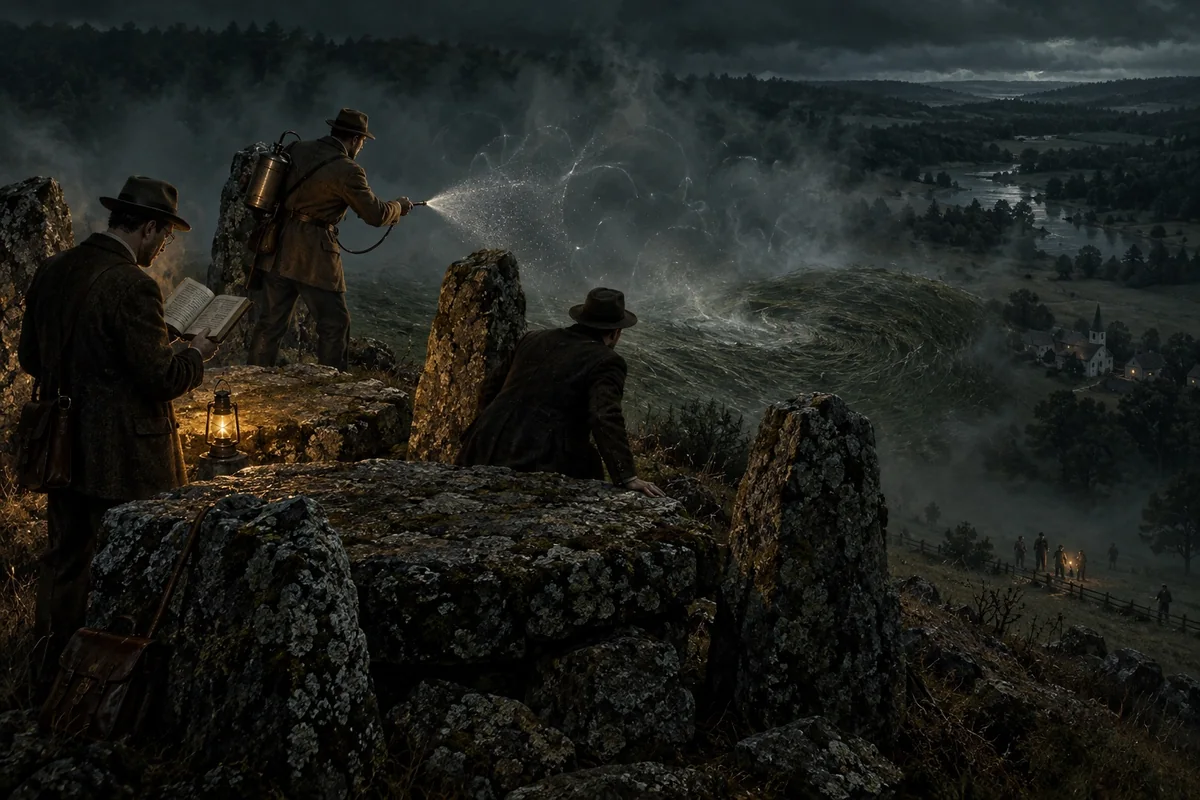
Armitage, Rice and Morgan compare forbidden texts, diagrams and the diary. They debate whether outside authorities could understand the danger without having seen what they have seen. Their preparation combines reading with experiments and practical equipment, including a sprayer for the revealing powder and material needed for the formula.
When they reach Dunwich, local testimony and physical damage confirm the urgency. They inspect tracks and ruins, speak with residents and attempt to position themselves where the being may be encountered. Weather and uncertainty interfere with the first effort.
The scholars’ advantage is explanatory rather than simply physical. They understand that the being is related to the Whateley undertaking and that ordinary methods are unlikely to suffice. The residents contribute local knowledge and observations, but the decisive interpretation comes from the evidence accumulated at Miskatonic.
This cooperation is one reason the story cannot be summarized by saying that Lovecraft’s investigators inevitably become helpless. The men are frightened and imperfectly prepared, yet they can combine information and choose a course of action that changes the outcome.
Sentinel Hill and the briefly visible body
The tracks lead toward Sentinel Hill. Armitage, Rice and Morgan ascend while the villagers remain below, watching through a telescope. This division limits the account of the climax: the community can observe gestures and effects without hearing or understanding every part of the procedure.
The powder makes the being visible for a brief interval. Curtis Whateley sees an enormous composite form with masses of appendages and organs, then collapses. Amid the unfamiliar anatomy he recognizes a face belonging to the Whateley family. The resemblance is the detail he initially struggles to communicate.
The scholars perform their formula, and the being’s final cries invoke its father. Yog-Sothoth’s relation to the family becomes explicit within the explanation surrounding the climax. The confrontation removes the immediate presence from the hill, accompanied by violent atmospheric effects.
The story does not show Yog-Sothoth arriving as a second visible combatant. The name identifies the greater relationship and the appeal made by the dying or departing offspring. Turning the scene into a battle against a fully materialized Yog-Sothoth would change the event rather than clarify it.
The twin revelation and the ending
Armitage explains that the being was Wilbur’s twin brother, possessing much more of the nonhuman father’s nature. The difference between the twins accounts for the plot’s central division. Wilbur could move through human society and seek books; his brother had to be confined, fed and prepared for another role.
The family resemblance seen by Curtis ties the apparently formless threat back to the local household. The horror is cosmological, but its entry into the world has taken the form of birth, kinship, domestic space and maintenance. That conjunction is what makes the final explanation more than the identification of an unrelated monster.
Armitage intends to destroy the diary and advises against further inquiry into the Whateley remains. His success produces a return to suppression rather than a new public field of knowledge. The immediate danger has been checked, but the means of reproducing it remain something he wishes to remove from circulation.
The victory is local and contingent. It does not establish a universe protected by benevolent powers or a universal rule that the same method defeats every alien being. The scholars succeed because this particular threat leaves evidence they can understand and exploit.
Major ideas, mythology and adaptation
The story joins biological inheritance with access between incompatible orders of reality. Yog-Sothoth is associated with the gate, while the twins make that abstract relation bodily and domestic. The house must literally expand to accommodate what the family has brought into it.
Its treatment of scholarship is unusually active. Armitage’s caution at the library, his labor over the cipher and his collaboration with Rice and Morgan are all necessary. The decisive act depends on reading accurately enough to intervene, rather than on discovering a consoling explanation that makes the danger unreal.
The source also uses degrading assumptions about rural life, disability and heredity. Those elements deserve critical attention alongside the construction of suspense. In particular, Lavinia’s marginalization and the narrator’s classifications of different families shape whose experience the story allows the reader to understand.
The 1970 film The Dunwich Horror, directed by Daniel Haller, changes the plot and gives Nancy Wagner a central role absent from the original text. Its entry treats those screen choices separately. For the literary mythology, the linked pages on Wilbur, his brother, Yog-Sothoth, Armitage, Dunwich and the Necronomicon distinguish the figures and sources that the story brings together.
Sources: The Dunwich Horror — Unspeakable Tales ebook, The Dunwich Horror (1970) — credits, synopsis and release history
Related music
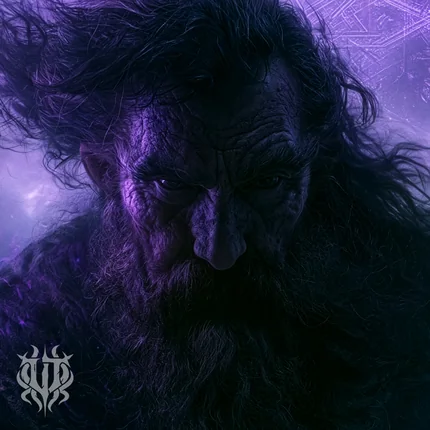
The Key and the Gate is a dark metal retelling of The Dunwich Horror, following Wilbur Whateley’s doomed search for forbidden knowledge and the power of Yog-Sothoth.
References
- H. P. Lovecraft Archive — fiction in composition order
Composition dates; question marks and ranges retain the source uncertainty.
- H. P. Lovecraft Archive — fiction in publication order
First publication dates and venues; issue dates can differ from actual release dates.
- The Dunwich Horror — Unspeakable Tales ebook
The fictional narrative is evidence for what the story says, not proof of events in the real world.
- The Dunwich Horror (1970) — credits, synopsis and release history
At a glance
H. P. Lovecraft
Summer 1928
1929, April
Weird Tales, 13, No. 4
Fiction