

The Cats of Ulthar
The Cats of Ulthar tells how a town came to prohibit the killing of cats. An orphan’s missing kitten, an unfamiliar prayer and the disappearance of every cat in the town precede the discovery of two human skeletons. The story gives the law a memorable origin while keeping the decisive act of revenge outside direct narration.
4 min read · 838 words
Composition, publication and frame
Lovecraft wrote the tale on 15 June 1920. It appeared in the November 1920 issue of The Tryout. Its brief form resembles an account of the origin of a local custom: the prohibition is announced at the beginning and its adoption closes the story.
The narrator begins beside a purring cat and imagines feline connections with ancient Egypt, the Sphinx and lost cities. This establishes a legendary atmosphere rather than a zoological explanation of feline ancestry. The particular events in Ulthar are then offered as the history behind a law already known elsewhere.
Sources: H. P. Lovecraft Archive — fiction in composition order, H. P. Lovecraft Archive — fiction in publication order, The Cats of Ulthar — Unspeakable Tales ebook
Cruelty protected by fear
Before the law, an old couple living in a dark cottage trap and kill cats that stray near them. Their neighbors suspect especially cruel practices from the sounds heard at night, but fear keeps the townspeople from confronting them.
Pet owners try to keep their animals away from the cottage. When a cat disappears, its owner mourns or takes the grim consolation that a child has not vanished instead. The community’s failure to intervene is therefore part of the story’s cause, not merely background decoration.
The couple are unnamed. The tale provides neither a documented religious affiliation nor a magical explanation for their cruelty. Their frightening appearance and secluded yard help sustain the villagers’ avoidance.
Menes and the visiting caravan
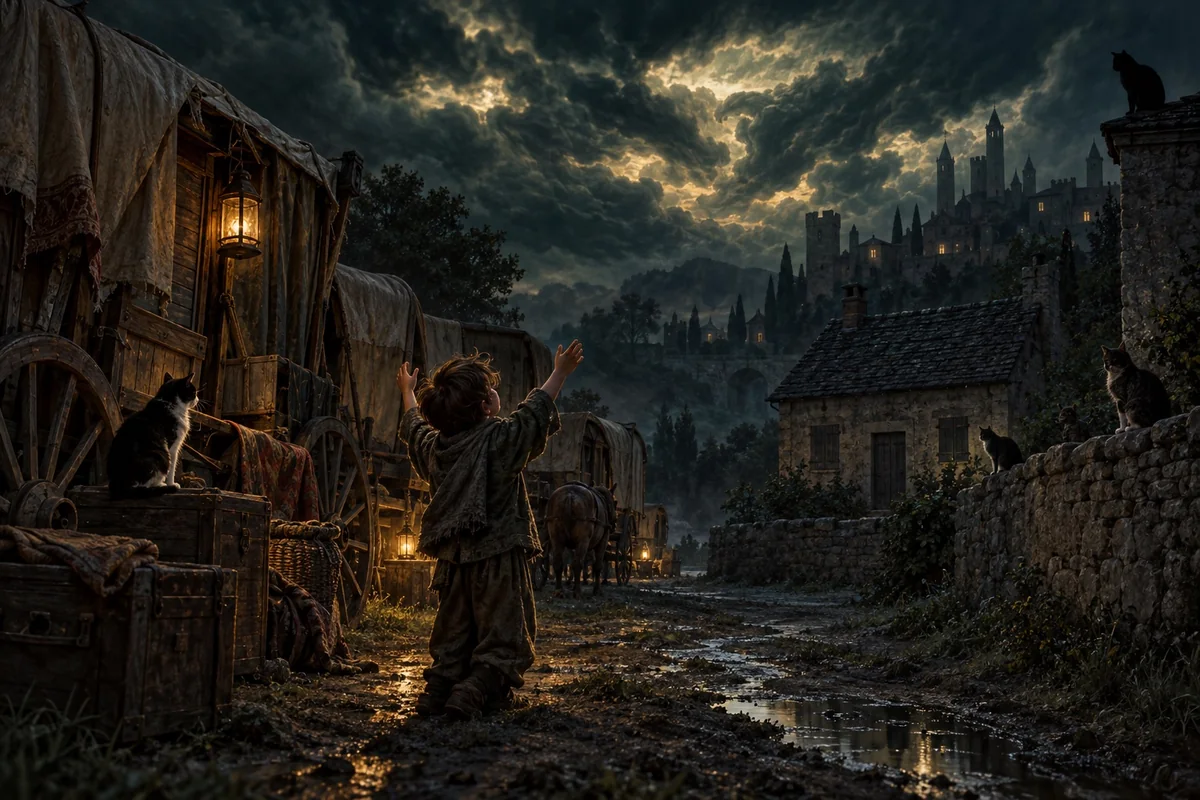
A caravan arrives from the south. Its members tell fortunes, trade in the marketplace and travel in wagons decorated with human figures bearing animal heads. Their leader wears a horned headdress with a disc between the horns.
One traveler is Menes, an orphan whose family has been lost to plague. His little black kitten gives him comfort. On the third morning of the caravan’s stay, he cannot find it, and villagers tell him about the couple and the sounds heard overnight.
The imagery recalls the Egyptian associations of the opening, but the narrator says the travelers’ homeland is unknown. Identifying them as a confirmed historical people or naming the god they worship would exceed the text.
The prayer and the missing cats
Menes turns from grief to prayer, raising his arms toward the sun and speaking a language the villagers do not understand. Strange cloud shapes appear above him, suggesting the hybrid figures painted on the wagons. The narrator briefly invokes the possibility of imaginative illusion without settling the matter.
The caravan leaves that night. Around the same time, every household discovers that its cats have vanished. Kranon, the burgomaster, blames the travelers; Nith, the notary, suspects the old couple.
Atal, the innkeeper’s young son, reports seeing the cats walking two abreast in a solemn circle around the cottage. Adults hesitate to credit so young a witness. Even this report fails to overcome their fear of entering the yard.
Return and discovery
At dawn all the cats are back at their usual hearths, sleek and contented. None will eat its normal food for two days. The townspeople debate their absence but do not immediately connect the couple’s subsequent silence with a definite conclusion.
Only after about a week does the lack of evening light in the cottage attract notice; another week passes before Kranon enters with Shang the blacksmith and Thul the stoneworker. Behind the door they find two cleanly stripped human skeletons and beetles in the corners.
The cats’ night away, their apparent fullness and the remains strongly imply collective revenge. The narrative does not show an attack or identify which animal inflicted a particular wound. Its power comes from the sequence of indirect observations.
The making of the law
The burgesses discuss the caravan, the kitten, the prayer, Atal’s report and the skeletons. The coroner Zath disputes the case with Nith, while the men who entered the cottage answer questions. Atal is questioned closely and rewarded with a sweet.
The resulting law prohibits killing cats. Traders in Hatheg and travelers in Nir spread knowledge of it beyond Ulthar. The ending transforms an unpunished private cruelty into a public rule, although only after a catastrophe has supplied the courage the community previously lacked.
The story never records Menes’s return or establishes that his kitten survived. Nor does it describe a confession from the cats. A complete synopsis should preserve those absences rather than supplying a reassuring reunion.
Later connections and a changing Atal
The Other Gods identifies the young priest Atal as an innkeeper’s son and says that Barzai helped advise the town when the law was passed. The Dream-Quest of Unknown Kadath later presents Atal as an elderly religious authority and makes Ulthar an important stop on Carter’s journey.
That later novel also develops the cats into organized allies capable of speech with Carter and extraordinary travel. Those abilities expand the feline world beyond what is directly shown in this short story. The law, the town and Atal provide the continuity; the full military and lunar lore belongs to the later account.
Sources: The Cats of Ulthar — Unspeakable Tales ebook, The Other Gods — Unspeakable Tales ebook, The Dream-Quest of Unknown Kadath — original text
References
- H. P. Lovecraft Archive — fiction in composition order
Composition dates; question marks and ranges retain the source uncertainty.
- H. P. Lovecraft Archive — fiction in publication order
First publication dates and venues; issue dates can differ from actual release dates.
- The Cats of Ulthar — Unspeakable Tales ebook
The fictional narrative is evidence for what the story says, not proof of events in the real world.
- The Other Gods — Unspeakable Tales ebook
The fictional narrative is evidence for what the story says, not proof of events in the real world.
- The Dream-Quest of Unknown Kadath — original text
The fictional narrative is evidence for what the story says, not proof of events in the real world.
At a glance
H. P. Lovecraft
15 June 1920
1920, November
The Tryout, 6, No. 11
Fiction