

Ulthar
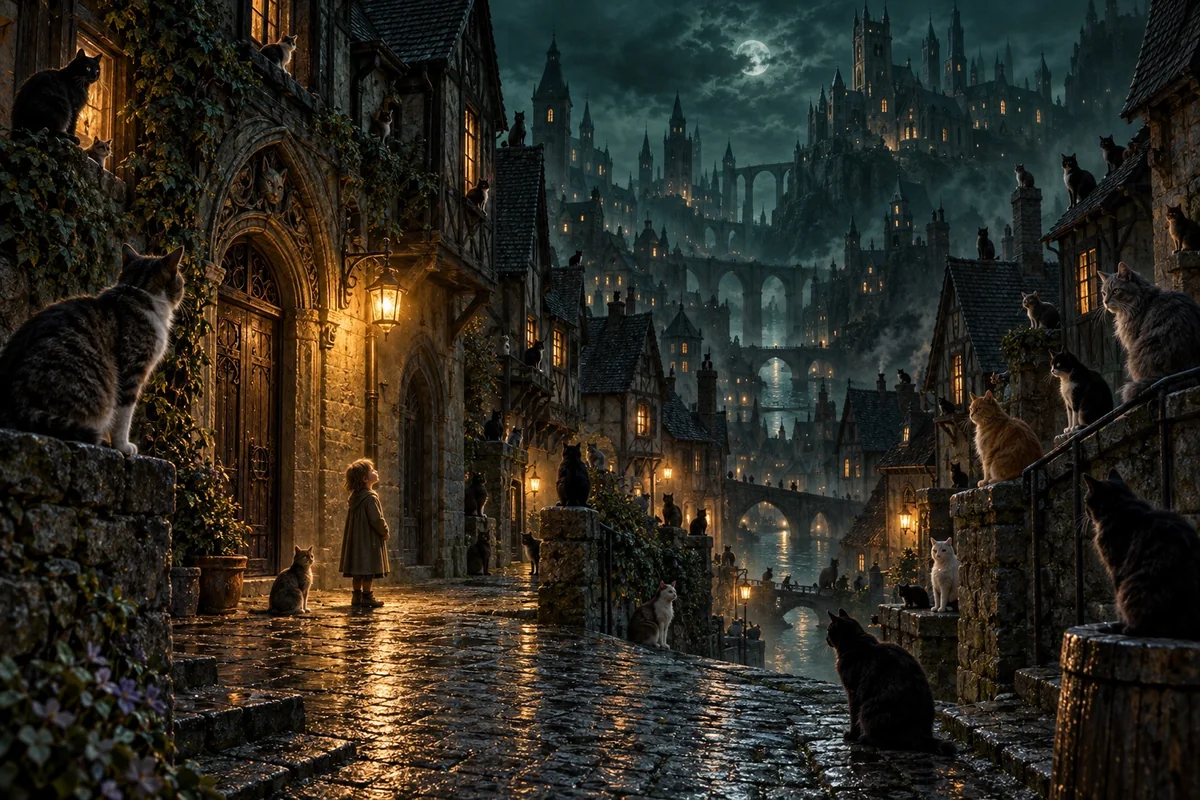
Ulthar is the town beyond the River Skai where killing a cat is forbidden. Its local legend, temple and unusually well-connected cats make it one of Lovecraft’s most developed inhabited places in the Dreamlands. It offers Randolph Carter hospitality and essential information while preserving memories of dangers its citizens prefer not to approach.
4 min read · 739 words
A town defined by its law
The Cats of Ulthar explains the prohibition through the disappearance of an orphan’s kitten and the eventual discovery of the cat-killing couple’s skeletons. The burgesses adopt the rule after debating the prayer, the cats’ collective absence and the surviving witnesses’ observations.
The law is known to traders in Hatheg and travelers in Nir. Its reputation therefore extends beyond the town itself. In The Dream-Quest, Carter recognizes his approach to Ulthar partly through the increasing presence of cats.
The rule should not be expanded into a fully documented legal code. The stories state the prohibition and its significance, but do not specify courts, fines, exemptions or a standing force dedicated to enforcement.
Streets, roofs and surrounding farms
Carter approaches across the Skai after passing through Nir. The countryside includes hedges, worked fields and cottages, while Ulthar’s suburbs contain small green houses and fenced farms.
Within the town, steep narrow streets pass beneath overhanging upper stories and peaked roofs. Chimneys, old cobbles and red tiles create a dense domestic landscape. The cats occupy so much of the street that the paving is visible between them.
The description is deliberately inviting. Ulthar is not simply another abandoned ruin or hostile cult settlement. Carter’s view from an inn balcony at sunset makes him consider it a place where he could happily remain, if his stronger desire for the unknown city did not keep him moving.
Sources: [2]
The temple and its records
The Temple of the Elder Ones crowns the highest hill in a circular tower of ivy-covered stone. Its upper shrine contains Atal’s ivory dais, and its priests preserve old records and religious knowledge.
The zoogs tell Carter that Ulthar holds the last copy of the Pnakotic Manuscripts, brought into dream from the old northern world. The narrative presents this as the information guiding his visit. It should be distinguished from other stories’ uses of the manuscripts rather than forced into an unqualified claim about every copy in every period and realm.
Atal and the books provide only limited help. The library is valuable without being exhaustive, and the patriarch’s most emphatic message is a warning against seeking Kadath.
Sources: [2]
Barzai’s legacy
The Other Gods makes Ulthar the home of Barzai and Atal. Barzai helps advise the town on the cat law, then leads his disciple to Hatheg-Kla in an effort to see the gods.
After his disappearance, people from Ulthar join those of Hatheg and Nir in searching the summit. They discover the huge symbol associated with the Other Gods. The episode leaves the communities fearful of eclipses and cloud-hidden peaks.
In Carter’s time, Atal turns that remembered catastrophe into practical advice. The town’s apparently peaceful daily life coexists with a long awareness of forces its inhabitants do not try to master.
Carter, the zoogs and the cats
Several curious zoogs secretly follow Carter into Ulthar. The cats react to their presence, and one zoog takes an ominous interest in a small black kitten. While Carter speaks with Atal, sounds of a disturbance reach him from below.
On leaving, he notices that the zoogs have vanished and that the cats are licking their mouths with unusual satisfaction. The scene strongly implies that the followers have been eaten, but it does not stage the encounter directly.
Carter’s affection for kittens makes him accept the outcome without mourning the zoogs. Later feline assistance depends on this wider history of friendship and protection. Ulthar provides the social foundation for alliances that extend as far as the moon and the enchanted wood.
Sources: [2]
Routes and commercial knowledge
Atal directs Carter along the Skai toward Dylath-Leen and the Southern Sea when Carter needs passage to Oriab. He does not know the route to Ngranek itself. Information comes through merchants traveling by boat, mule caravan and cart.
Ulthar distrusts Dylath-Leen because of the black galleys with hidden rowers that trade there. This is a reputation reported from one community about another, later supported by Carter’s own dangerous experience; it is not evidence that every inhabitant of the port belongs to the same conspiracy.
The town’s position combines inland comfort with connections to a much wider world. Its inns, temple and cats make it a meeting point for travelers, but its residents generally prefer tactful distance from divine and maritime mysteries.
Sources: [2]
References
- The Cats of Ulthar — Unspeakable Tales ebook
The fictional narrative is evidence for what the story says, not proof of events in the real world.
- The Dream-Quest of Unknown Kadath — original text
The fictional narrative is evidence for what the story says, not proof of events in the real world.
- The Other Gods — Unspeakable Tales ebook
The fictional narrative is evidence for what the story says, not proof of events in the real world.
At a glance
Earth’s Dreamlands
Skai
Nir and Hatheg
No person may kill a cat
Temple of the Elder Ones
Atal; formerly Barzai the Wise