

Cats of the Dreamlands
Lovecraft’s dream cats combine familiar domestic behavior with secret travel, language, military organization and extensive social memory. The Cats of Ulthar establishes their protected status through a local revenge legend; The Dream-Quest of Unknown Kadath develops them into some of Randolph Carter’s most effective allies. Their affection and their capacity for violence belong to the same portrayal.
5 min read · 980 words
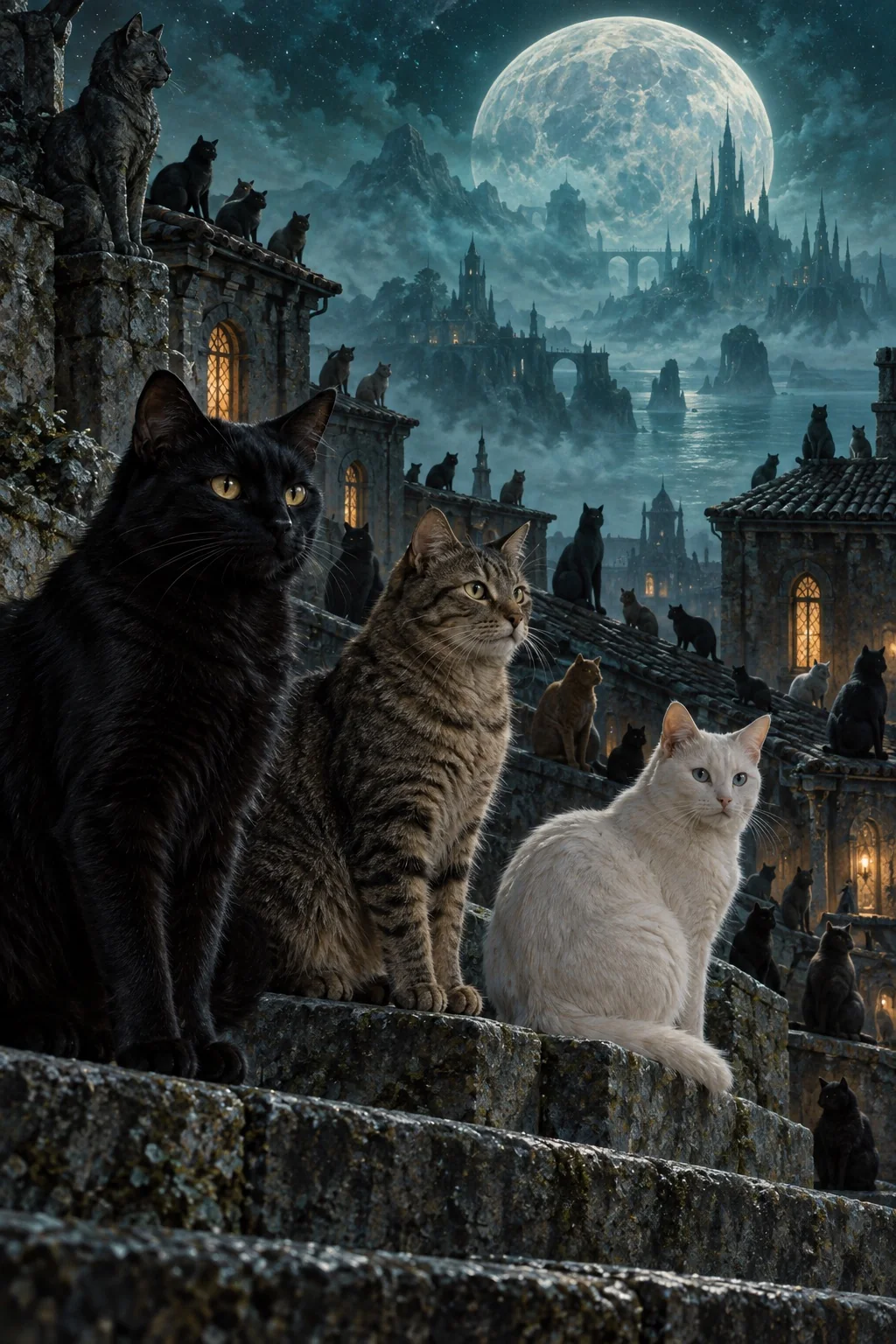
Domestic familiarity and ancient associations
The Cats of Ulthar opens beside a purring household cat, then associates the species with ancient Egypt, the Sphinx and knowledge older than human civilization. The shift gives an ordinary animal an inaccessible history without erasing its recognizable behavior.
The story’s cats return to hearths, enjoy sleep and refuse food after an implied extraordinary meal. Their otherness is embedded in familiar gestures rather than announced through a wholly alien body.
The Dream-Quest retains this combination. Carter meets kittens, inn cats and dignified older animals who can also organize armies and speak across a wide network of communities.
Sources: The Cats of Ulthar — Unspeakable Tales ebook, The Dream-Quest of Unknown Kadath — original text
The Ulthar legend
After Menes’s kitten disappears, all the cats in Ulthar leave their homes for one night. Atal reports seeing them circle the cottage of a couple known for killing cats. The animals return sleek and contented and will not eat for two days.
The couple’s stripped skeletons are later discovered inside. The sequence strongly implies feline revenge, but the attack itself is not narrated. Ulthar’s resulting prohibition against killing cats becomes a defining feature of the town.
The legend does not state that Menes gains permanent command over the species or that every cat must obey a human prayer. The cats’ collective action remains more mysterious than a simple spell with a documented mechanism.
Recognizing Carter as a friend
Carter knows much of the cats’ language and has a longstanding reputation for kindness toward them. In Ulthar he pets the cats after they apparently dispose of zoogs threatening a kitten. At the inn he welcomes another little kitten and gives it cream.
These acts are remembered by other cats. When he is later rescued, the army’s leader turns out to be that kitten’s grandfather. The connection turns a small domestic kindness into part of an international and interplanetary alliance.
The cats do not serve him as an automatically obedient summoned force. Their assistance arises from recognition, shared interests and friendship, and their officers retain authority over their own members.
Journeys to the moon
The Dream-Quest explains that older cats secretly leap from rooftops to the moon’s hidden side at night. There they roam the mountains and communicate with ancient shadows.
Carter hears their familiar cries while being escorted by moon-beasts and their servants toward a feared meeting with Nyarlathotep. The cats recognize him and attack the procession in overwhelming numbers, killing his captors and surrounding him protectively.
Their ordinary forms remain visible in the battle: different colors and familiar breeds fight with claws and teeth. The scale and coordination of the attack transform household animals into a formidable collective force.
The cats from Saturn
The lunar army posts lookouts for the large and peculiar cats from Saturn. These are hostile to terrestrial cats and allied by treaty with the moon-beasts.
A warning from an outpost prompts the rescuers to leave rather than risk an encounter. They close ranks around Carter and carry him in their mass leap back to Dylath-Leen, the destination he requests.
The narrative gives little anatomical detail about the Saturnian cats and does not stage the anticipated battle. Their size, hostility, treaty and presence on the moon are the established information; a detailed species description would need a separately identified source.
The threatened war with the zoogs
After returning from the underworld, Carter overhears zoogs planning surprise attacks on cats in revenge for the party lost at Ulthar. He alerts nearby cats, and the call passes through the countryside to Ulthar’s forces.
The former kitten now appears as a promising junior officer. Carter and the generals plan an immediate operation to surround the zoogs’ councils before their own attacks can begin. The zoogs offer little resistance once their preparations have been anticipated.
Carter interprets during the negotiations. The zoogs retain their freedom on condition of supplying an annual tribute of game birds, while twelve young members of noble families are taken as hostages to Ulthar’s Temple of the Cats.
The terms show that the cats’ attractive companionship does not exclude coercive politics. The victory involves tribute and hostages, not merely a friendly reconciliation.
Ranks, discipline and onward assistance
The cats have commanders, a field-marshal, generals and junior officers. Their organized behavior contrasts with the loosely observed domestic lives humans ordinarily see.
After the settlement with the zoogs, a feline escort accompanies Carter through the wood. The grandfather gives him passwords and recommends the leader of Celephaïs’s cats. The younger officer would like to continue with him, but the general insists that his duty lies with his own community and army.
That refusal matters to the relationship. Carter’s friendship gives him help and introductions without allowing him to override feline obligations.
The network in Celephaïs
At the sheep-butchers’ bazaar, Carter uses his introductions to speak with the local patriarch. The cat knows reports from the waterfront and explains why cats refuse to sail on Inganok’s ships.
The concern is the oppressive presence associated with the northern country, to which cats are more sensitive than humans. The patriarch also tells Carter where Kuranes is living, making feline information useful for both dangerous geography and an ordinary social visit.
The cats do not know everything. The Ulthar commander cannot locate Kadath or identify the sunset city, and the Celephaïs report does not reveal a safe route through Inganok. Their intelligence remains extensive but situated.
The return to the hearth
When Carter finally wakes in Boston, a black cat rises from sleep by the hearth, disturbed by his sudden movement. The last domestic image recalls the companionship that repeatedly sustained him in dream.
Across the stories, cats offer an alternative to the assumption that strangeness must always be hostile. Their secret powers coexist with recognizable warmth, while their violence and political interests prevent them from becoming merely decorative symbols of comfort.
Sources: The Cats of Ulthar — Unspeakable Tales ebook, The Dream-Quest of Unknown Kadath — original text
References
- The Cats of Ulthar — Unspeakable Tales ebook
The fictional narrative is evidence for what the story says, not proof of events in the real world.
- The Dream-Quest of Unknown Kadath — original text
The fictional narrative is evidence for what the story says, not proof of events in the real world.
At a glance
The Cats of Ulthar; The Dream-Quest of Unknown Kadath
Ulthar
A language Carter partly understands
Leaps between Earth and the moon
Moon-beasts; hostile zoogs
Cats from Saturn
Military ranks, negotiations, tribute and hostages