

The Outsider
The Outsider follows an isolated narrator who escapes a decaying castle in search of light and human company, only to discover why the people he approaches flee in terror. Written in 1921 and first published in the April 1926 Weird Tales, it makes the apparent monster the voice through which the reader experiences longing, fear and recognition.
7 min read · 1,269 words
Composition, publication and narrative form
Lovecraft wrote The Outsider in 1921. Its first publication followed in the April 1926 Weird Tales. The story is a first-person retrospective account, introduced by an epigraph from Keats. Its narrator remains unnamed.
The account withholds information that the narrator himself initially lacks. This arrangement is central to the ending: readers experience the approach to a frightening figure through a consciousness that does not yet understand its own appearance. The synopsis below includes that revelation.
Sources: H. P. Lovecraft Archive — fiction in composition order, H. P. Lovecraft Archive — fiction in publication order, The Outsider — Unspeakable Tales ebook
An education without human company
The narrator remembers an ancient castle filled with damp passages, high ceilings, darkness and the odor of decay. Enormous trees exclude daylight from the accessible parts of the building. One ruined black tower rises beyond their reach, but its missing stairs make the upper levels almost impossible to attain.
Books provide the narrator’s knowledge of the world. No remembered teacher explains them, no familiar human voice interrupts the silence, and no mirror supplies a view of his face. He assumes that he resembles the youthful figures pictured in the volumes because his limited memories make him feel young.
Bones in the crypts seem ordinary to him, while the brightly colored depictions of living people seem remote. The narrative establishes a consciousness whose standards have developed in isolation, so that what the reader finds immediately disturbing does not initially disturb its inhabitant in the same way.
The desire for light
The narrator dreams of joining happy crowds beyond the forest. An attempt to leave on foot ends when the trees grow denser and the fear of becoming lost drives him back.
Eventually the longing for the sky becomes stronger than the fear of falling. He decides to climb the ruined tower even if the attempt kills him. The ascent begins as a movement toward the ordinary pleasures described in books: daylight, open space and companionship.
That motivation is essential to the story’s emotional effect. The narrator is not setting out to terrorize anyone. He is trying to reach a world he imagines as welcoming and alive.
The impossible ascent
He climbs the surviving stairs and then struggles upward using small holds in the masonry. The darkness persists far longer than he expects. Instead of reaching an opening into the sky, his head encounters a stone barrier.
After searching around the circumference, he discovers a movable slab and pushes through it. The slab falls back into place. In the chamber above, he finds marble shelves holding oblong boxes and a stone door that he forces open.
Moonlight finally appears beyond a passage and iron grating. Expecting a dangerous height, he hesitates to step out. When the moon emerges from cloud, he sees solid ground immediately outside, together with monuments and an old church. The laborious upward journey has brought him into a churchyard at ground level, overturning his understanding of the castle’s position.
A landscape altered by time
The narrator leaves the burial ground and crosses the countryside. His route appears partly guided by memories he cannot consciously recover. Sometimes he follows a visible road; elsewhere he passes through fields where ruins suggest that an older road once ran.
He swims a river beside the remains of a vanished bridge and eventually reaches a castle in a wooded park. The place is both familiar and changed. Its moat has been filled, some towers are gone and new wings have appeared.
These details suggest a relationship between the narrator’s uncertain past and the inhabited world he has reached. The text does not provide a dated architectural history or a named family whose records explain every alteration. Recognition develops through fragments rather than through a recovered biography.
The gathering and the flight
Through the windows he sees a brightly lit room full of people talking and celebrating. Their dress seems strange, and some faces stir remote associations. He steps through a low window, expecting at last to enter the companionship he has imagined.
The entire company reacts with horror. Guests scream, cover their eyes, stumble over furniture and drag fainting companions away. The narrator remains alone, unable to understand what has terrified them.
His first explanation is that something dreadful must be near him. That mistake allows the reader to retain his viewpoint for a few moments longer. The social catastrophe is experienced first as bewilderment and abandonment, before it becomes knowledge about the self.
The figure beneath the arch
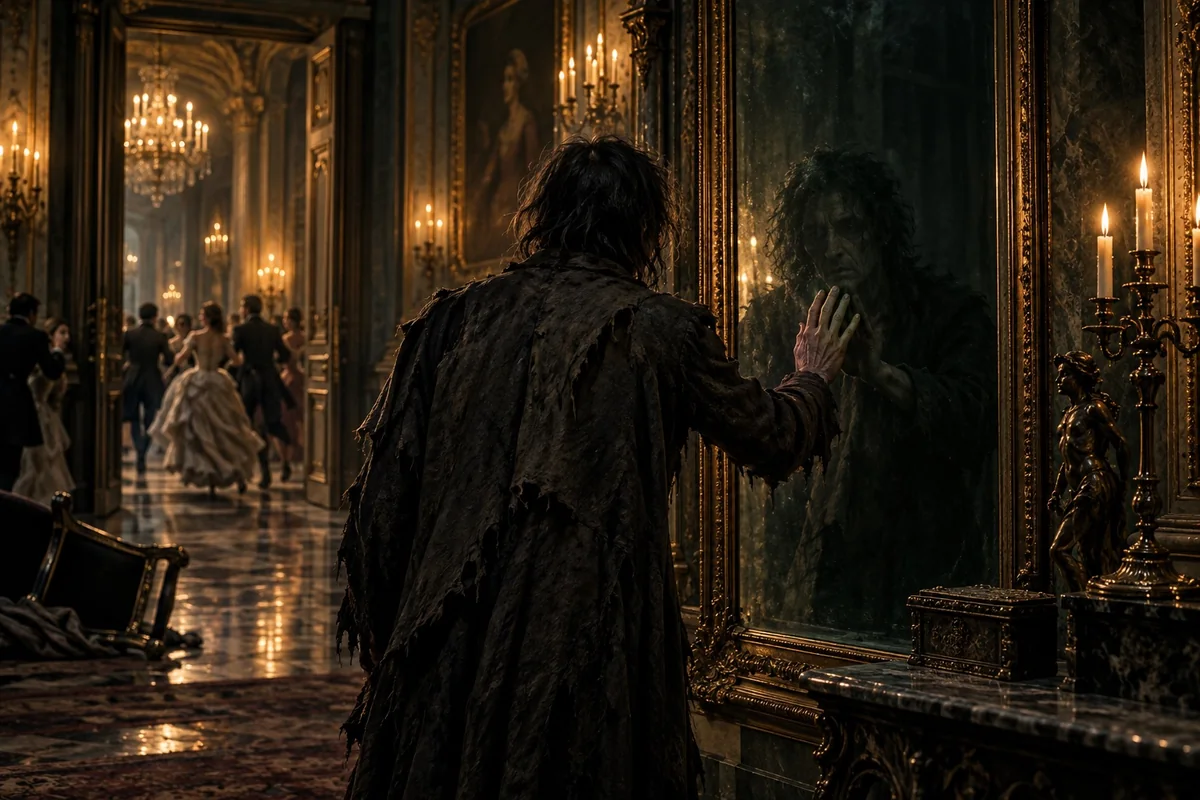
Movement in an alcove draws his attention toward a gilded frame. He sees a decayed, humanlike figure with exposed bone and disintegrating clothes. The sight horrifies him as completely as his arrival horrified the guests.
Trying to recoil, he loses his balance and moves closer. He extends a hand to ward the figure off, apparently touching its outstretched hand. A sudden return of memory tells him what he has encountered and what the changed building means.
The final sentence supplies the physical detail that resolves the encounter: his fingers met polished glass. The figure is his reflection. The narrative has made the feared object and the frightened observer the same being, while delaying the word that would have explained the scene immediately.
After recognition
The recovered memory does not remain fully available. The narrator describes forgetfulness as a relief from the revelation’s force. He flees the inhabited castle and returns to the churchyard, where the stone slab can no longer be moved.
He does not mourn the loss of access to his former isolation. Instead he describes a new existence among ghouls, the catacombs of Nephren-Ka, the valley of Hadoth and the feasts of Nitokris. Moonlight and subterranean company replace the daylight society that rejected him.
The ending leaves an enduring knowledge of exclusion even though much of the remembered past has receded. His new freedom has a bitter quality, but it also includes companionship unavailable in the opening castle. The final state is more complicated than simply being imprisoned forever after the mirror scene.
What the narrator is, and what remains unidentified
The reflected body is humanlike, decomposed and associated with the grave. The narrator also understands himself as belonging outside the society of those who remain human. Those details support an undead reading, but the text does not supply a personal name, a date of death or a technical species classification.
His later company of ghouls does not establish that he has exactly the same anatomy or origin as Pickman’s underground companions. Nor does the Egyptian imagery prove that his original castle stood in Egypt. The closing passage expands the imaginative geography without retrospectively naming every earlier location.
A useful illustration can preserve the castle, ascent, moonlit graveyard or encounter with a reflection. Assigning him a detailed invented life story would go beyond the evidence that makes the tale work.
Interpretation: the monster as a desiring subject
In this encyclopedia’s reading, the story draws much of its force from allowing the apparent monster an ordinary desire for company. The reader has already inhabited that desire before learning what the other characters see.
The books that educate him also mislead him by providing no explanation of his own condition. He can recognize an image of social happiness without understanding whether he can enter it. The missing mirror is therefore part of a larger absence of reliable feedback from other people.
Light promises liberation and then makes the truth visible. The ascent promises a high viewpoint and ends at the surface of a graveyard. These reversals repeatedly change the meaning of an apparently straightforward movement toward knowledge. The final recognition answers one question while leaving the narrator’s emotional estrangement unresolved.
References
- H. P. Lovecraft Archive — fiction in composition order
Composition dates; question marks and ranges retain the source uncertainty.
- H. P. Lovecraft Archive — fiction in publication order
First publication dates and venues; issue dates can differ from actual release dates.
- The Outsider — Unspeakable Tales ebook
The fictional narrative is evidence for what the story says, not proof of events in the real world.
At a glance
H. P. Lovecraft
1921
1926, April
Weird Tales, 7, No. 4
Fiction