

The White Ship
The White Ship is Basil Elton’s account of a voyage from his lonely lighthouse through lands embodying forgotten beauty, dangerous mysteries, pleasure and imagination. After finding a realm without suffering, he insists on pursuing a still more perfect destination. His return joins the loss of that imagined happiness to the consequences of a failed beacon.
5 min read · 1,018 words
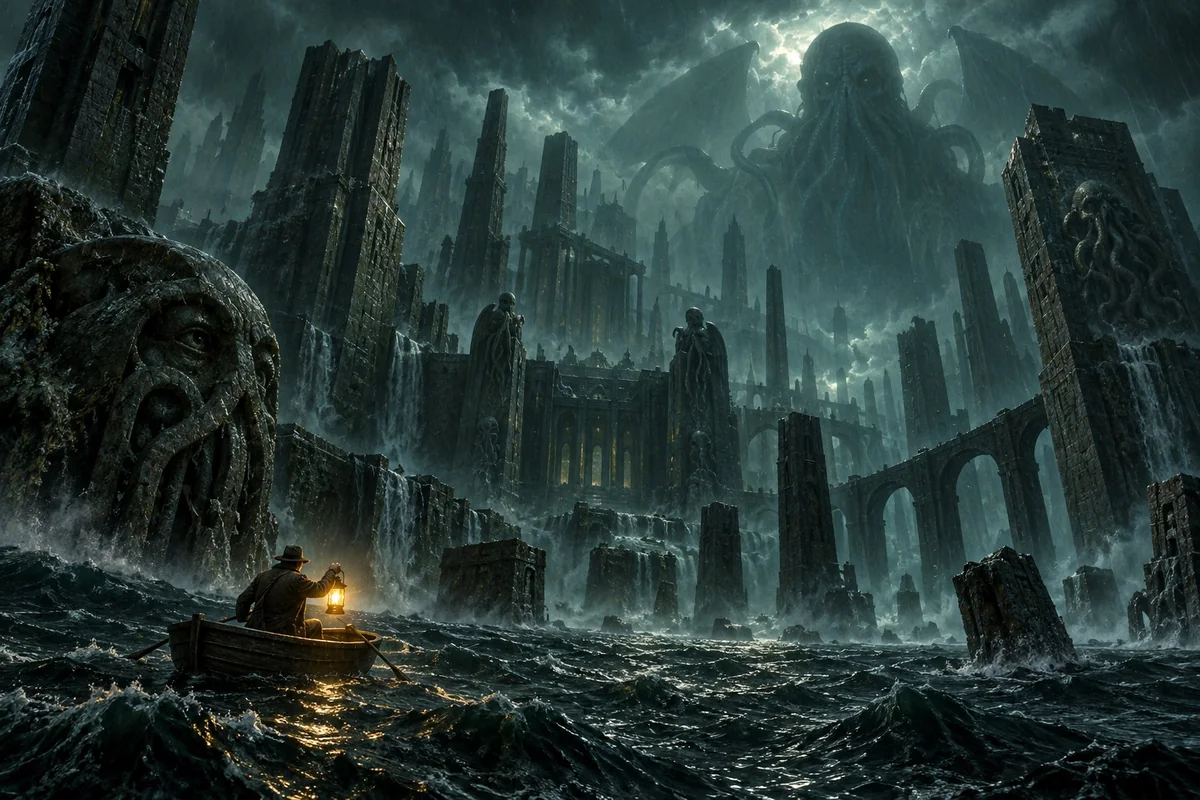
Composition and first appearance
Lovecraft wrote The White Ship in November 1919, and it appeared in the November 1919 issue of The United Amateur. It is narrated in the first person by Basil Elton, keeper of North Point light.
The story uses an episodic voyage rather than an investigation of one concealed monster. Each coast offers a different relation between desire and experience, and the narrator’s changing response to the guide organizes the movement toward catastrophe.
Sources: H. P. Lovecraft Archive — fiction in composition order, H. P. Lovecraft Archive — fiction in publication order, The White Ship — Unspeakable Tales ebook
The inherited lighthouse
Elton keeps the light previously tended by his father and grandfather. The tower stands offshore above dangerous rocks that become invisible at high tide. Fewer ships pass with each generation, leaving him increasingly isolated.
Family stories, books and prolonged observation make the sea a source of imagined knowledge. He describes it as communicating memories and possibilities from times and places beyond ordinary experience. The narration does not begin by labeling all subsequent events a conventional sleep dream.
Under the full moon, a white vessel repeatedly approaches from the south, moving smoothly regardless of wind or waves. A bearded, robed man beckons from its deck. Elton eventually walks to it across a bridge of moonlight and hears a welcome in an unfamiliar yet comprehensible language.
Zar and the preservation of lost beauty
The first shore is Zar, where forgotten thoughts and dreams of beauty continue to exist. Elton recognizes sights he has glimpsed in sea mist and phosphorescent water, alongside visions imagined by poets who died before anyone could appreciate them.
The vessel does not land because those who step ashore cannot return home. Beauty is therefore not simply a reward available without consequence. Zar preserves what the waking world neglects, but entering it permanently would also sever the traveler’s former life.
The guide’s warning establishes a pattern. He knows enough to explain a shore’s attraction and cost, while Elton must decide how to respond to that information.
Thalarion and Xura
Thalarion is an immense city associated with mysteries humans have failed to solve. Its temples and walls attract Elton despite an ominous appearance. He asks to land near the gate Akariel, but the guide refuses, describing inhabitants no longer human and the bones of those who looked upon the ruling eidolon Lathi.
Next comes Xura, whose flowers, music and laughter initially seem irresistible. This time the guide waits as the ship approaches. A wind then brings the odor of death and decay, overturning the promise conveyed by sight and sound.
The two episodes distinguish intellectual fascination from sensual attraction, while showing that neither is a reliable guarantee of safety. Elton accepts retreat when warned about Thalarion and when Xura’s concealed corruption becomes apparent.
The long stay in Sona-Nyl
Following a blue celestial bird, the ship reaches Sona-Nyl. Two crystal headlands meet above the harbor in an arch, and Elton walks ashore over another moonlit bridge.
He describes a realm without ordinary limits of time and space, suffering or death. Gardens, cities and landscapes continually disclose further beauty, and its inhabitants live happily. His own stay seems to last for immense ages.
Unlike Zar, Thalarion and Xura, this is a place he actually enters and experiences at length. The happiness he later rejects therefore has a firmer narrative basis than the imagined perfection of Cathuria.
Cathuria as expectation
Seeing the bird again awakens unrest. Elton wishes to reach Cathuria beyond the western basalt pillars, a land people associate with perfect ideals but which nobody has seen.
He describes its supposed golden cities, fragrant forests, the River Narg and the palace of Dorieb in elaborate detail. Crucially, these descriptions are his own anticipatory speech. They are not observations made after arrival or independent confirmation by the guide.
The guide warns that Sona-Nyl’s happiness is known, whereas the seas beyond the pillars are uncertain. Elton insists on leaving at the next full moon. The oarsmen’s silence replaces the welcoming songs of the earlier voyage.
The western pillars and the cataract
After thirty-one days following the bird, the ship reaches the mist-covered pillars. Elton imagines hearing music that surpasses Sona-Nyl’s songs and praises his own achievements. This personal flattery helps him disregard the guide’s final plea to turn back.
Beyond the mist they find no confirmed Cathuria. A powerful current carries the vessel toward an enormous waterfall where the oceans appear to descend into emptiness. The guide grieves that the travelers have abandoned a beautiful land they cannot recover.
Elton closes his eyes before the expected crash. The celestial bird remains above the torrent, its once reassuring movement now described as mocking. The narrative never establishes that Cathuria itself has been reached.
Return to a failed light
In darkness and violent wind, Elton finds himself back on the lighthouse platform. A ship is breaking apart on the rocks below. The beacon has failed for the first time since his grandfather began keeping it.
Inside, the calendar has not advanced from the day he left, despite the immense duration he experienced. At dawn he finds only a dead blue bird and a brilliantly white broken spar among the wreckage he seeks.
These remnants connect the fantastic voyage to the wreck without providing a complete mechanical explanation. The text does not identify every casualty, certify which vessel broke on the rocks or describe an external inquiry into Elton’s absence.
Loss, responsibility and the final silence
Afterward the sea no longer communicates its secrets, and the white vessel never returns. Elton loses both the inhabited happiness of Sona-Nyl and the imaginative relationship with the ocean that originally relieved his isolation.
His neglected duty gives the ending a consequence beyond private disappointment. The lighthouse exists to protect vessels from hidden rocks, and its failure coincides with a wreck. The story joins desire for impossible perfection with responsibility for a real task.
The geography remains that of this particular visionary voyage. Its named lands should not automatically be assigned measured routes to Ulthar or Kadath, and the Cathuria of Elton’s expectations should not be catalogued as though the story had verified every palace he imagines.
References
- H. P. Lovecraft Archive — fiction in composition order
Composition dates; question marks and ranges retain the source uncertainty.
- H. P. Lovecraft Archive — fiction in publication order
First publication dates and venues; issue dates can differ from actual release dates.
- The White Ship — Unspeakable Tales ebook
The fictional narrative is evidence for what the story says, not proof of events in the real world.
At a glance
H. P. Lovecraft
November 1919
1919, November
The United Amateur, 19, No. 2
Fiction