

Celephaïs
Celephaïs follows an impoverished London dreamer who rediscovers the beautiful city he first visited in childhood. His effort to return becomes increasingly desperate as his waking circumstances collapse. The ending places an apparently eternal reign beside a neglected human body, leaving triumph in dream inseparable from loss in the world he has left.
6 min read · 1,199 words
Composition and first publication
Lovecraft wrote Celephaïs in early November 1920. It first appeared in the second number of The Rainbow in May 1922. The difference between composition and publication matters when following the emergence of his dream geography: the city belongs to his writing of 1920 even though readers encountered the printed story later.
The narrative is in the third person. Its protagonist is called Kuranes in dreams, while his waking name is withheld. The tale tells readers about both his imaginative experiences and his degrading material circumstances, allowing the final paragraph to place the two beside each other.
A solitary writer in London
Kuranes is the last member of an old family. His land and money have gone, and he lives alone among people with whom he feels little connection. He initially writes about his dreams, but ridicule discourages him from sharing his work and eventually from writing at all.
The narrator contrasts his pursuit of beauty with a modern literary impulse to expose an ugly reality. That contrast is part of the story’s values, rather than an objective account of all contemporary writing. Kuranes’s imagination concentrates on childhood, ancestral places and the remembered promise of a world larger than ordinary adult experience.
This withdrawal has a practical consequence. His dreams become more elaborate as his participation in waking society diminishes. The story does not present a successful author choosing a comfortable retirement; it presents someone increasingly unable to maintain a place in the world around him.
Sources: [3]
The road through the childhood village
His rediscovery begins with a dream of the ivy-covered house where thirteen generations of his family lived. He walks through its gardens and park to the village, which appears deserted or half dead. A lane leads toward the channel cliffs, but the familiar landscape ends in an immense, unlit gulf.
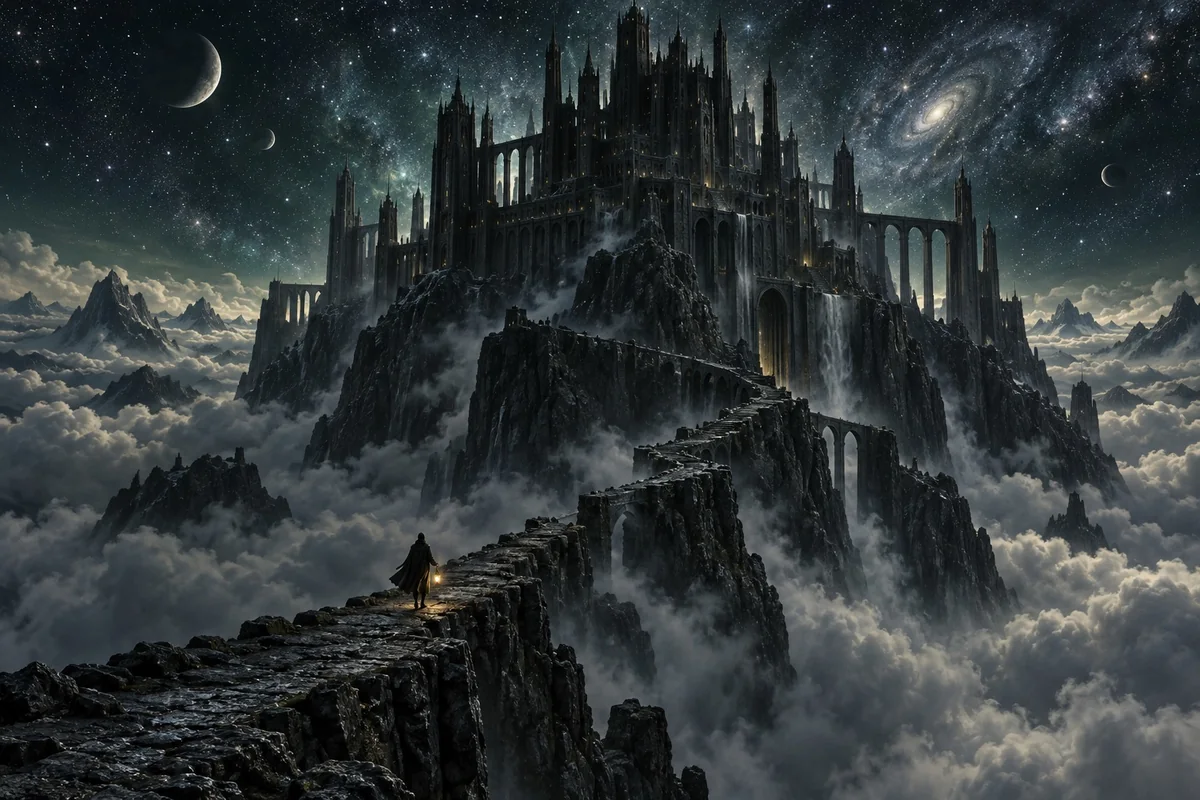
Kuranes trusts the summons that has drawn him onward and passes over the edge. He descends among incomplete dream forms and strange winged things. A break in the darkness reveals a shining city beneath a snowy mountain and beside the sea.
He wakes immediately, but recognizes Celephaïs in Ooth-Nargai beyond the Tanarian Hills. As a child, he visited it while sleeping near the cliff, then protested when his nurse brought him back to waking life. Its sudden return restores a desire that has survived forty years.
Sources: [3]
A city that has not grown old
Three nights later he reaches the city again and is allowed to remain. He lands on a grassy hillside, crosses the Naraxa and recognizes a little bridge where he once carved his name. The route through the grove and across a larger stone bridge returns him to the city gate.
Nothing seems to have aged. The marble walls and bronze statues remain bright, and the guards are as young as before. Merchants recognize him without surprise. At the turquoise temple of Nath-Horthath, the priests explain that Ooth-Nargai possesses perpetual youth rather than the passage of time familiar to him.
The episode gives nostalgia a material setting. Kuranes can test remembered details against streets, people and architecture that apparently preserve them. The discovery is more intimate than an encounter with a generally beautiful place: this is a city that seems to remember him when London does not.
Sources: [3]
The interrupted voyage to Serannian
At the waterfront he finds Athib, the captain who had once agreed to take him sailing. Athib is still sitting on the same chest of spices and behaves as if no interval has passed. Together they embark on a galley across the Cerenerian Sea.
The ship reaches the horizon and continues directly into the sky. Below its keel lie unfamiliar rivers, cities and landscapes. Athib explains that they are approaching Serannian, a pink marble city among the clouds.
Kuranes wakes just as its highest towers become visible. His second loss repeats the first childhood interruption on a larger scale: reaching the beloved city has opened another possibility, and waking life again prevents its fulfillment.
Sources: [3]
Other wonders and a worsening search
For months he cannot recover the route. His dreams take him beyond an enormous wall to deserted gardens, and to a tower overlooking an ancient city whose apparent beauty gives way to evidence of ruin. He also narrowly escapes the masked high-priest of Leng.
These episodes show that abundant wonders cannot substitute for the particular place he wants. The deserted gardens briefly delight him, but offer nobody who can explain the way to Ooth-Nargai. The ruined city suggests that age and catastrophe exist elsewhere even if Celephaïs seems exempt.
He begins using drugs to prolong sleep. One vision carries him into a region without material forms, where a violet gaseous intelligence has never heard of planets or organisms. The encounter enlarges the imagined cosmos while doing nothing to resolve his immediate homelessness.
Sources: [3]
The returning knights
After exhausting his money, Kuranes is expelled from his room. While wandering away from central London, he encounters a procession of armored knights who say they have come from Celephaïs. Their leader explains that Kuranes created Ooth-Nargai in dreams and is therefore to become its chief god.
They provide him with a horse and escort him through Surrey toward his ancestral country. As they travel, the villages appear to move backward through historical time. At dawn they reach the childhood village, now alive, and turn toward the precipice.
The gulf becomes radiant rather than dark. The procession descends through luminous clouds until Celephaïs appears beneath them. What had previously been a solitary and interrupted descent is transformed into a ceremonial arrival.
Sources: [3]
The ending’s two simultaneous images
The narrator says that Kuranes thereafter rules Ooth-Nargai and neighboring dream regions, holding court alternately in Celephaïs and Serannian. The account even promises that his happiness will continue forever.
Its final image nevertheless returns to the waking coast. The tide moves the body of a tramp beneath the cliffs at Innsmouth, near the ancestral Trevor Towers now occupied by a wealthy brewer. The placement identifies the human cost of the dreamer’s apparent fulfillment without providing a conventional scene of his death.
This English coastal Innsmouth should not be silently relocated to the Massachusetts town of The Shadow over Innsmouth. The surrounding journey, channel setting and ancestral landscape belong to a different presentation of the name.
The ending supports more than one emphasis: dream sovereignty may survive bodily death, or the magnificent arrival may express the last escape available to a ruined man. The narrator’s juxtaposition is the secure textual fact; a single clinical diagnosis would go beyond it.
Sources: [3]
The later portrait of Kuranes
The Dream-Quest of Unknown Kadath brings Carter to Celephaïs and confirms that Kuranes cannot return bodily to England because his waking body is dead. It also changes the emotional conclusion. Kuranes has grown dissatisfied with limitless splendor and has recreated a small Cornish landscape near his dream city.
His advice to Carter comes from that disappointment: gaining an imagined destination may not supply the emotional roots the traveler needs. The later story therefore complicates the earlier promise of permanent happiness. Reading both preserves the development of Kuranes from successful dream fugitive into a warning about the limits of escape.
References
- H. P. Lovecraft Archive — fiction in composition order
Composition dates; question marks and ranges retain the source uncertainty.
- H. P. Lovecraft Archive — fiction in publication order
First publication dates and venues; issue dates can differ from actual release dates.
- Celephais — Unspeakable Tales ebook
The fictional narrative is evidence for what the story says, not proof of events in the real world.
- The Dream-Quest of Unknown Kadath — original text
The fictional narrative is evidence for what the story says, not proof of events in the real world.
At a glance
H. P. Lovecraft
early November 1920
1922, May
The Rainbow, No. 2
Fiction