

T’yog
T’yog is the priest who challenges Ghatanothoa in the ancient history recounted by Out of the Aeons. A servant of Shub-Niggurath, he believes he can protect himself and humanity from the god’s petrifying appearance. His failure results from the secret replacement of his protective scroll. The modern museum mystery gradually identifies a supposedly dead specimen with the lost challenger and makes his fate far worse than a simple death on the mountain.
4 min read · 801 words
Priest of Shub-Niggurath
T’yog guards the copper temple of Shub-Niggurath in the ancient land of K’naa. He studies the powers of the gods and receives dreams and revelations concerning the world’s past.
Sources: [1]
He concludes that Shub-Niggurath, her sons Nug and Yeb, and Yig can be aligned against Ghatanothoa. The claim belongs to his religious understanding within the story. It is not a general rule that those beings are invariably benevolent in every author’s work.
His opposition is directed both at the dangerous being on the mountain and at the human order sustained by fear of it. Deliverance would make the existing priesthood’s special privileges unnecessary.
The protective formula
Inspired by his goddess, T’yog writes a charm in the priestly Naacal script. The writing occupies a membrane made from the inner skin of an extinct lizard. He stores it inside a cylinder of lagh, a metal brought to Earth by the beings from Yuggoth.
The charm is believed to prevent petrification and to restore those already affected. With it, T’yog expects to approach Ghatanothoa face to face and negotiate or impose an end to its threat.
The exact outcome of such a meeting is uncertain even to him. His plan depends on the protection holding long enough for a confrontation no human has previously survived or reported.
Sources: [1]
Courage and ambition
T’yog sincerely imagines freeing humanity from a continuing terror. The population welcomes that prospect, and King Thabon refuses to prohibit the expedition despite the objections of Ghatanothoa’s priests.
He also imagines the rewards of success. The honors presently given to the other priesthood could become his; kingship or something approaching divine status seems conceivable. The narrative does not hide this element of self-interest.
His character is consequently more complicated than a disinterested martyr. Personal ambition helps sustain a courageous challenge, while the rival priests’ self-interest produces a much more destructive response.
Sources: [1]
Imash-Mo’s substitution
The high priest Imash-Mo fears that a successful confrontation will destroy his order’s influence. Public denunciation fails to turn the king and people against T’yog, so he resorts to sabotage.
While T’yog sleeps, Imash-Mo removes the true scroll from its cylinder and substitutes a similar-looking copy with crucial differences. He counts on the challenger not examining it again before departure.
The stolen original is preserved for the priesthood’s own use. This detail makes the deception especially pointed: the same men who insist that resistance is impossible retain a means of resistance when it might serve them.
Sources: [1]
The ascent of Yaddith-Gho
T’yog begins the climb at dawn on the Day of the Sky-Flames, carrying a wooden staff and the cylinder he believes contains his protection. The people watch him ascend the basalt slopes until he disappears around the mountain.
They wait through the following days and weeks. A few sensitive dreamers report an unusual disturbance, but no reliable account of his confrontation returns to the crowd.
His disappearance becomes evidence in favor of obedience. Even when the substitution is eventually known, the fear inspired by his fate remains stronger than any renewed willingness to challenge Ghatanothoa.
Sources: [1]
The museum specimen
Centuries and millennia pass before sailors recover a crouching body from an ancient crypt on an island briefly raised from the Pacific. Beside it lies the cylinder and scroll. The Cabot Museum acquires the objects and exhibits the body as an unexplained mummy.
Later comparison with von Junzt’s account suggests that the specimen is T’yog and that the preserved writing is the ineffective substitute. Visitors associated with surviving cults address the figure by his name and speak of restoring him with the true scroll.
This identification grows through converging evidence. The body does not speak to confirm its own history. The horror instead depends on the possibility that it has retained consciousness while remaining unable to communicate through the whole interval.
Sources: [1]
The last sight and the living brain
When the mummy’s eyes open, a tiny image survives within them. Johnson sees the interior of the crypt and the being emerging through its trapdoor. The retained scene explains what the ancient climber encountered after disappearing from public view.
A later dissection reveals preserved internal organs and finally a living brain. The body’s rigidity has concealed survival rather than proving death. The victim’s apparent passivity in the museum can now be understood as imprisonment.
The story ends at this discovery. It does not provide a successful awakening, an account of T’yog’s thoughts or a rescue that restores his freedom. His importance lies in that unfinished duration: the failed expedition has never fully ended for its participant.
Sources: [1]
Related music
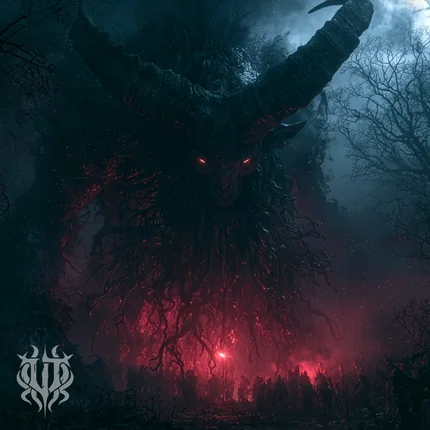
The Black Goat of The Woods is a dark metal tribute to Shub-Niggurath, the ancient woodland deity whose forgotten cults gather beneath twisted trees and indifferent stars.
References
- Out of the Aeons — original text
The fictional narrative is evidence for what the story says, not proof of events in the real world.
At a glance
Out of the Aeons
High priest of Shub-Niggurath; guardian of her copper temple
K’naa in Mu
Ghatanothoa and its priesthood
Imash-Mo
Petrified exterior with a living brain, preserved into the twentieth century