

Ghatanothoa
Ghatanothoa is the being beneath Mount Yaddith-Gho whose appearance inflicts a petrification more terrible than ordinary death in Out of the Aeons. Its victims retain living brains inside immobilized bodies. The tale connects an ancient priest’s attempt to defeat this power with a mysterious museum specimen in twentieth-century Boston. Ghatanothoa acts through the danger of being seen, the authority of its priests and an image preserved across an almost inconceivable span of time.
6 min read · 1,216 words
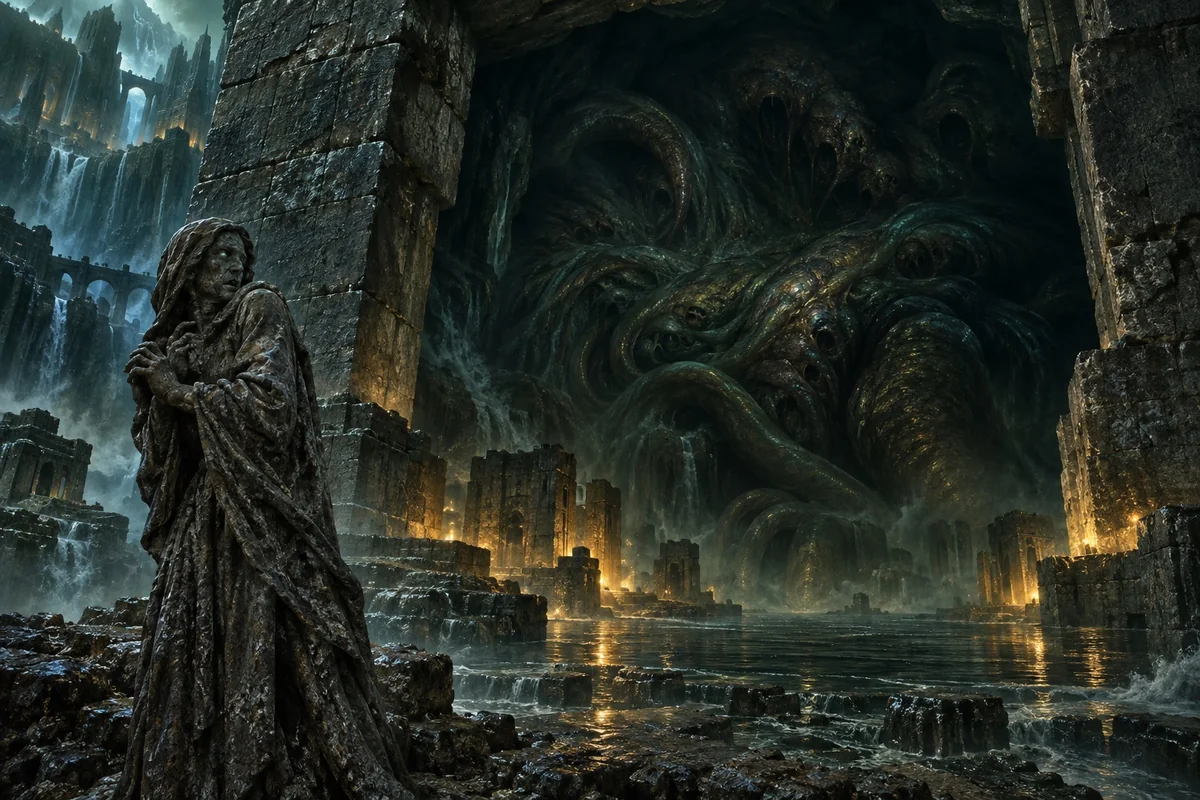
The fortress on Yaddith-Gho
The ancient account places Ghatanothoa beneath a vast fortress on Mount Yaddith-Gho in K’naa, a region of the lost continent Mu. The builders were beings from Yuggoth who had colonized Earth before terrestrial life. They vanished long before the human society described in the legend, leaving their god or patron behind.
Humans avoid the basalt cliffs and view the fortress only from a distance. Ghatanothoa is believed to remain in the depths beneath it, capable of emerging and descending into the inhabited country if neglected.
The history is transmitted within the story through von Junzt’s Nameless Cults. Mu, the fortress and its alien builders belong to the fictional account, not to verified archaeology. Mount Yaddith-Gho should also be distinguished from the planet Yaddith in the Carter cycle; the similar names do not establish that they are the same location.
Petrification with a living mind
The distinctive power operates through sight. Beholding Ghatanothoa, or a perfectly accurate representation of it, is said to harden the victim’s exterior into a substance resembling stone and leather. The effect is not described as instantaneous conversion of every organ into inert rock.
The brain remains alive and potentially conscious inside the rigid shell. Release may depend on damage and decay eventually exposing it to death, while the passage of immense time threatens the mind with madness long before that happens.
This separation of body and consciousness is the story’s central horror. A preserved form may appear to be a dead relic while enclosing an experience that has never ended. The apparent antiquity of a museum specimen becomes the possible duration of its imprisonment.
Sources: [1]
The danger of an accurate image
The legend extends the power to a perfect image, even a very small one. Size is therefore less important than fidelity. A tiny representation may transmit a danger associated with a being of enormous scale.
The Boston events turn this proposition into a physical mechanism within the fiction. The mummy’s eyes preserve an image of the last scene it witnessed. When the eyes open, that image offers a route by which a remote ancient encounter can affect people in the present.
The image gradually fades. Johnson’s partial view through magnifying lenses does not have the same result as an earlier, clearer exposure apparently had for an intruder. His survival depends on the damaged transmission of the sight rather than on a demonstrated immunity of his own.
Sources: [1]
What the narrator glimpses
Johnson sees a huge stone chamber with repellent carvings and an immense trapdoor lifting from its floor. Something emerges from below. The right eye’s image is already too indistinct to show it clearly, while the left retains enough detail to overwhelm him.
His resulting description combines tentacles, trunklike features, octopus-like eyes and a partly shapeless, flexible body. Its surface includes both scaly and wrinkled textures. No single familiar animal supplies an adequate model.
The description is a fragmentary recollection of a fading image, not an exhaustive anatomical survey. Illustrations can work from its stated elements, but precise numbers of limbs, a fixed posture or a complete silhouette remain interpretive choices.
Sources: [1]
The power of the priesthood
Ghatanothoa’s cult in K’naa sacrifices twelve young warriors and twelve young women each year. The rites occur at the temple near the mountain’s base because the priests themselves do not dare approach the fortress.
A hundred priests enjoy exceptional wealth, personal privilege and authority under their high priest Imash-Mo. Even the king must acknowledge their position. Their social power rests on the claim that their service prevents the god from descending upon the population.
The arrangement joins a potentially genuine supernatural threat to a very human institution. The story does not require Ghatanothoa to issue political orders directly. Fear of its appearance allows its representatives to control society in its absence.
Sources: [1]
T’yog’s challenge
T’yog, a priest of Shub-Niggurath, believes that divine powers more favorable to humanity can help him resist Ghatanothoa. He prepares a protective formula and proposes to climb the mountain, enter the fortress and confront the being.
The plan promises liberation from fear but also enormous rewards for T’yog. He imagines receiving the honors of the existing priesthood and perhaps even greater authority. His courage and ambition coexist rather than cancelling one another.
Imash-Mo secretly replaces the effective scroll with a close but powerless imitation. T’yog ascends believing himself protected and never returns. The priests preserve the stolen original, keeping for their own possible use the defense they denied to the challenger.
Sources: [1]
The true scroll
The protective writing is placed on a special membrane in a cylinder of lagh, an alien metal associated with the earlier visitors from Yuggoth. According to the legend, it can prevent Ghatanothoa’s effect and restore victims already affected.
In Boston, one intruder holds a similar scroll while the other does not. The first dies without petrification; the second acquires the mummy’s rigid, gray exterior. Investigators also experience a strange stiffness that recedes while the writing is passed among them.
These correspondences strongly support the ancient account within the plot. Nevertheless, the museum officials refuse the public demand for an experiment applying the scroll to the victims. The story therefore never demonstrates a complete successful restoration or supplies a practical ritual that readers can reproduce.
Sources: [1]
Survival after Mu
The old account describes Mu’s destruction and the dispersal of its surviving devotees. The cult’s continuity depends on people, objects and fragments of knowledge rather than the continued visibility of the original mountain.
The preserved scroll and transmitted names become central to the later mystery. Publicity about the Boston mummy attracts visitors whose chants and behavior suggest that the ancient tradition still has active adherents.
The narrative assigns this supposed survival to real regions and peoples through an exoticizing, frequently racist lens. Its global conspiracy is a literary device and must not be treated as a factual account of those communities’ religions or activities.
Sources: [1]
The evidence in the museum
Two intruders die beside the opened display case on 1 December 1932. One body has the same hardened exterior as the mummy, while an examination finds internal organs unexpectedly preserved. Johnson then discovers the fading scene in the older specimen’s eyes.
A week later, the museum’s dissection reaches the mummy’s brain. It is still alive. That final finding supplies the most terrible correspondence with the legend, transforming the old narrative of prolonged consciousness into an immediate problem for the observers.
Ghatanothoa itself never leaves its ancient setting in a directly narrated modern appearance. The horror reaches Boston through a survivor and an image, making distance in time and geography inadequate protection.
Sources: [1]
Authorship and divine categories
Out of the Aeons was written by Lovecraft for Hazel Heald in 1933 and published in Weird Tales in April 1935. Its religious conflict is expressed through T’yog’s understanding of which gods might help humanity against a particular enemy.
That local alliance should not be turned into a universal moral classification of every Mythos deity. Shub-Niggurath and Yig occupy a potentially protective role in this narrative’s ancient legend, while other stories frame them differently. The variation is part of the tradition’s literary history.
Related music
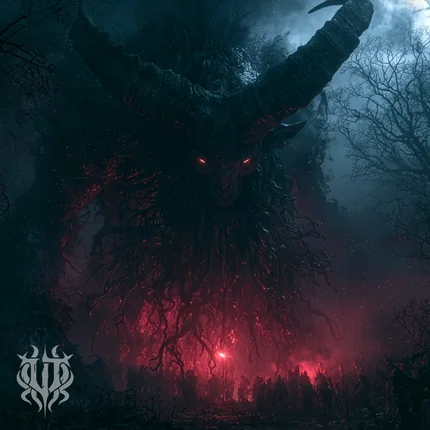
The Black Goat of The Woods is a dark metal tribute to Shub-Niggurath, the ancient woodland deity whose forgotten cults gather beneath twisted trees and indifferent stars.
References
- Out of the Aeons — original text
The fictional narrative is evidence for what the story says, not proof of events in the real world.
- Through the Gates of the Silver Key — original text
The fictional narrative is evidence for what the story says, not proof of events in the real world.
- H. P. Lovecraft Archive — fiction in composition order
Composition dates; question marks and ranges retain the source uncertainty.
- H. P. Lovecraft Archive — fiction in publication order
First publication dates and venues; issue dates can differ from actual release dates.
At a glance
Out of the Aeons
H. P. Lovecraft for Hazel Heald
April 1935, Weird Tales
Beneath the fortress on Mount Yaddith-Gho, K’naa, Mu
Petrifies the exterior while leaving the brain alive
Sight of the being or an accurate image
Imash-Mo
T’yog