

The Antarctic city
The Antarctic city is the immense, unnamed settlement explored by Dyer and Danforth in At the Mountains of Madness. Built by the star-headed Elder Things, it preserves an architectural and pictorial history extending far beyond human civilization. Its abandoned streets lead into a second, more dangerous environment beneath the ice, where the distinction between a dead archaeological site and an inhabited world breaks down.
7 min read · 1,303 words
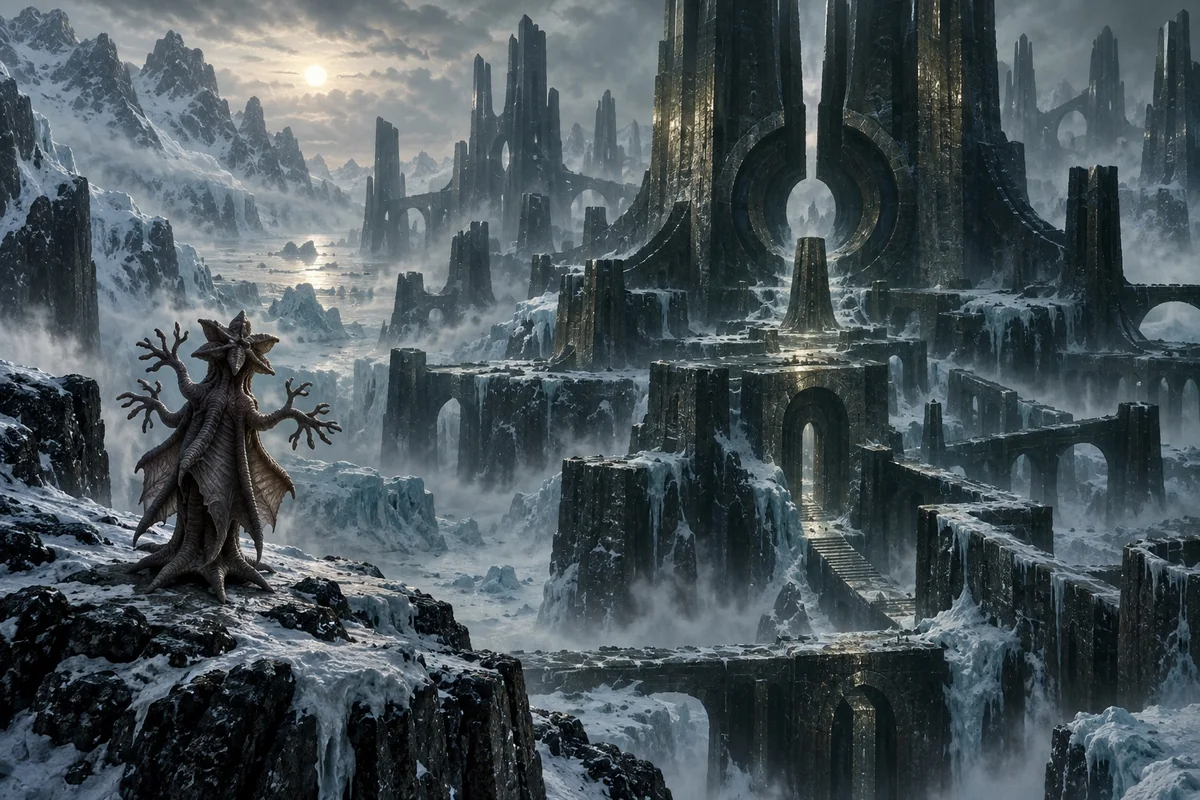
Discovery beyond the mountain barrier
Dyer and Danforth reach the city by flying across the enormous range discovered by Lake’s advance party. The mountains form a physical barrier between the expedition’s camp and a plateau covered with ruins.
Their first clear view reveals a settlement of extraordinary extent. What seemed from a distance like an impossible combination of natural and artificial forms becomes unmistakably constructed. The explorers have crossed into evidence of a civilization whose existence would overturn their assumptions about terrestrial history.
The city has no securely supplied proper name in the novella. Descriptive labels such as the city of the Elder Things identify its builders and setting without establishing an ancient name that the explorers have translated.
A skyline built for another kind of life
The surviving structures include cones, pyramids, terraces, cylinders, cubes and more complex grouped forms. Massive blocks of dark slate, schist and sandstone form walls and towers, while some portions appear cut directly from bedrock.
The arrangement is not a collection of recognizable human monuments enlarged for effect. Its proportions, repeated geometries and internal organization reflect the bodies and habits of its builders. Fivefold patterns recur, connecting architecture with the radial organization of the Elder Things themselves.
Carvings show that the original skyline included finer spires, finials and horizontal tiers that weathering has removed. An earlier mirage appeared to display features no longer present in the surviving ruins, leaving Dyer with an additional puzzle about what the atmosphere seemed to reveal.
Entering the buried levels
Snow and ice conceal lower parts of many buildings. The explorers seek roofed structures whose interiors may preserve routes down toward the original ground level, rather than assuming that every visible rooftop marks an isolated ruin.
They enter through openings, follow passages and use a spiral descent to reach deeper spaces. Their progress depends on lamps, maps, careful observation and the ability to retrace a route through an unfamiliar built environment.
This vertical movement changes the archaeological experience. From the air, the city is an overwhelming visual field. Inside, it becomes a sequence of legible surfaces and connected rooms. Lower still, those connections begin to suggest that the surface city was only one part of a much larger system.
The carved historical record
Extensive bas-reliefs supply the principal account of the builders’ past. Dyer and Danforth interpret them through comparison between repeated scenes, recognizable organisms, geographical forms and changes in artistic treatment.
The sculptures describe the arrival of the Elder Things, their early marine settlements and the production of life forms for particular uses. Shoggoths appear as adaptable workers capable of forming temporary organs and moving enormous weights.
The resulting narrative is a reconstruction by two human visitors. It is supported by a large visual record, but it remains an interpretation of that record. The novella itself distinguishes relatively clear episodes from uncertain deductions, especially when the explorers try to infer institutions rather than visible events.
A civilization with ordinary institutions
The reliefs show commerce, agriculture, animal husbandry, mining and forms of manufacturing. Furniture and equipment are adapted to the builders’ bodies; their books consist of hinged surfaces marked with organized groups of dots.
Small inscribed counters appear to serve as money. Dyer tentatively associates some of the expedition’s greenish soapstone objects with this currency. Political organization is harder to reconstruct, and his suggestion about its character is explicitly less secure than the evidence of trade.
These details make the city more than a fortress of monsters. Its inhabitants had everyday arrangements for work, communication, exchange and comfort. Recognizing those arrangements prepares the explorers to understand the revived beings as displaced members of a civilization rather than as mere biological specimens.
Conflict with other inhabitants of Earth
The historical carvings describe wars with the beings associated with Cthulhu and changing divisions of land and sea. They also place later conflicts with the Mi-Go within the long decline of the Elder Things’ dominance.
The city is therefore situated within a contested planetary history. Its builders were neither the sole extraterrestrial arrivals nor permanently secure rulers of every environment. Retreat, compromise and territorial loss belong to their story.
The account should not be converted into a perfectly dated universal chronology of the Mythos. Dyer is interpreting an incomplete visual archive, and the tale’s broad historical sequence does not settle every relationship among traditions introduced elsewhere.
Climate and the retreat below
Cooling conditions gradually make the land settlements harder to inhabit. Later reliefs depict heating devices, protective coverings and movement toward warmer refuges. Some populations return to marine settings, while others descend into the nearby subterranean waters.
The old city remains useful as a seasonal residence, a communication center and a route to mines and mountain sites. Purpose-built passages improve the connection between the surface and the underground refuge.
Abandonment is thus a process, not a single unexplained catastrophe. Environmental change, reduced capabilities and altered patterns of habitation transform the city across immense periods before the explorers arrive.
The return of the awakened Elder Things
The beings that emerge from Lake’s specimens cross the mountains and attempt to find a place within the world their civilization once occupied. Traces of their route connect the ruined expedition camp with the city.
They carry supplies and specimens of their own, including the bodies of Gedney and a dog. What first looked to the human rescuers like irrational mutilation is reinterpreted as investigation by unfamiliar scientists confronting unfamiliar organisms.
The returning Elder Things can read the history of their city, but that knowledge does not restore the living community they expected. Their movement toward the underground refuge becomes a tragic attempt to reach survivors of their own civilization.
The subterranean threat
Dyer and Danforth find the returning beings dead and encounter evidence that something else now occupies the lower passages. The damaged bodies, slime and altered wall markings point toward the shoggoths whose earlier history they have just learned.
The pursuing shoggoth demonstrates that the city’s danger is not exhausted by the revived specimens. The workers created and controlled by the old civilization have survived in a changed relationship to its remains.
The explorers escape through the passages they have mapped. Their route back upward turns the historical monument into an active survival problem, in which the ability to read space matters as much as the ability to read sculpture.
The farther mountains
Beyond the city lies another, more distant range, visible as violet peaks on the horizon. The Elder Things’ own records treat that region with fear and reluctance. Its significance therefore exceeds the dangers the explorers have directly encountered.
During the return flight, Danforth glimpses something he later associates with those farther heights. He does not provide a stable description that allows Dyer to identify it. The city is the setting of their documented exploration; the region beyond remains a separate and less certain horror.
This distinction preserves the novella’s expanding scale. The ruins reveal an entire hidden history, yet the beings who made that history also faced something they did not comfortably explain.
Why the city matters
The city turns alien life into historical life. Its builders leave records of conflict, technical achievement, adaptation and loss, making them comparable to human civilizations without making them human in anatomy or origin.
It also changes the meaning of discovery. What begins as a scientific triumph becomes evidence that excavation can awaken survivors and expose routes into still-active environments. Dyer’s later warning grows from both the knowledge he acquires and the consequences of acquiring it.
For an encyclopedia, the most useful approach is to retain both layers: the city as a remarkably detailed fictional archaeological site, and the city as a narrative device that forces the explorer to recognize intelligence and vulnerability in beings he first considered specimens.
Related music
The Dead But Dreaming is a dark folk metal song inspired by The Call of Cthulhu, evoking R’lyeh, forbidden worship and the ancient dream beneath the sea.
References
- At the Mountains of Madness — original text
The fictional narrative is evidence for what the story says, not proof of events in the real world.
At a glance
At the Mountains of Madness
The star-headed Elder Things
Not supplied in the novella
Dyer and Danforth
Extensive carved reliefs interpreted by the explorers
Connected subterranean refuge; surviving shoggoths
A plateau beyond the expedition’s newly discovered Antarctic range