

Mi-Go
The Mi-Go are the winged, fungus-like extraterrestrials associated with the Vermont hills and the distant outpost Yuggoth. Their contact with Henry Akeley and Albert Wilmarth combines material extraction, concealed human agents, ritual communication and a technology that can transport a living brain beyond its body.
8 min read · 1,610 words
The Whisperer in Darkness and its evidence
The Whisperer in Darkness was written in 1930 and published in Weird Tales in August 1931. It is the main narrative source for the Mi-Go. Albert Wilmarth, an academic at Miskatonic University, initially enters a public dispute about strange bodies reportedly seen after flooding in Vermont. His correspondence with Henry Wentworth Akeley changes that dispute into a private investigation.
The story builds its case from photographs, recordings, letters, testimony and a final visit. These forms of evidence do not all have equal reliability. A photograph can fail to show what a witness claims was present; a voice can be reproduced or disguised; a letter can change in style and purpose. The Mi-Go become frightening partly because the media through which the investigators try to understand them are themselves vulnerable to interference.
The narrator’s account is retrospective. He has survived the visit but cannot produce every object he encountered. The disappearance of the equipment and the absence of an ordinary explanation for Akeley’s fate leave him with a conviction whose most decisive evidence is difficult to recover.
External form and unusual substance
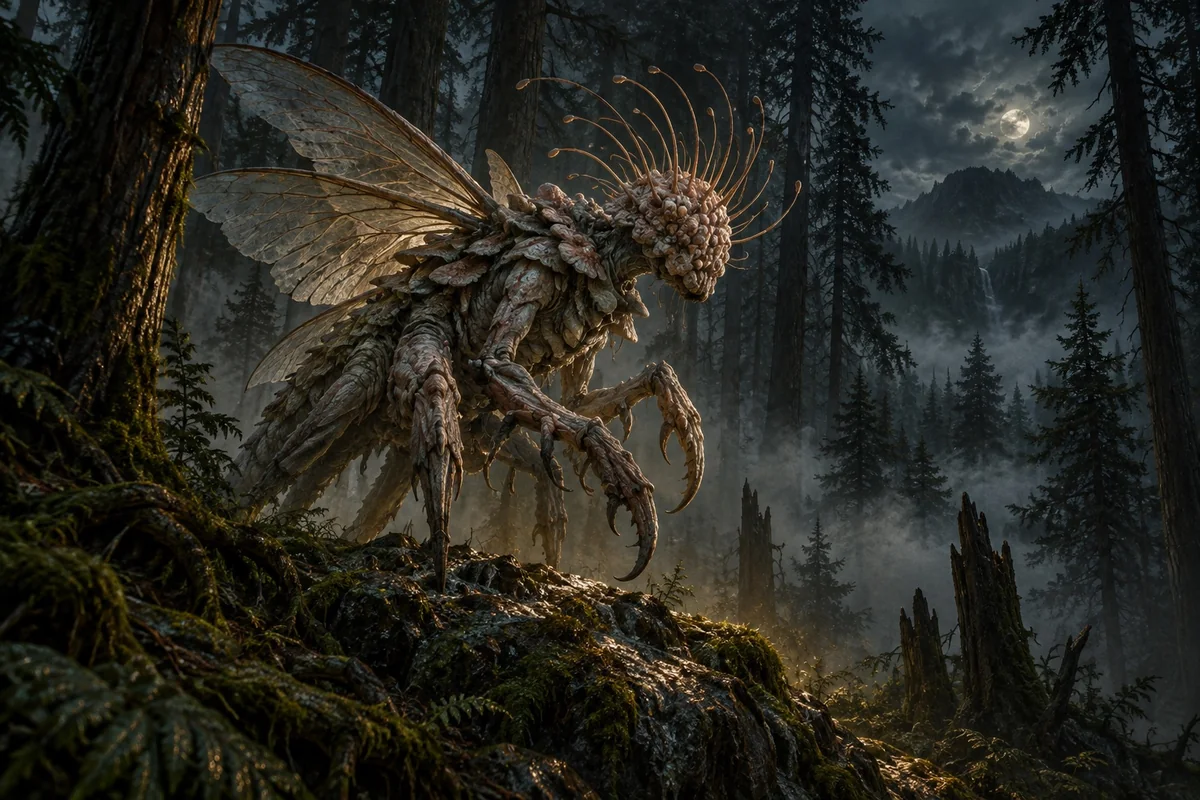
Reports from Vermont describe pinkish organisms roughly five feet long. Their bodies suggest crustaceans, with several sets of jointed limbs and structures resembling dorsal fins or membranous wings. In place of a familiar head is a convoluted ellipsoid covered with many short antenna-like features. The comparisons are attempts by human observers to describe something outside known local fauna.
Akeley and Wilmarth eventually connect the beings with the Mi-Go of Himalayan lore. The story’s reference to the Abominable Snow-Men does not mean that these organisms are simply large furry primates. Their described form is winged, segmented and alien, while the folklore identification is part of the investigators’ effort to join remote reports.
Their substance does not behave like ordinary terrestrial flesh. The photographic difficulties and their association with a fungus-like mode of life challenge the categories with which Wilmarth begins. An illustration should preserve the nonhuman head and the compound body rather than converting the Mi-Go into people wearing insect masks. The source’s biological uncertainty is a feature, not a missing invitation to supply a complete modern taxonomy.
Sources: [1]
Yuggoth and travel beyond Earth
Yuggoth is described as a dark outpost at the edge of the solar system. It is not presented as the ultimate birthplace of the entire race. The information transmitted through Akeley points toward a far wider existence and modes of travel beyond ordinary human experience. The story’s immediate Vermont events thus belong to a network whose scale extends far beyond a local cave or settlement.
The narrative associates the newly discovered outer planet with this imagined world. That is a use of contemporary astronomy in the fiction, not evidence that real Pluto contains the buildings or inhabitants described by the speakers. The planet’s actual scientific history and the invented outpost require separate kinds of source.
The Mi-Go’s ability to cross space is connected with their wings and unfamiliar matter. For human visitors, however, the proposed method is different. The brain-cylinder technology offers to separate consciousness from the bodily limitations that ordinarily prevent such travel. The promise makes cosmic exploration accessible while simultaneously threatening everything familiar about being the traveler.
Sources: [1]
Mining, remote places and secrecy
The beings’ activity in the Vermont hills includes the extraction of materials they cannot obtain in the same way elsewhere. Their interest is therefore practical as well as religious or scientific. Earth is a useful site within a larger network, and its human population is not necessarily the central object of every operation.
Remote terrain, caves and forested hills make concealment possible. The apparent beauty of the countryside is repeatedly set against Akeley’s growing fear of what moves through it. Familiar regional features become threatening because they offer routes and cover for another population whose purposes are only partly visible.
Human agents complicate the situation. The Mi-Go do not need to appear openly whenever they wish to intercept communication or influence events. Cooperation, coercion and disguise can act through people. This makes the investigation a problem of trust as much as a problem of identifying an alien organism.
Sources: [1]
Akeley’s resistance and the correspondence
Akeley begins as a source of detailed observations supported by local familiarity. He supplies material that Wilmarth first interprets cautiously, then increasingly takes seriously. The letters describe unusual sights, sounds, evidence gathered from the woods and pressure against Akeley’s household. His dogs are part of his defense, and their losses help measure the worsening situation.
The correspondence allows two contrasting positions. Wilmarth is distant enough to question the interpretation and organize the material intellectually; Akeley is exposed to the practical consequences of possessing it. Their roles change as the evidence accumulates. The academic’s skepticism weakens just as his correspondent appears increasingly endangered.
A sudden reassuring letter then announces that the beings have been misunderstood and that cooperation offers extraordinary possibilities. The change invites Wilmarth to come to Vermont and inspect the equipment himself. Because the letter follows a period of fear and coercion, its calmness is itself suspicious. The story makes a shift in tone into a clue rather than treating every document bearing a familiar name as unquestionably authentic.
Sources: [1]
The recording and ritual vocabulary
The recorded ceremony includes human speech and an inhuman buzzing voice. Its references connect the Vermont beings with names such as Shub-Niggurath and Nyarlathotep, and with places and powers beyond Earth. The material gives Wilmarth an audible encounter with the wider mythological network before he reaches the house.
The voices are significant as sound as well as content. The response resembles speech adapted through organs not designed for ordinary human vocalization. This anticipates the later encounter in which tone, breathing and mechanical reproduction become crucial to judging who is actually speaking.
A ritual invocation establishes a relationship in the particular recorded scene. It does not supply the religion of every member of the species, a universal command chart or a complete list of divine allegiances. The source joins technical activity and cult language without requiring either to cancel the other.
Sources: [1]
Brain cylinders: the promised liberation of consciousness
At Akeley’s house, Wilmarth is shown containers and attachments said to preserve brains outside their original bodies. Connected devices can supply speech, hearing and sight. The apparatus therefore divides functions that people ordinarily experience as one embodied condition: a mind may remain capable of communicating while lacking the face, limbs and organs through which others normally recognize it.
The proposed advantage is travel. A human body cannot endure all the conditions the Mi-Go can cross, while a specially contained brain can supposedly be transported and later restored. The speakers present this as an opportunity to encounter places and knowledge otherwise inaccessible. Curiosity becomes an instrument through which consent might be obtained.
The narrative also gives reasons to fear the arrangement. Control of the container, attachments and transport remains with the beings offering it. The traveler would depend on them for contact with the outside world and for any hoped-for return. The promise of a larger universe thus arrives with an extraordinary loss of practical autonomy.
Not every claim made during the demonstration is independently verified. The equipment produces a voice, but the full history and wishes of the consciousness associated with it are mediated by the situation’s hosts. The difference between technical possibility and trustworthy consent is central to the horror.
Sources: [1]
The apparent Akeley and the final discovery
The figure receiving Wilmarth sits in dim conditions and speaks in an altered whisper. Physical weakness and sensitivity to light are offered as explanations. The room’s arrangement, the strange atmosphere and the apparently passive body allow a familiar identity to be accepted while details increasingly contradict the visitor’s expectations.
Wilmarth overhears disturbing communication and ultimately discovers objects that make the appearance of Akeley profoundly suspect: a face and hands associated with the man he thought he had met. Their presence suggests that the familiar exterior has been used to conceal a different occupant or means of presentation. The climax turns recognition itself into an unreliable faculty.
He escapes without obtaining a complete explanation or rescuing Akeley. The final record does not establish every step in the man’s removal or transformation. The remaining uncertainty is part of the ending: Wilmarth understands enough to flee, while the beings retain control of the evidence that could settle the precise fate of his correspondent.
Sources: [1]
Connections with the Antarctic history
At the Mountains of Madness also places the Mi-Go within an account of Earth’s nonhuman past. Dyer’s reconstruction from the Elder Things’ carvings includes conflicts and arrivals involving other extraterrestrial populations. This gives the beings a history beyond the Vermont episode and confirms that the names belong to different civilizations with potentially competing interests.
The winged fungal-crustacean forms of The Whisperer in Darkness are distinct from the fivefold, star-headed bodies examined by Lake. Their shared antiquity, ability to travel and place in forbidden literature do not make them one species. A detailed reference should preserve both the cross-connection and the anatomical difference.
Interpretation: knowledge offered on unequal terms
The Mi-Go make a distinctive version of cosmic temptation possible. Their offer is not simply wealth or the satisfaction of a human appetite. It is access to a universe that scholarship, imagination and ordinary travel can only suggest. Wilmarth is vulnerable because he has good reasons to want more reliable knowledge.
The problem is who controls the conditions under which that knowledge can be obtained. Letters, recordings, bodies and sensory apparatus can all be managed by the same beings. An apparently generous invitation can therefore conceal a transfer of control over perception and movement. The story’s technological details make that danger concrete rather than leaving it as an abstract warning against curiosity.
Sources: [1]
Related music
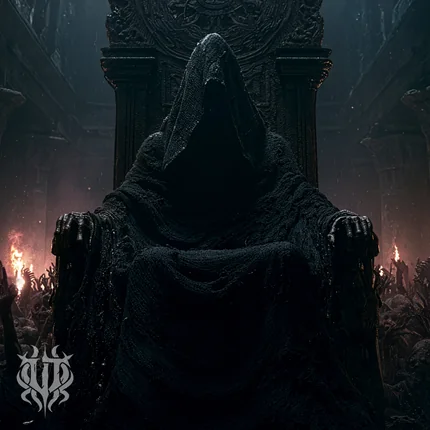
A Thousand Masks is a dark metal song inspired by Nyarlathotep, the Crawling Chaos who walks among humanity, hiding behind countless faces and whispered lies.
References
- The Whisperer in Darkness — original text
The fictional narrative is evidence for what the story says, not proof of events in the real world.
- H. P. Lovecraft Archive — fiction in publication order
First publication dates and venues; issue dates can differ from actual release dates.
- H. P. Lovecraft Archive — fiction in composition order
Composition dates; question marks and ranges retain the source uncertainty.
- At the Mountains of Madness — original text
The fictional narrative is evidence for what the story says, not proof of events in the real world.
At a glance
H. P. Lovecraft
The Whisperer in Darkness
August 1931 · Weird Tales
Pinkish, segmented, winged; convoluted antenna-covered head
Five feet
Vermont hills; extraction and concealed contact
Yuggoth
Brain-preservation cylinders and sensory/speech attachments