

At the Mountains of Madness
A Miskatonic expedition finds an Antarctic civilization older than humanity, then discovers that some of its inhabitants have awakened into a future they cannot recognize. At the Mountains of Madness turns scientific exploration into a reconstruction of alien history and, finally, a desperate encounter with that history’s surviving consequences.
14 min read · 2,760 words
Composition, serialization and the warning narrative
Lovecraft wrote At the Mountains of Madness between February and 22 March 1931. It first appeared in Astounding Stories in three installments, February through April 1936. Its length and extended reconstruction of a civilization distinguish it from the compressed single-incident structure of many shorter tales.
The narrator is William Dyer, the geologist who led the Miskatonic expedition. He writes after the party has returned and after an incomplete public account has circulated. His purpose is to discourage the proposed Starkweather–Moore expedition from entering the same region. The narrative is therefore an intervention in a future decision, not merely a private recollection.
Dyer knows from the beginning that he will have to disclose discoveries he previously concealed. The text repeatedly negotiates that reluctance. Its structure moves from publicly known scientific activity to withheld physical evidence, then to the city and the event that neither Dyer nor Danforth can comfortably explain. The growing disclosure is meant to stop further exploration, although Dyer recognizes that extraordinary discoveries may instead provoke more curiosity.
Sources: H. P. Lovecraft Archive — fiction in composition order, H. P. Lovecraft Archive — fiction in publication order, At the Mountains of Madness — original text
The expedition’s personnel, equipment and aims
The Miskatonic party leaves Boston on 2 September 1930 aboard the Arkham and the Miskatonic. Dyer represents geology; Lake brings biological expertise; Atwood works in physics and meteorology; and Frank H. Pabodie provides engineering knowledge and specialized drilling equipment. Graduate students, mechanics and the ships’ crews support the operation.
Aircraft allow the party to move personnel and equipment across distances that would otherwise severely limit the season’s work. Dogs and sledges remain important for movement on the ground. Wireless communication links the separated parties and carries reports outward through the ships to the press. The expedition’s effectiveness depends on a coordinated technical system.
Pabodie’s apparatus is designed to penetrate material that ordinary collection cannot reach. Its success will expose the strange specimens. The machinery is therefore part of the plot’s causal structure: the hidden past becomes accessible because the expedition has developed a better way to enter the rock and ice.
The initial aims are scientific. The party is investigating geological history and the possibility of evidence beneath the Antarctic surface. The later horror does not simply arrive from outside this program. It is discovered through its successful execution, making the story a crisis within inquiry rather than an argument that the investigators should never have observed carefully.
Lake’s diversion and the mountains
Lake becomes interested in markings whose apparent age and form disturb the expected account of early life. He presses for a westward investigation rather than strict adherence to the planned route. Dyer initially resists the diversion, treating it as a potentially costly interruption, but the later reports persuade him that Lake may have found something decisive.
The sub-expedition encounters a mountain range of extraordinary height and antiquity. From a distance, certain formations appear regular enough to suggest structures, although geological explanations remain available. Atmospheric effects and the difficulty of judging scale make the landscape uncertain before the party finds a city.
Lake’s wireless bulletins carry excitement across the distance. Dyer receives discovery as a sequence of messages rather than through direct observation. The reader shares that mediated position: the scientific description becomes increasingly astonishing while the narrator remains unable to inspect the scene himself.
The mountains first function as a destination, then as a barrier concealing another landscape, and finally as something beyond which Dyer wishes no later expedition to pass. Their changing role gives the title a geographical and psychological development across the narrative.
The fossil cavern and fourteen unusual specimens
Drilling opens a cavern containing a remarkable mixture of remains. Lake discovers barrel-shaped organisms with an elaborate fivefold arrangement and a combination of characteristics that does not fit comfortably into familiar plant and animal categories. He ultimately reports fourteen specimens, eight comparatively complete and six damaged.
Their anatomy receives unusual descriptive attention. A central body supports branching appendages, folded wings and star-shaped structures, while internal examination suggests highly developed organs and nervous organization. The source’s precise observations make them objects of scientific interest before the reader understands them as people with a history.
Preservation becomes one of the puzzle’s central features. Some tissues remain unexpectedly tough and sound despite the inferred age. Heat appears to affect the bodies. The dogs react with intense hostility, introducing a practical problem the human investigators cannot yet explain.
Lake provisionally connects the forms with old mythological descriptions. Such a name does not settle their nature. At this stage the team has morphology, geological context and strange reactions, but no secure knowledge of the organisms’ original society or their remaining capacity for life.
Dissection, interrupted communication and the relief party
Lake begins dissecting one specimen with the limited facilities of a field camp. His account repeatedly revises the categories he tries to apply: structures that initially suggest vegetable organization coexist with features of active animal life. The nervous system implies a level of sensitivity and intelligence far beyond what the expedition expects from remains so ancient.
Preparations continue to bring Dyer and the other men to the discovery. Then the weather worsens and communications fail. Because several sets should be available, sustained silence becomes more alarming than the loss of one transmitter. The separation that made the early bulletins dramatic now makes the party’s helplessness concrete.
Dyer’s relief group reaches a devastated camp. Men and dogs are dead, equipment is disordered, and the eight intact specimens are missing. Six damaged organisms have been buried under strange mounds. Gedney, a graduate student, is also absent, creating a tempting but inadequate explanation involving human violence or collapse.
The public account attributes the disaster to extreme wind. Dyer’s later narrative gradually reveals why that account was incomplete. Weather can explain some damage but not the purposeful, if unfamiliar, treatment of bodies, books, supplies and machinery.
The camp as a scene of alien investigation
The disturbing evidence includes carefully cut human and canine remains, cleaned instruments, opened provisions, altered clothing and attempts to use machines. Some objects are missing in groups that suggest a practical undertaking: sledges, food, fuel, tools, books and other supplies. The apparent disorder contains a pattern, but the human observers initially lack the right agent to explain it.
A man and a dog have been dissected where Lake had examined an ancient organism. The reversal is exact in its implications even though the procedures are unfamiliar. A place where humans classified another body has become a place where unfamiliar investigators classified human and animal bodies.
The buried damaged specimens provide another clue. Their treatment differs from that of the expedition’s dead, suggesting an identification of some bodies as belonging to the investigators’ own kind. Dyer does not recognize the full meaning immediately, but the distinction will become important when he reconstructs the awakening.
The missing Gedney initially bears the weight of speculation because he is the only human member unaccounted for. Later evidence clears him of the camp’s atrocities. The narrative shows how an explanation can look plausible only because the investigators have not yet accepted the existence of the actual participants.
Across the range: the abandoned city
Dyer and Danforth take a lightened aircraft across the mountains. Beyond them lies a vast plateau with an immense city whose surviving forms extend far beyond any ordinary human settlement. The scale implies a civilization with long development, substantial engineering and a relationship to the landscape that predates the present ice.
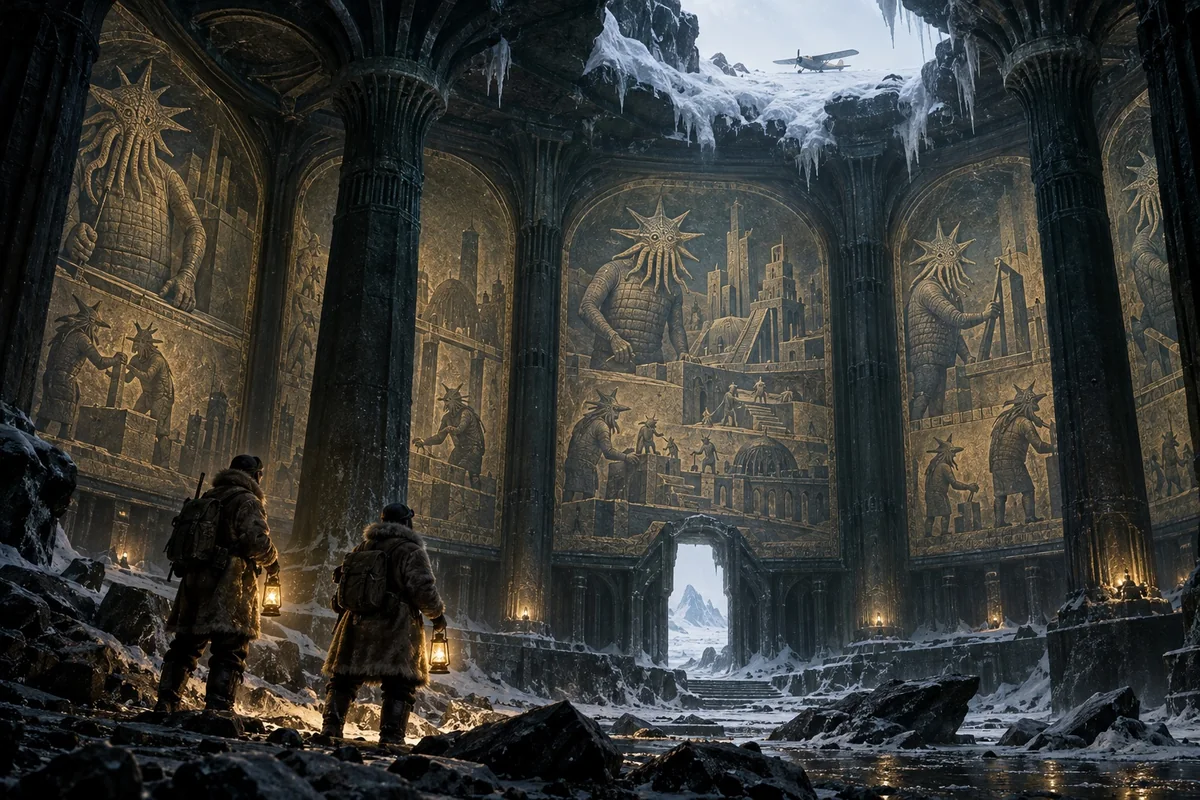
They land and begin exploring the structures. The architecture is organized for bodies unlike theirs, yet it has intelligible purposes. Passageways, inhabited spaces and extensive carved records suggest planning and accumulated work rather than a random heap of monstrous shapes.
The city’s age is not conveyed only through ruins. Successive levels and artistic changes allow the explorers to infer duration within the civilization itself. It had periods of expansion, technical development, conflict and decline. Humanity’s whole historical perspective becomes a small interval inside that larger account.
The expedition’s methods now shift from geology and specimen collection toward archaeology and interpretation. Dyer and Danforth must read an unfamiliar visual language while remaining aware that they cannot recover every nuance. The history that follows is their reconstruction of the carvings, not an omniscient account delivered independently of the explorers.
What the carvings reveal about the Elder Things
The builders are the same kind of beings Lake recovered. Their extraterrestrial origins place them outside the human evolutionary sequence, while their long residence makes them deeply involved in Earth’s biological history. They established themselves in the sea and on land, developed cities and adapted to changing conditions.
The reconstructed history associates them with the creation of early terrestrial life. It also describes shoggoths as engineered organisms used for heavy work. Human origins are thereby displaced from the center of creation: the story’s planetary history does not culminate in humanity as its intended or most significant result.
The builders possess social organization, art, communication and everyday domestic arrangements. Their bodies are alien, but their activities become increasingly recognizable. Dyer can understand craftsmanship, pride, continuity and the desire to preserve a record without requiring the beings to look human.
This recognition changes the emotional register. What began as an anatomical monstrosity becomes a civilization capable of being studied and, to an uncomfortable degree, sympathized with. The elaborate historical middle of the narrative is necessary to that change; without it, the revived specimens would remain only dangerous creatures from a camp.
Wars, changing geography and the retreat beneath the ice
The carvings describe conflicts with other arrivals, including beings identified as Cthulhu’s spawn and the fungi associated with Yuggoth. These episodes give the wider mythology a historical dimension: different nonhuman populations have competing interests, periods of conflict and arrangements that do not reduce to one universal allegiance.
Geological change alters the builders’ position. Continents, seas and climates transform over the immense span represented in the art. The civilization loses or abandons some capacities, and its options narrow. The story’s reconstruction combines cultural history with environmental pressure rather than explaining every decline through one sudden supernatural curse.
The Antarctic population eventually develops a refuge beneath the advancing ice, connected with a subglacial sea. The surface city becomes a record of a world that has moved or disappeared. Routes into the depths promise the recent arrivals a way toward other members of their civilization, while offering the human explorers a more dangerous continuation of the archaeological inquiry.
The geological dates and scientific vocabulary reflect the period and the fiction’s own reconstruction. The invented chronology should not be substituted for modern scientific accounts of life’s origins or Antarctic history. Within the story, its function is to make the human expedition confront a past vastly larger than the one it expected to recover.
Shoggoth labor, rebellion and altered records
Shoggoths were designed as adaptable masses capable of forming temporary organs and carrying out difficult work. Their creators directed them through imposed control. The organisms’ usefulness lay in a flexibility that also made their eventual development dangerous: they could acquire capacities beyond the original role assigned to them.
The history includes rebellion and reconquest. The builders retain power for a time through superior means of control, but the relationship remains a source of instability. In later periods the quality and character of carved work change, suggesting that the production of cultural records no longer belongs exclusively to the original makers.
This history matters when the explorers hear a familiar piping cry in the tunnels. A sound associated with the Elder Things no longer guarantees their presence. Mimicry turns a sign of recognizable civilization into a possible instrument of deception or a survival of voices whose owners are gone.
A reading concerned with domination and created labor is supported by these events, although the story does not present a single explicit political thesis. The narrative’s sympathy for the builders also has limits: recognizing them as civilized does not remove their responsibility for the dependent life they manufactured and controlled.
The fate of the awakened specimens
Tracks, supplies and other evidence connect the missing organisms to the city. The eight intact specimens had revived after an immense period of dormancy. They encountered the expedition as an unfamiliar group of organisms in an incomprehensibly changed environment. Their actions at the camp begin to make sense as defense, investigation and preparation for travel.
They adapted human equipment, gathered provisions and carried specimens of their own. In the city, Dyer and Danforth find the missing sledges and the bodies of Gedney and the dog. Gedney was a transported specimen, not the man responsible for the disaster. That discovery removes the human explanation that had temporarily protected the investigators from the more extraordinary one.
Dyer imagines the awakened beings trying to reach the remnants of home. Their intelligence and resourcefulness become grounds for sympathy even though their treatment of the expedition’s bodies was horrifying. He recognizes a likeness in situation and conduct: they too were investigators forced to confront an unknown world.
The recognition arrives too late to produce contact. The explorers find the recent remains of four beings, killed and mutilated in the underground passage. The source does not settle the fate of all eight through a complete inventory. What it establishes is that the revived scientists themselves encountered a surviving danger within the place they sought as refuge.
The blind penguins and the shoggoth pursuit
Large, pale, blind penguins inhabit the subterranean environment. Their ordinary biological existence makes the tunnels feel like an ecosystem rather than an abstract descent into supernatural space. They also provide signs of movement and disturbance around the explorers, whose own survival depends on interpreting small changes quickly.
Beyond the dead Elder Things, Dyer and Danforth confront a shoggoth moving through the passage. Its immense changing body produces temporary eyes and other structures, while its advance makes the confined route a trap. The historical organism reconstructed from carvings has become a present material force.
The piping cry is revealed as imitation. What might have suggested the survival of the city’s makers comes from the being associated with their destruction. The encounter overturns the reassurance that familiarity can offer: recognition of a sound is inadequate without understanding who can produce it.
The humans flee and regain the aircraft. Their escape depends on distance, speed and the ability to retrace the route, not on defeating the organism. The story preserves the scale of the threat by allowing survival without mastery.
Danforth’s final glimpse and the unresolved farther range
During the return flight, Danforth looks back and sees something Dyer does not. His reaction is severe, and his later speech offers fragments rather than a stable description. The narrative ends by returning to the cry associated with Poe’s Arthur Gordon Pym, placing the experience within another literary history of polar terror.
Dyer attempts to understand the glimpse through atmospheric effects, earlier shocks and the strange landscape beyond the city. He cannot provide an independently observed identification. The farther mountains had already troubled the builders themselves, whose records suggested fear of that region. The ending thus places a further unknown beyond a civilization that has just expanded the human idea of antiquity.
No named later deity can be substituted confidently for what Danforth saw. The story’s refusal to identify it is part of its structure: after a long explanation of one mystery, another remains beyond the narrator’s evidence. The last disclosure is the limit of disclosure.
The warning to Starkweather–Moore therefore concerns more than the organism that pursued the two men. Dyer fears what renewed drilling and exploration might release or expose. His account is an effort to make knowledge impose restraint, even while it demonstrates how powerfully the unknown attracts inquiry.
Scientific method, sympathy and connected reading
The story’s scientific detail is not a removable introduction to the monsters. Equipment determines access, anatomy produces the first questions, wireless reports control the initial pace, and geological and archaeological reasoning reveal the city’s history. The same habits that bring the explorers into danger allow them to understand enough to escape.
Its most striking reversal is ethical as well as intellectual. Dyer begins with bodies he calls monstrous and ends by recognizing fellow investigators. Their unfamiliar appearance no longer determines whether their acts can be understood. That sympathy remains troubling because it includes beings who dissected humans and manufactured subordinate organisms.
The narrative’s larger scale comes from nested histories. The expedition uncovers the builders’ past; the builders’ own records point toward powers they feared; the final glimpse exceeds what the expedition can reconstruct. Explanation enlarges the horizon without eliminating what lies outside it.
The Elder Things, shoggoths and Antarctic city entries develop the associated biology and geography. The Shadow out of Time offers a useful comparison for alien archives and the displacement of human history, while the entries on Dyer and Danforth distinguish the narrator’s evidence from his companion’s unrecoverable final perception.
Sources: At the Mountains of Madness — original text, The Shadow out of Time — original text
References
- H. P. Lovecraft Archive — fiction in composition order
Composition dates; question marks and ranges retain the source uncertainty.
- H. P. Lovecraft Archive — fiction in publication order
First publication dates and venues; issue dates can differ from actual release dates.
- At the Mountains of Madness — original text
The fictional narrative is evidence for what the story says, not proof of events in the real world.
- The Shadow out of Time — original text
The fictional narrative is evidence for what the story says, not proof of events in the real world.
At a glance
H. P. Lovecraft
February–22 March 1931
1936, February–April
Astounding Stories, 16, No. 6 – 17, No. 2
Fiction