

Atlach-Nacha
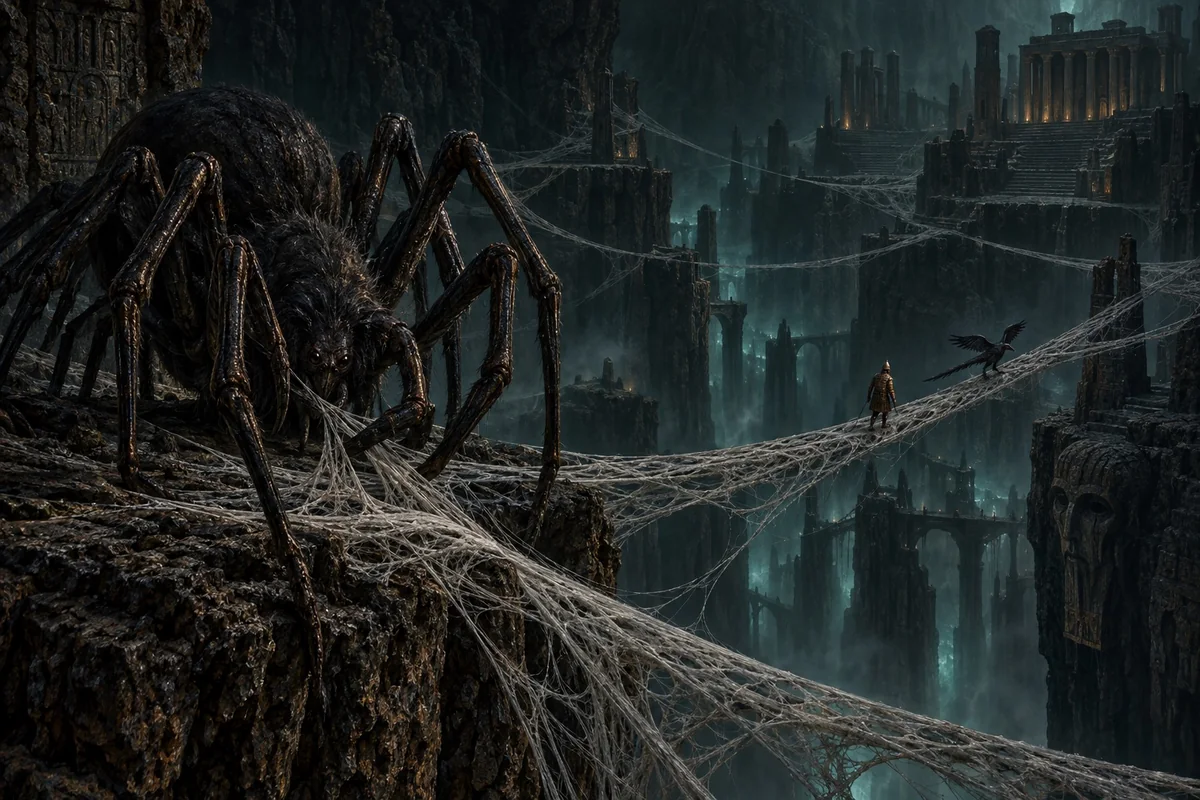
Atlach-Nacha is the spider-god encountered in Clark Ashton Smith’s The Seven Geases. Beneath Mount Voormithadreth, the deity constructs web bridges across a vast subterranean gulf. Its meeting with Ralibar Vooz combines menace with an almost practical impatience: a human sacrifice is less useful than an uninterrupted work schedule and a test of a newly finished crossing.
5 min read · 935 words
A deity below Voormithadreth
Atlach-Nacha enters the story after Ralibar Vooz has been forced into the underworld by the sorcerer Ezdagor. Tsathoggua, to whom the hunter has been sent as a blood offering, has recently eaten and passes him onward under another geas.
The route descends through enormous chambers and past precipices above subterranean waters. Eventually the hunter reaches a gulf whose opposite edge cannot be seen. The bird Raphtontis, his supernatural guide, waits there while he approaches the brink.
This sequence places Atlach-Nacha within a particular underworld itinerary. Tsathoggua occupies an earlier chamber; Haon-Dor's palace lies across a bridge. The story offers these spatial relationships without turning the cavern system into a fully measured geographical survey.
Appearance and movement
Seen at a distance on a web, Atlach-Nacha is approximately the size of a crouching human, with elongated spiderlike limbs. As it approaches, the hunter sees a dark, compact body and a face set low among the jointed legs.
Small eyes surrounded by hair express inquiry and calculation. The face unsettles the hunter because it joins an intelligible attention to an unfamiliar bodily arrangement. The god moves toward him with startling speed, then speaks in a thin, penetrating voice.
The original description supplies a scale and an anatomy considerably more specific than the generalized idea of a gigantic spider. It does not describe a human woman attached to a spider abdomen, a crowned arachnid monarch, or a body large enough to cover a continent.
The web bridges
Great strands connect points along the chasm's edge. Their thickness and intersecting arrangement make them usable as crossings. In the otherwise bridgeless gulf, they provide a route for beings unable to fly.
Atlach-Nacha explains that no one else performs this work and that the task requires eternity. At the time of the meeting, one bridge has just been completed. It reaches the steps leading to Haon-Dor's dwelling on the farther shore.
After sending the hunter across, the god runs along the edge to resume construction elsewhere. Its activity is continuous, and its own explanation emphasizes the scale and duration of the obligation. The narrative does not reveal an employer, a written commission or a complete plan for the structure.
Why the offering is refused
Ralibar Vooz announces that Tsathoggua has sent him as a gift. Atlach-Nacha acknowledges the gesture but does not accept the meal. The hunter remains inside his armor, and extracting him would consume time needed for weaving.
Instead, the god proposes that Haon-Dor might find a use for the visitor. A fresh geas directs Ralibar Vooz to cross the completed bridge and present himself to the sorcerer.
The decision is not an act of human sympathy. The hunter is redirected because the practical inconvenience of consuming him outweighs the immediate benefit. His survival at this stage depends on circumstances that he neither intended nor controls.
A human used as a structural test
Atlach-Nacha gives the crossing an additional purpose: the hunter's weight will test the new weaving. The body offered as food becomes a load placed on a bridge.
Ralibar Vooz follows Raphtontis across strands that move slightly beneath him. Through their gaps he glimpses forms in the darkness below, including shapes resembling winged dragons and less identifiable masses. The crossing is frightening but successful.
At the opposite side, a huge serpent guards the steps to Haon-Dor's palace. It recognizes or accepts the bird and allows passage. Atlach-Nacha's bridge therefore joins two distinct supernatural domains without implying that the spider-god rules everything at either end.
The later crossing and the fall
After further encounters, Abhoth orders the hunter to leave for the Outer World. Raphtontis leads him along a return route that avoids several of the places visited during the descent, but once again reaches the web-spanned gulf.
Some of Abhoth's offspring follow, growing larger as the journey continues. A heavy, slothlike creature has already crossed the web immediately ahead of the hunter. Its passage has weakened and damaged the strands.
Pressed by the pursuing offspring, Ralibar Vooz hurries onto the bridge and fails to notice its condition. Near the farther edge the weaving gives way, and he falls with broken strands still in his hands. The final catastrophe is a failure of a particular damaged crossing, not a narrated decision by Atlach-Nacha to execute him.
The geas does not guarantee success
The sequence exposes a distinction between compulsion and protection. A geas can force Ralibar Vooz to undertake a journey and pronounce an appointed message; it does not automatically make his body invulnerable or ensure that the route remains passable.
Atlach-Nacha's first bridge bears him safely. The return crossing fails after another creature has strained it. Even supernatural workmanship remains embedded in material circumstances within the story.
This limits what can be inferred about the deity's power. It can speak, move rapidly, weave extraordinary bridges and impose a geas, but the tale does not demonstrate omniscience or universal control over every strand at every moment.
What the story leaves outside its account
The Seven Geases does not provide a human cult organization devoted to Atlach-Nacha, a ritual calendar, a genealogy or a scene of the final completion of all its webs. It also does not state that completing the weaving will end the world.
Such claims require their own later sources if included in a wider account. The source presented here establishes the ongoing bridge-making and the hunter's two crossings. Keeping that boundary clear lets the vivid original episode stand without replacing it with an uncredited synthesis of adaptations.
References
- Clark Ashton Smith — The Seven Geases (1934)
Original story; the host identifies these texts as believed to be in the public domain.
At a glance
Clark Ashton Smith
The Seven Geases
Weird Tales, October 1934
A chasm beneath Voormithadreth
Weaving bridges across the gulf
Ralibar Vooz, guided by Raphtontis