

Mount Voormithadreth
Mount Voormithadreth is the immense volcanic mountain above the underworld journey in Clark Ashton Smith’s The Seven Geases. Its upper caves house the Voormis; its concealed precincts shelter the magician Ezdagor; beneath it stretch the domains of Tsathoggua, Atlach-Nacha, Haon-Dor, the serpent-people, the Archetypes and Abhoth. A hunting expedition becomes a descent through increasingly alien measures of human value.
5 min read · 957 words
Position in Hyperborea
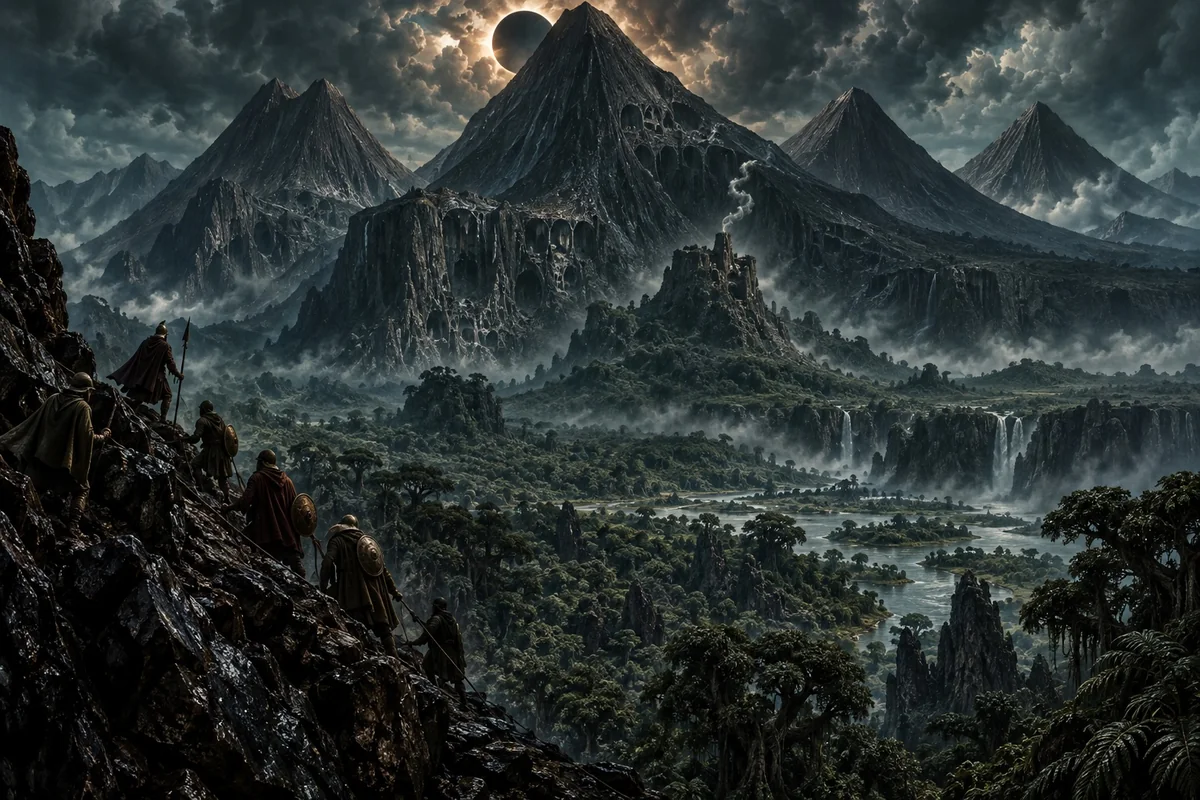
Voormithadreth is the highest and most formidable of the Eiglophian Mountains. Ralibar Vooz and his twenty-six retainers reach the mountains after a day's journey from Commoriom, leaving the lesser game of the intervening jungle behind.
Sources: [1]
The mountain has four volcanic cones whose craters are considered extinct. Its dark rock interrupts the afternoon sun and blocks the sunset. The expedition camps beneath the lower crags, keeping fires and watch while listening to the hunting cries of the Voormis above.
The story's geography begins at this human scale of marching, camping and climbing. Only later does the mountain become the entrance to spaces that cannot be understood through the dimensions of the visible peak alone.
Lava, obsidian and defended caves
Black lava and glassy surfaces make the ascent difficult. In the hot sun the rocks burn the climbers' hands, while cliffs repeatedly rise beyond their apparent objective. Ropes, grappling hooks and carefully chosen approaches become essential.
The Voormis occupy narrow, dark caves high in the rock. They can throw material down upon attackers and defend the interior at close quarters. Ralibar Vooz decides that one group of openings can best be reached from above, requiring a dangerous climb through a chimney and onto the summit edge of a buttress.
This detailed physical obstacle prepares the later loss of control. The hunter begins by treating the mountain as a tactical problem, choosing equipment and a route; after the geas, he must cross its dangers according to commands imposed by others.
Sources: [1]
The disputed origins of the Voormis
The mountain is named for the Voormis who inhabit its caverns. Their cries and the remains thrown from their dens make them frightening adversaries to the hunters. Ralibar Vooz has hunted them before and keeps their pelts as trophies.
His attendants repeat stories that connect their ancestry with beings from the caverns beneath the mountain. The magistrate dismisses these accounts and prefers an explanation involving a degraded population displaced by the Hyperboreans.
Both explanations are voiced within the narrative's human social world. The expedition does not establish their truth through an independent investigation, and the hunters' dehumanizing language reflects their own attitudes toward those they pursue.
Sources: [1]
Ezdagor’s protected dwelling
On a broad buttress, Ralibar Vooz notices a thin spiral of smoke. The apparent distance to it keeps changing as he advances among rocks that seem to alter their arrangement. His companions' replies become faint and then disappear.
He eventually finds an old magician beside a fire burning on an obsidian block, with a rough shelter behind him and the bird Raphtontis on a nearby carved stone. He has interrupted an evocation and driven away the beings with whom Ezdagor was communicating.
The magician says that twelve interlocking circles of illusion protect the place and that the encounter should have been exceedingly unlikely. The mountain now contains a space whose accessibility depends on more than climbing skill or line of sight.
Sources: [1]
The forced entrance into the underworld
Ezdagor punishes the interruption with a geas. Ralibar Vooz must abandon his weapons, pass through the Voormis' dens and offer himself to Tsathoggua. He may retain his armor so that he reaches the intended recipient in suitable condition.
Raphtontis guides him. The Voormis avoid attacking the bird, and its presence partly protects the hunter as he climbs and enters the cave. Within, however, he must fight his way forward without his former arsenal.
The passage slopes down until the attackers are left behind. The air acquires mineral odors, and the darkness gives way to a dim unexplained radiance in an underground hall. That transition marks the beginning of the deeper journey.
Sources: [1]
The inhabited depths
Tsathoggua rests among the remains of previous victims but declines the new offering because his hunger is satisfied. He sends the hunter downward to Atlach-Nacha, whose webs bridge an otherwise impassable gulf.
Across the gulf stands Haon-Dor's palace, with a serpent guarding the approach, immense halls and familiars emerging from walls and floor. Beneath it are the working caverns of serpent-people engaged in chemical and metallurgical activity.
The sequence leads farther down to the Cavern of the Archetypes, where landscape and creatures have an unstable, preliminary materiality. Abhoth's pool occupies another cavern at the same general depth. These places form the visited route, not an assertion that no other regions exist.
Sources: [1]
A route through the seven commands
The chain begins with Ezdagor's order to seek Tsathoggua. Tsathoggua sends the hunter to Atlach-Nacha; Atlach-Nacha sends him to Haon-Dor; Haon-Dor sends him to the serpent-people; the serpent-people send him to the Archetypes; the Archetypes send him to Abhoth; Abhoth orders him back toward the Outer World.
Each recipient finds the visitor unsuitable for its immediate purposes. The order of encounters steadily strips his human rank of significance. A royal relative and accomplished hunter becomes a rejected offering, an unneeded laboratory specimen and an unwelcome copy of a supposed original.
This is the narrative hierarchy that matters within the mountain. It organizes successive reversals rather than a reliable ranking of the inhabitants' absolute power.
Sources: [1]
The incomplete return
Raphtontis chooses a shorter route back, avoiding several of the earlier chambers. The journey still requires another crossing of Atlach-Nacha's gulf.
A heavy creature has damaged the chosen web, and growing offspring of Abhoth pursue the hunter from behind. He runs across too quickly to inspect the strands. The bridge breaks, and the last geas fails to deliver him safely to the surface.
The mountain does not close neatly around a solved mystery. Ralibar Vooz has experienced its inhabitants without mastering its geography or surviving to report a complete account to his companions.
Sources: [1]
References
- Clark Ashton Smith — The Seven Geases (1934)
Original story; the host identifies these texts as believed to be in the public domain.
At a glance
Clark Ashton Smith
Eiglophian Mountains
Four-coned volcanic mountain
Voormis; the sorcerer Ezdagor in a concealed precinct
The Seven Geases
A narrated itinerary, not an exhaustive atlas