

Hatheg-Kla
Hatheg-Kla is the remote mountain whose summit Barzai attempts to reach in The Other Gods. The earth’s gods revisit it from Kadath, while an encounter with their protectors transforms a difficult climb into a catastrophic upward fall. The mark left on its summit preserves evidence that later visitors can see without explaining what took Barzai.
3 min read · 581 words
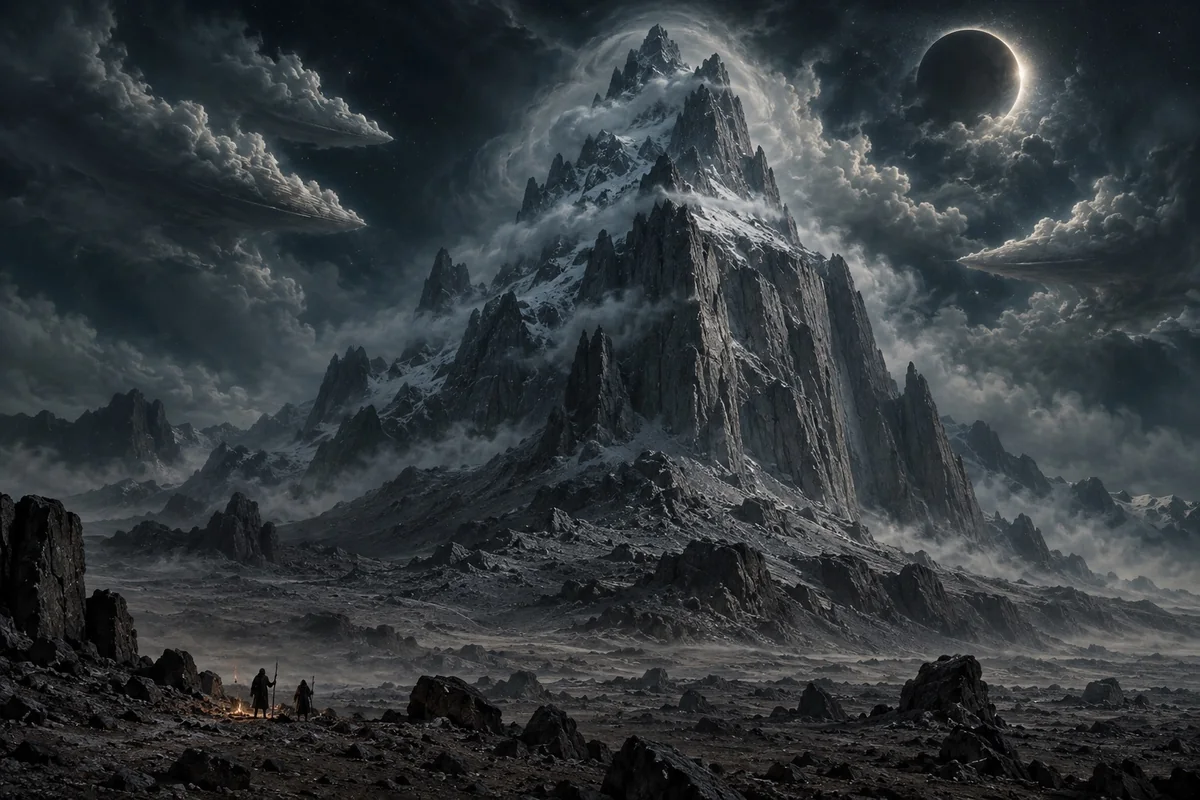
Location and former divine residence
The mountain stands in the stony desert beyond Hatheg, from which its name derives. Barzai and Atal reach its base on the thirteenth day of their journey from the settlement. That duration belongs to their particular expedition, not a standardized travel time for all visitors.
The earth’s gods formerly lived there and continue to return in cloud-ships because they miss their old homes. Their permanent refuge is now unknown Kadath. Hatheg-Kla is consequently a place of visits and remembered residence, not another name for Kadath.
Mists surround its summit, and local people associate cloud-covered nights with particular danger. The opening’s description of divine nostalgia makes those mists and winds signs of a remembered history as well as atmospheric effects.
The physical ascent
The lower climb is made hazardous by broken rock, cliffs, falling stones and chasms. Higher up, snow, cold and thin air slow the travelers. They use staves and axes and spend three days ascending before waiting for the right conditions.
After four clear nights, clouds gather at the full moon. Barzai climbs toward the concealed summit, leaving the more reluctant Atal behind. The final obstacle visible to Atal is an overhanging cliff beyond which his teacher disappears.
These material details prepare the later reversal. What begins as an exhausting ascent against gravity becomes an unnaturally easy movement upward. The danger changes from falling down the mountain to being drawn beyond it.
The eclipse and disappearance
Atal hears Barzai claim that the earth’s gods fear him, then hears his confidence collapse during an unpredicted eclipse. Barzai identifies the Other Gods and warns his disciple not to look.
A tremendous thunderclap reaches the surrounding communities. When the moon reappears, Atal is on the lower snowfields and Barzai is gone. No witnessed body or ordinary fall resolves the disappearance.
The account leaves the summit as a boundary where familiar physical relations fail. Describing it as a permanent portal with a controllable destination would impose a system the narrative never provides.
The carved sign and the earlier climber
The Pnakotic Manuscripts mention Sansu, who climbed the mountain in the youth of the world and found rock and ice. Searchers looking for Barzai later find an immense symbol, fifty cubits wide, cut into the bare summit.
Learned observers recognize a resemblance to a sign in ancient, unreadable portions of the same manuscripts. The visual correspondence survives even though its textual meaning cannot be recovered.
The story does not identify a human carver or narrate the moment when the sign was made. The Dream-Quest later treats the event as one of the occasions when the Other Gods set their seal on the earth’s granite, providing an additional interpretive layer.
Sources: The Other Gods — Unspeakable Tales ebook, The Dream-Quest of Unknown Kadath — original text
An enduring warning
After the expedition, Ulthar, Nir and Hatheg retain a fear of eclipses and obscured summits. The earth’s gods nevertheless keep visiting Hatheg-Kla, knowing themselves safe.
Atal later uses Barzai’s fate to warn Carter against approaching Kadath. The contrast is essential: if a human can disappear while seeking gods at a mountain they sometimes visit, entering their secluded stronghold promises still greater danger.
Hatheg-Kla therefore contributes both a specific landscape and a precedent. Its importance rests on a narrated failure of confident exploration, not on a long invented list of cults, resident monsters or repeat expeditions.
Sources: The Other Gods — Unspeakable Tales ebook, The Dream-Quest of Unknown Kadath — original text
References
- The Other Gods — Unspeakable Tales ebook
The fictional narrative is evidence for what the story says, not proof of events in the real world.
- The Dream-Quest of Unknown Kadath — original text
The fictional narrative is evidence for what the story says, not proof of events in the real world.
At a glance
Stony desert beyond Hatheg
Barzai and Atal
Sansu
A symbol fifty cubits wide
A former home revisited by the earth’s gods