

The Nameless City
An explorer enters an unnamed ruin in the Arabian desert and follows an underground route into the history of its reptilian builders. He repeatedly mistakes evidence of a nonhuman civilization for the symbolism of a human one. The Nameless City combines archaeological discovery, immense antiquity and a final encounter that turns recurring desert winds into something alive and hostile.
7 min read · 1,339 words
Composition and first publication
Lovecraft wrote The Nameless City in January 1921. It first appeared in the November 1921 issue of The Wolverine. The unnamed narrator recounts an expedition he survived but cannot remember or explain completely.
The opening introduces Abdul Alhazred as a poet associated with a dream of the city. It includes the famous couplet concerning death and immense stretches of time, but does not name the Necronomicon. This makes the story important to the later network of invented references without giving it every detail subsequently attached to that network.
Sources: H. P. Lovecraft Archive — fiction in composition order, H. P. Lovecraft Archive — fiction in publication order, The Nameless City — original text
Arrival beyond the warnings
The explorer reaches the ruins by moonlight with a camel. He knows that local people avoid the place, yet his determination to find it has overcome their warnings. On arrival, satisfaction gives way to an immediate sense of danger.
He waits outside until dawn. A small storm of sand moves among the stones while the rest of the desert remains still. As the sun appears, he thinks he hears a distant metallic sound.
His first excavations reveal no writing or sculpture that can explain the civilization. The absence frustrates him because he wants evidence that the ruins were built by human beings. Their unsettling proportions already make that assumption uncertain.
Sources: The Nameless City — original text
The recurring winds
At night the explorer withdraws beyond the walls, disturbed by another localized movement of cold air and sand. The following dawn repeats the earlier pattern.
The recurrence gives the site a rhythm independent of his investigation. At first he can treat the disturbance as a peculiarity of the terrain, but it remains anomalous because the surrounding landscape is quiet.
Later, while exploring the rock temples, he sees the sand moving from a particular entrance. Tracing the wind offers him a practical way to discover what lies beneath the ruins. The same force that warned him away becomes the means by which he enters more deeply.
Sources: The Nameless City — original text
The low temples
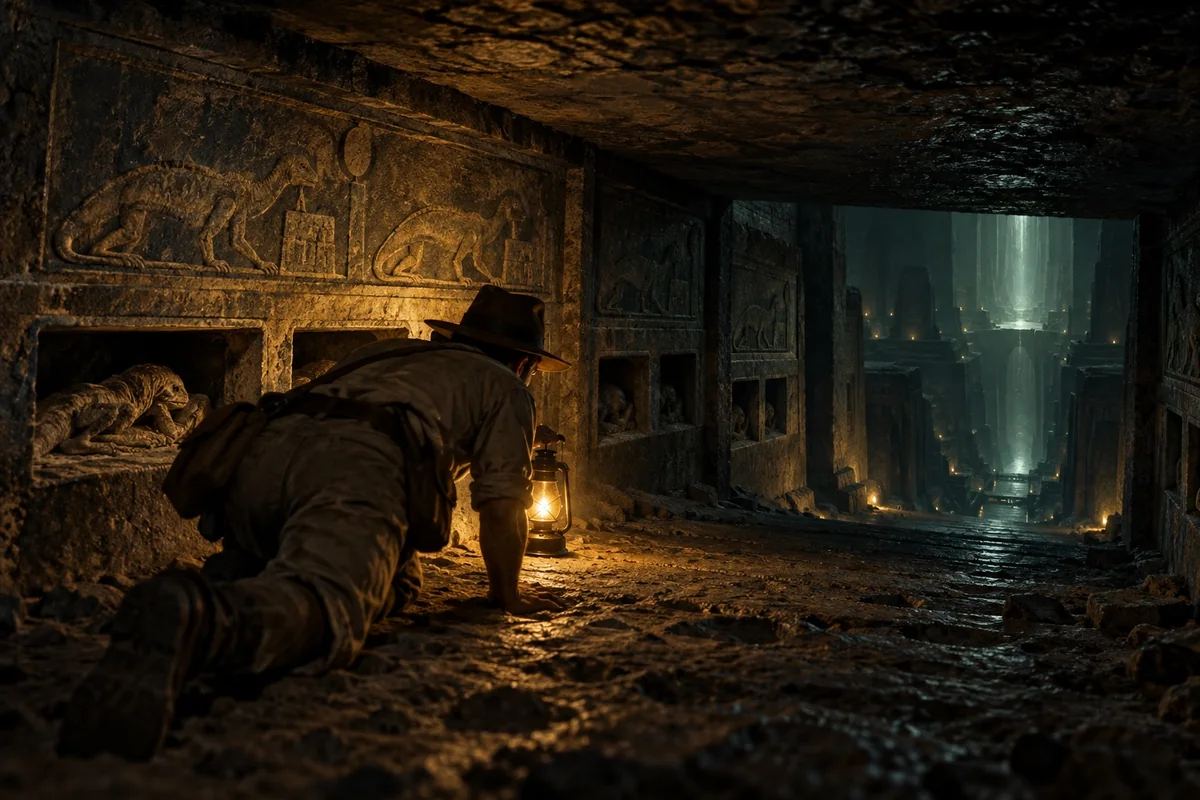
A cliff face contains several small entrances choked with sand. Inside the first chambers he finds altars, pillars, niches and worked stones. Their arrangement indicates religious use, though the rituals remain unexplained.
The ceiling is too low for standing and barely allows kneeling. The visitor initially interprets this as an unusual ceremonial requirement. That explanation permits him to maintain a human model of the vanished society.
The larger temple from which the wind emerges contains traces of painting and carved designs. A further door cut into solid rock reveals a stairway. The engineered route proves that the wind comes through a connected underground system rather than an isolated chamber.
Sources: The Nameless City — original text
Descent beyond the torchlight
The steps are small and steep. The explorer descends feet first, passes through a cramped level stretch and continues until the torch burns out. He has lost a reliable sense of both time and distance.
Fragments of reading accompany him in the dark. His mind moves among Alhazred, older literary references and familiar imaginative descriptions of abysses. These recollections give him language for the experience while also intensifying its associations.
When the passage levels, he feels smooth wood and glass along its sides. The materials imply deliberate preservation and craftsmanship in a place he had imagined only through extreme age. He follows the corridor until a glow ahead begins to reveal its contents.
Sources: The Nameless City — original text
The cases and the nonhuman bodies
The light discloses elaborate paintings and rows of glass-fronted cases. Inside lie preserved reptilian beings dressed and ornamented with evident care.
Their bodies suggest several familiar animals without corresponding exactly to any. Flexible forefeet resemble hands; the heads combine horns, prominent foreheads, absent noses and long jaws. Their size and posture fit the low architecture much better than the narrator’s own body does.
He first wonders whether they are artificial images. Once he accepts that they are preserved organisms, he still treats their prominent role in the paintings as allegorical. The interpretive retreat shows how strongly he resists the simplest connection between architecture, bodies and art.
Sources: The Nameless City — original text
A civilization’s migration
The murals appear to recount the city’s history from a fertile coastal beginning through the advance of desert. Wars, prosperity, setbacks and engineering works form a long communal record.
Eventually the inhabitants cut downward toward a new realm described in the paintings as a place of light and magnificent landscapes. The corridor through which the visitor has traveled is recognizable within their history.
The later pictures preserve longing for the abandoned city and growing anger at the world above. Their declining technical quality and increasingly hostile imagery suggest a society changed by retreat and loss. A scene of a human victim provides an ominous warning about how an outsider might be received.
Sources: The Nameless City — original text
The threshold of another world
The corridor opens through a monumental brass door onto a luminous gulf. Small steps descend into bright vapor, beyond which the explorer can see no definite ground or buildings.
The apparent immensity contrasts with the cramped route behind him. He is exhausted and pauses at the threshold, reflecting on what he has seen. The ruins’ low dimensions now become harder to explain as religious symbolism alone.
He notices that the only human figure in the entire painted record is the victim of violence. The supposed animals are everywhere else performing the activities of a civilization. His earlier explanation begins to collapse even before the final encounter makes that collapse unavoidable.
Sources: The Nameless City — original text
The dawn current
A moaning sound approaches from the upper passages, followed by a rapidly strengthening cold current. Consulting his watch, the traveler realizes that dawn is near and connects the movement with the periodic winds on the surface.
That apparently natural explanation briefly steadies him. The force soon becomes strong enough to push him toward the open abyss, however, and he struggles against it on the stone floor.
The wind seems full of hostility. He remembers the mutilated human figure in the mural and fears that the same ancient resentment now surrounds him. His familiar language and reasoning give way to the repetition of Alhazred’s couplet.
Sources: The Nameless City — original text
The figures against the light
The voices acquire a more articulate quality. Turning toward the luminous opening, the narrator sees partly transparent reptilian figures passing through it, identifiable with the beings in the cases and paintings.
The great brass door closes behind the last of them. Its metallic resonance explains the sound that reached the desert at sunrise. The architecture and atmospheric cycle have become elements of a continuing passage between the abandoned city and the world below.
The narrator does not provide a coherent account of how he escaped. His existence as the teller establishes survival, while the missing interval preserves the extremity of the experience. He remains disturbed whenever the night wind rattles his windows.
Sources: The Nameless City — original text
Human assumptions as the obstacle to knowledge
The explorer is not prevented from discovering evidence. He finds enough to infer the builders’ nature well before admitting it: appropriately scaled rooms, practical passageways, preserved bodies, clothing and a consistent pictorial history.
His difficulty is the demand that civilization must ultimately refer to human beings. Allegory becomes a way to protect that demand rather than an interpretation compelled by the material itself.
The final recognition therefore changes more than the identity of a monster. It revises who can possess architecture, history, religion and an attachment to place. The terror arises partly from encountering inhabitants whose achievements have been denied by the visitor’s expectations.
Sources: The Nameless City — original text
Deep time and the unfinished past
The ruin’s age repeatedly exceeds the landmarks by which the narrator tries to measure it. Familiar ancient civilizations become comparatively recent, while the paintings imply former coastlines and lands beyond remembered history.
Yet immense age does not guarantee inactivity. The recurring wind and closing door show that the site participates in an ongoing process. What appears deserted from the surface is connected with presences that still respond to it.
This combination anticipates a recurring pattern in Lovecraft’s later fiction: an investigator reads architecture or images as the record of an extinct world, then discovers that the record is also evidence of a continuing claim upon the present.
Sources: The Nameless City — original text
References
- H. P. Lovecraft Archive — fiction in composition order
Composition dates; question marks and ranges retain the source uncertainty.
- H. P. Lovecraft Archive — fiction in publication order
First publication dates and venues; issue dates can differ from actual release dates.
- The Nameless City — original text
The fictional narrative is evidence for what the story says, not proof of events in the real world.
At a glance
H. P. Lovecraft
January 1921
1921, November
The Wolverine, No. 11
Fiction