

Ngranek
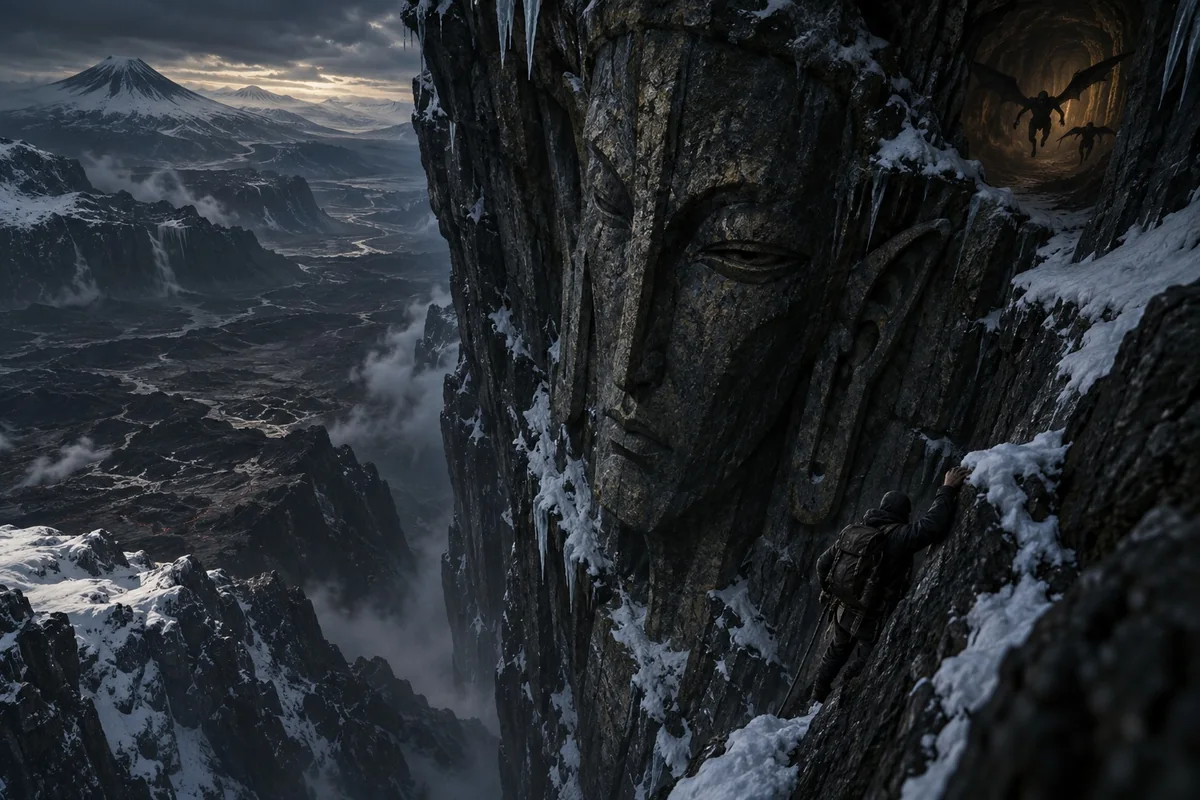
Ngranek is the mountain on Oriab whose hidden cliff bears an immense carved likeness of the earth’s gods. Carter climbs it to learn the features of the divine race, but the night-gaunts inhabiting its high caves carry him away into the Great Abyss.
4 min read · 701 words
The clue disclosed by Atal
Carter first hears about the image from Atal in Ulthar. After drinking the moon-wine Carter supplies, the old priest becomes less guarded and describes a likeness said to have been carved by the gods themselves. Atal suggests that its unusual features reveal their race. Carter reasons that the human descendants of gods should preserve similar features and might therefore point him toward Kadath.
Sources: [1]
The mountain’s importance is evidential: it offers an image that could be compared with living faces elsewhere. Carter is not told that Kadath stands on Oriab or that Ngranek is another name for it. His proposed route depends on an intermediate discovery, and the geography of the quest repeatedly frustrates any assumption that learning one clue immediately reveals the final destination.
Volcanic past and difficult terrain
Ngranek rises jagged and snow-crowned above Oriab. Sparse trees and shrubs give way to bare rock, broken lava, cinders and high ice. The narrative attributes an extremely ancient volcanic past to the mountain, but presents it as silent during Carter’s visit. Lava gatherers still collect material from lower reaches for the island’s image makers.
The carved face is on a difficult side overlooking sheer cliffs and a bleak valley. Local accounts emphasize that many travelers repeat its legend without actually having seen it. The mountain’s appearance from a ship or a village is not equivalent to reaching the hidden carving. Carter must pass beyond the range of ordinary work and make a hazardous climb to obtain the information he wants.
Sources: [1]
Abandoned settlements and the night-gaunt warnings
The approach includes empty brick villages once occupied by people who worked and carved the mountain’s lava. As settlement spread higher, more inhabitants disappeared. The remaining people withdrew to Baharna, taking their craft with them. A recent disappearance among the lava gatherers repeats the pattern: a man who climbed above his companions does not return, and searchers find his turban without evidence of a fall.
The workers associate such losses with night-gaunts, although the beings retain an uncertain, almost legendary reputation in their speech. Their warnings distinguish these disappearances from the blood-draining attack Carter experienced at the ruins beside Lake Yath. Night-gaunts are not identified as the creatures that killed his zebra. Near the mountain he also hears a voonith at a distant pool, but has been told that those amphibious creatures avoid Ngranek’s slopes.
Sources: [1]
The climb and the divine likeness
Carter takes his replacement zebra as far as the route permits, then leaves it tethered and climbs alone. The ascent forces him onto increasingly difficult rock until he can reach the mountain’s hidden side. The enormous face confirms that the story told in Ulthar has a material object behind it.
Its long features, narrow eyes and extended ears recall a race of sailors Carter has seen trading in Celephaïs. This recognition changes the direction of the quest. Ngranek does not simply provide a spectacle to admire: it connects remembered human faces to the alleged appearance of the gods. Carter now has a reason to seek the northern traders and the country from which they come.
The logic belongs to the narrative’s divine genealogy. It should not be converted into a real-world claim that facial structure establishes supernatural ancestry. Within the story, recognition is the practical link between the image on Oriab and the later voyage to Inganok.
Sources: [1]
Abduction and the underworld connection
Before Carter can descend normally, night-gaunts seize him. Their faceless, winged bodies and grasping limbs make the rumors unmistakably concrete. They carry him away through darkness and eventually deposit him in the bone-filled Vale of Pnath. The mountain’s caves thereby connect the inhabited island with an underworld whose extent Carter must learn by surviving it.
The abduction also has a delayed consequence. Later, when Carter sees similar high caves near the mountains dividing Inganok and Leng, he notices that shantaks fear them. Frescoes and ghoul testimony help him recognize the same night-gaunt network. What first appears only as a disaster becomes information that his eventual allies can use. Ngranek’s role extends from the initial clue to the knowledge enabling his northern passage.
Sources: [1]
References
- The Dream-Quest of Unknown Kadath — original text
The fictional narrative is evidence for what the story says, not proof of events in the real world.
At a glance
Oriab
A colossal carved divine face on a difficult cliff
Night-gaunts in the high caves
Lava used for carved images
The face helps Carter recognize the sailors of Inganok