

Night-gaunts
Night-gaunts are silent, faceless, winged creatures whose disturbing touch and aerial abductions recur in Lovecraft’s dream imagery. In The Dream-Quest of Unknown Kadath they first carry Randolph Carter into the subterranean darkness, but later become essential allies through their connection with ghouls and their allegiance to Nodens.
7 min read · 1,348 words
Appearance and physical presence
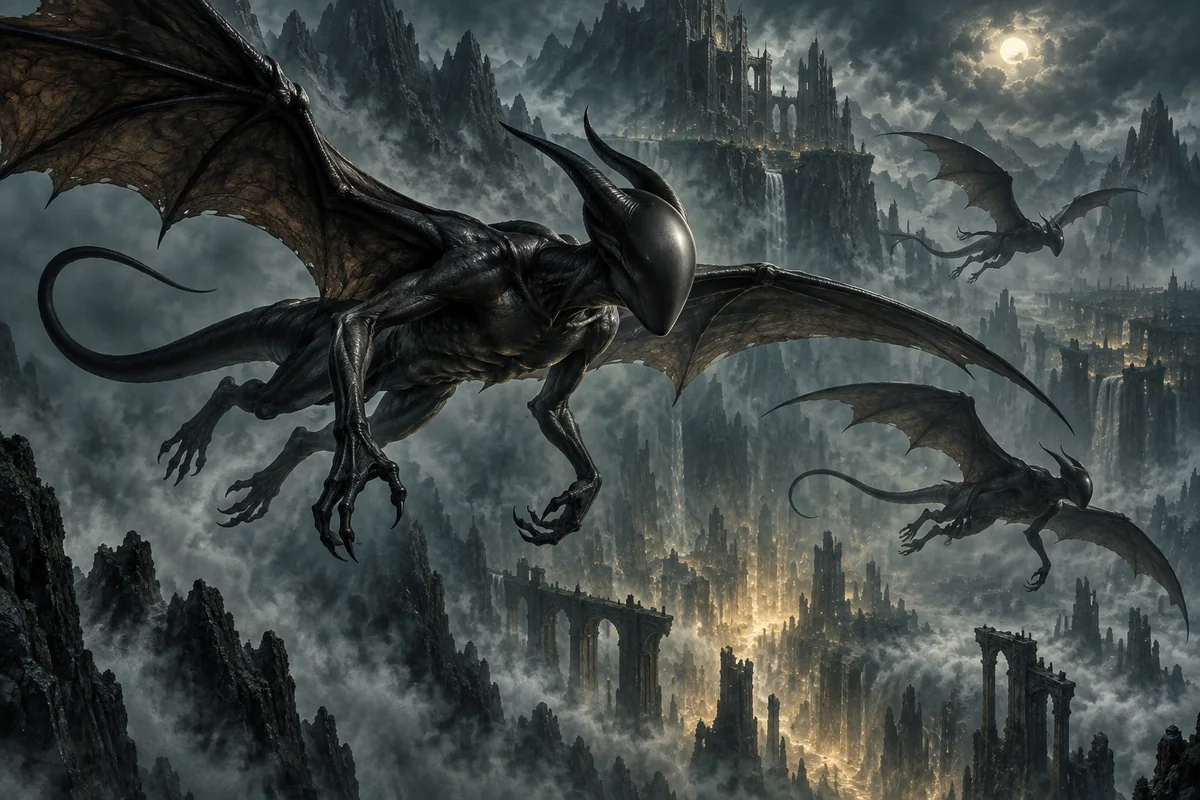
The Dream-Quest describes black bodies with smooth, oily surfaces resembling whale skin, inward-curving horns, membranous bat-like wings, grasping paws and long barbed tails. The place where a face would normally appear is blank. There are no visible expressions to interpret and no spoken reassurance or threat.
Their contact is cold, damp and rubbery. Carter experiences their bodies and paws at close range when they seize his neck and feet and carry him from a mountainside. The description makes touch almost as important as sight: the traveler is surrounded by beings whose movements he can feel but whose intentions he cannot read.
The wings beat without audible sound. This silence extends to the creatures themselves, which neither converse nor laugh during his captivity. Their horns, wings and tails suggest a recognizable demonic outline, while the missing face removes the familiar human feature that would ordinarily give that outline a personality. The story supplies no universal height, weight or numerical measure of their strength.
The guardians of Ngranek
Carter encounters the night-gaunts while climbing Ngranek on the island of Oriab. He hopes to inspect the enormous face carved on the mountain, believing that its features will help him recognize the descendants of the gods among human travelers. His concentration on that image leaves him exposed on the remote mountainside.
The creatures emerge from an inaccessible opening in the rock and carry him through the cavern into a labyrinth. They then descend through enormous underground spaces toward the Peaks of Thok. The flight moves from starlight through a dim subterranean radiance into near-total darkness.
Their destination is the Vale of Pnath, where they leave Carter on accumulated bones. The narrative identifies this transportation as the duty of the night-gaunts guarding Ngranek. It does not present the abduction as an attempt to feed on his blood or consume his body. The danger continues after they depart because the valley contains other, less visible inhabitants.
Tickling, restraint and helplessness
When Carter struggles, his captors deliberately tickle him. His cries lead to more refined applications of the same treatment. The behavior makes an apparently minor bodily sensation into a means of control, particularly because the victim is suspended above abysses and cannot simply pull away.
This is not playful interaction from Carter’s perspective. His inability to direct the flight, stop the touching or obtain a response turns the experience into an assault on bodily autonomy. The creatures’ silence makes it impossible to judge whether they enjoy his distress or merely perform a habitual task.
The tails are conspicuous in the physical description, but the account also explicitly identifies the paws as instruments of tickling. A rigid rule that only the tail can produce this effect would narrow the original evidence. Similarly, there is no need to invent a poison or supernatural paralysis to explain the helplessness portrayed in the scene.
Communication and recognition
Later encounters demonstrate that the night-gaunts can understand more than Carter first realizes. Richard Upton Pickman provides knowledge of the ghouls’ ways, including the means of establishing friendly contact with their winged associates. When Carter gives the appropriate sign or password during another seizure, the creatures immediately change their treatment of him.
They stop tormenting him, arrange their hold more comfortably and respond to his requests. His information about captured ghouls produces purposeful action rather than random flight. On reaching the ghouls’ territory, the night-gaunts wait around him while he explains what has happened.
The narrator sometimes describes them in terms that suggest blankness or mindlessness. Their practical behavior nevertheless includes recognition, cooperation and obedience to instructions. An encyclopedia should preserve that tension instead of turning a frightening impression into a rule that they are incapable of understanding anything.
Nodens and the limits of Nyarlathotep’s authority
The Dream-Quest explicitly places the night-gaunts under Nodens, Lord of the Great Abyss. Carter learns more about their position through images in the monastery on Leng and later uses that information when planning his approach to Kadath.
Their lord is distinguished from Nyarlathotep. This matters because much of Carter’s journey involves beings whose activities ultimately serve the Crawling Chaos. The night-gaunts offer a possible means of crossing territory where those other powers would normally obstruct him.
The Great Ones fear them, and shantaks recoil from their presence. These relationships provide advantages in particular situations, but they do not establish an absolute ranking in which every night-gaunt is stronger than every god. The story presents overlapping loyalties and fears rather than a universal table of combat values.
Alliance with the ghouls
The night-gaunts are closely associated with the ghouls of the lower world. Their ability to carry passengers allows the two groups to operate together across distances and obstacles that would defeat travelers on foot. Carter benefits from that relationship because Pickman and other ghouls have reasons to trust him.
When three ghouls are held by the moon-beasts near Sarkomand, Carter brings news to their companions. A combined response follows. Night-gaunts provide movement and military assistance, while ghouls conduct much of the fighting and organization. The resulting campaign reveals social relationships that are invisible during Carter’s first terrifying flight.
After the fighting, night-gaunt sentries remain among Sarkomand’s ruined columns and sphinxes. More are summoned to carry the surviving ghouls. These scenes give the creatures a role in guarding, transport and collective action; they are not confined to abducting solitary dreamers.
The proposed flight to Kadath
Carter asks the ghouls for enough night-gaunts to take him across the northern barriers toward Kadath. His argument draws together knowledge acquired at different stages of the journey: shantaks fear the winged creatures, the night-gaunts answer to Nodens, and the gods themselves regard them with anxiety.
The request converts a former source of terror into a practical route through hostile geography. Carter has not domesticated an entire species. He has earned assistance from particular allies and learned how their relationships can serve his quest.
This reversal is characteristic of the novella’s treatment of the unfamiliar. The outwardly repulsive may help him, while an apparently authoritative guide can betray him. The night-gaunts retain their disturbing bodies and uncanny silence even after their behavior becomes helpful.
Night-gaunts in Fungi from Yuggoth
Sonnet XX returns to a more concentrated nightmare. Its speaker is carried away by black, horned, rubbery beings with wings and forked barbs on their tails. The flight passes the Peaks of Thok and descends toward a lake where shoggoths lie in troubled repose.
The poem focuses on recurrence, involuntary travel and the intolerable absence of faces and voices. It does not develop the ghoul alliance or the extended negotiations found in The Dream-Quest. The two presentations share imagery without requiring every destination to be identical: the sonnet’s lake should not automatically be substituted for the novella’s bone-covered Vale of Pnath.
Connection with Lovecraft’s childhood dreams
In a letter displayed by Brown University Library, Lovecraft tells Robert Bloch that at about six years old he dreamed of bat-winged entities he called night-gaunts. The exhibit dates the letter to 4 August 1933 while recording a different September dating in the Arkham House edition.
This is retrospective testimony by Lovecraft about his own dreams. It gives a documented personal background to the creatures without proving that every later fictional detail was present in the childhood experiences. The exhibition also discusses another dream and a drawing by Bloch; those materials should not all be treated as illustrations of the same night-gaunt encounter.
Sources: Brown University Library — Lovecraft’s letter to Robert Bloch about dreams
Distinctions that matter
The winged beings around Azathoth are not automatically night-gaunts merely because some descriptions use bat-like imagery. Identification requires a textual connection beyond the presence of wings. Likewise, the blood-draining attacks and theft of glittering objects discussed by Oriab’s inhabitants are not assigned to the night-gaunts guarding Ngranek.
Their lack of eyes or a mouth does not receive an anatomical explanation in these texts. Nor do the stories provide a breeding cycle, diet, lifespan or complete origin history. Such additions may be useful in a particular adaptation, but they need to be identified with that adaptation rather than presented as information supplied by Lovecraft.
Sources: The Dream-Quest of Unknown Kadath — original text, Fungi from Yuggoth — original sonnet sequence
Related music
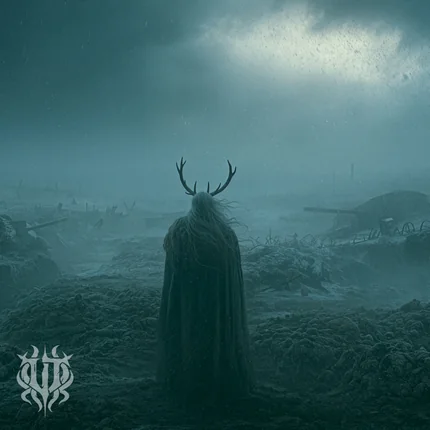
The Dreamkeeper is a dark metal journey into the Dreamlands, inspired by Nodens, the ancient guardian who watches over the boundary between dreams and the unknown.
References
- The Dream-Quest of Unknown Kadath — original text
The fictional narrative is evidence for what the story says, not proof of events in the real world.
- Fungi from Yuggoth — original sonnet sequence
- Brown University Library — Lovecraft’s letter to Robert Bloch about dreams
The exhibit dates the letter 4 August 1933 and notes Arkham House’s September dating.
At a glance
The Dream-Quest of Unknown Kadath
Fungi from Yuggoth, sonnet XX
Black, smooth-skinned, horned, winged and faceless; barbed tails
Silent flight, grasping and tickling
Nodens
Ghouls
Ngranek, the lower abysses and Sarkomand