

Rhan-Tegoth
Rhan-Tegoth is the enormous six-limbed being worshipped by the museum owner George Rogers in The Horror in the Museum. Rogers claims to have recovered it from ancient Alaskan ruins and revived it through offerings. Its detailed anatomy, the injuries of its victims and a final exhibition tableau connect the supposed god with a tangible predatory body. The narrative separates that body from the less secure cosmic claims made by its devoted keeper.
7 min read · 1,303 words
The Alaskan discovery
Rogers says that a ritual in the eighth Pnakotic fragment guided him toward a northern survival older than humanity and Lomar. He and his assistant Orabona traveled into Alaska, following the Noatak from Fort Morton to a ruined complex.
After clearing ice from the central structure, they found stairs leading through several levels. In a chamber below stood a carved ivory throne with the motionless being upon it. Rogers interpreted the inactivity as a need for nourishment rather than proof of death.
The two men packed it into a large box but could not move the burden alone. They brought other members of the party down to help, explaining the contents as archaeological material. Their assistants saw enough of the chamber to accept that account without being shown the body itself.
These events are related by Rogers and supported for Jones by photographs. Jones acknowledges that the expedition reached unusual places while continuing to suspect that the most extraordinary images might have been staged.
A body unlike an ordinary terrestrial animal
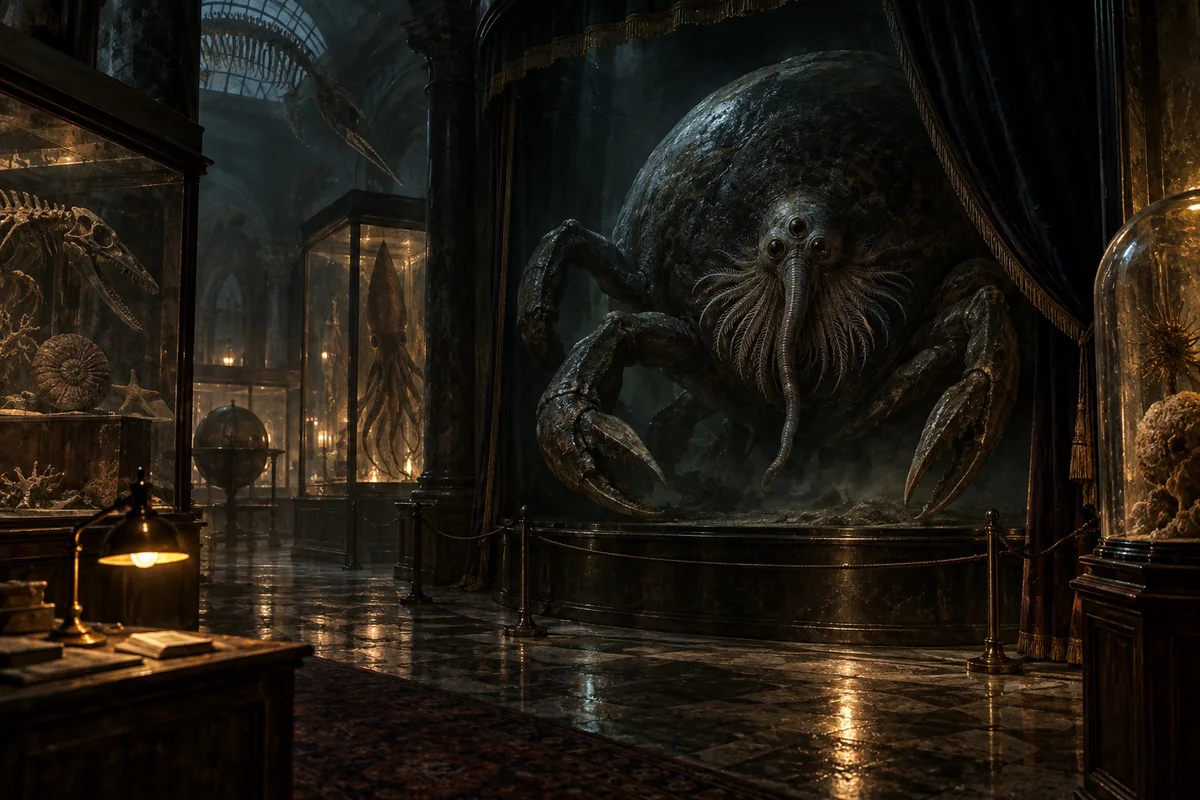
The torso is approximately spherical. Six long, flexible limbs end in dark paws and crablike claws. A smaller rounded projection functions as the head, carrying three eyes arranged in a triangle.
The eyes are compared with those of fish. A flexible proboscis approximately a foot long projects from the head, and expanded structures on either side resemble gills. The final exhibit is about ten feet high even though the body is crouched, giving it considerable bulk beside a human observer.
This combination matters to the creature’s identity. It is not a humanoid figure with an octopus head, and its six limbs should not be confused with six separate facial tentacles. The body’s round masses, triangular arrangement of eyes, proboscis and claws form the story’s specific design.
The living covering
What initially resembles fur is a dense covering of dark filaments. On closer inspection, these are small tentacular or sucking structures, each ending in a mouthlike form compared with the head of a snake.
The filaments are longer and thicker near the head and below the proboscis, where spiral markings give them a more conspicuous appearance. The Medusa comparison in the narrative concerns this arrangement rather than an assertion that ordinary snakes grow from the creature.
The covering connects its anatomy with the condition of its victims. The multitude of small punctures on the remains Rogers displays implies feeding through many points of contact rather than one conventional bite.
Feeding and revival
Rogers keeps the being out of the public display while trying rites and offerings. He explains that the original forms of sacrifice are no longer available but that other blood-bearing victims may suffice.
A dog’s cry first alerts Jones to something taking place behind the workroom. Rogers later shows him the animal’s collapsed remains, marked by extensive punctures and loss of blood. Jones initially reads this as evidence of the owner’s cruelty, not as proof that a monster has fed.
Rogers insists that he merely supplied the offering and that the being consumed it in its own way. This distinction does not remove his responsibility: he actively procures victims and plans to continue doing so. His worship is a system for sustaining the predator at the expense of others.
The hidden tank
The living specimen occupies a space beyond a heavily secured wooden door behind the museum workroom. Rogers says that he has excavated a deep tank and regards the creature as amphibious. The visible gill-like structures provide a bodily detail consistent with that claim.
During Jones’s final struggle with the owner, splashing and heavy wet movements become audible beyond the door. An animal odor follows through the cracks. The sequence advances from a keeper’s explanation to sounds and signs that the skeptical visitor can experience independently.
The creature eventually strikes the door hard enough to break through it. Jones sees a dark clawed extremity and escapes before obtaining a prolonged view of the living organism.
Godhood according to Rogers
Rogers names himself the first priest of a renewed hierarchy. He expects an exchange in which blood offerings sustain Rhan-Tegoth and the god grants him power. His devotion includes invocations of other Mythos names, but those invocations do not establish a fully explained divine family or chain of command.
He also claims that the return of the Old Ones depends on the being’s survival. The statement comes from an increasingly desperate worshipper trying to free himself and secure another offering. The narration does not independently demonstrate the cosmic consequence he predicts.
The physical evidence and the theological assertions therefore have different statuses. The ending strongly supports the existence of a dangerous organism. It does not verify every conclusion Rogers has drawn about its importance to the universe.
The claim of origin on Yuggoth
Rogers associates Rhan-Tegoth with Yuggoth and describes cities beneath a warm deep sea. This information is spoken during the crisis as he explains the sounds from the hidden tank.
The detail should retain its attribution. Yuggoth is also described in The Whisperer in Darkness through a different set of interested speakers, with emphasis on dark cities and rivers. Neither account is an impartial atlas.
The museum story does not narrate Rhan-Tegoth’s actual journey from that world to Earth. It supplies a claimed extraterrestrial origin, the reported Alaskan find and a directly threatening presence in London.
Sources: The Horror in the Museum — original text, The Whisperer in Darkness — original text
The planned sacrifice of Stephen Jones
Rogers initially considers offering Orabona, whose fear of reviving the being has made him an unwelcome critic. Jones’s skepticism then makes him a more attractive target.
The owner locks Jones in the exhibition room for an overnight test and returns in a frightening disguise. Once the victim has been terrified into unconsciousness, Rogers drags him toward the hidden chamber while naming the god he intends to feed.
Jones recovers, recognizes the human voice and defeats his captor. This is important to the creature’s chronology: the first monster that physically attacks him that night is Rogers in a costume, not Rhan-Tegoth. The later sounds and breaking door introduce a separate threat.
The final exhibit and Orabona’s intervention
When Jones returns after recovering, Orabona claims that Rogers has suddenly gone to America. He also describes a new specimen, explains reports of apparent gunshots as chemical noises and offers a private viewing.
The tableau shows Rhan-Tegoth holding a mangled human victim. The creature matches the earlier photograph, while the victim’s face resembles Rogers. A scratch on the cheek corresponds to the injury Jones inflicted during their struggle.
The convergence makes Orabona’s account of an ordinary artistic creation untenable for Jones. It strongly implies that the owner became the victim and that the assistant converted the aftermath into an exhibit.
The precise sequence after Jones fled is not narrated. The reported shots suggest action by Orabona, but the story does not give a direct witnessed account of how he subdued or killed the creature, prepared the bodies or arranged the final tableau.
The museum’s category error
Rhan-Tegoth exploits the setting’s central uncertainty: an accurately made model and a preserved organism may look alike behind an exhibition barrier. Jones’s admiration for Rogers’ skill makes him repeatedly explain evidence of life as exceptional craftsmanship.
The last display collapses that distinction. The supposed work of art may contain both a real monster and the man who tried to control it. The label tells the visitor what to think, while the physical details reveal a different history.
This is why the creature’s anatomy receives so much attention. Its repeated appearance in photograph, sound, partial emergence and final tableau allows recognition to accumulate even when the narration never provides a complete view of the decisive attack.
Related music
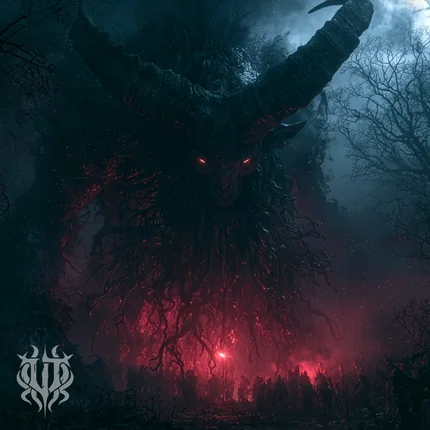
The Black Goat of The Woods is a dark metal tribute to Shub-Niggurath, the ancient woodland deity whose forgotten cults gather beneath twisted trees and indifferent stars.
References
- The Horror in the Museum — original text
The fictional narrative is evidence for what the story says, not proof of events in the real world.
- The Whisperer in Darkness — original text
The fictional narrative is evidence for what the story says, not proof of events in the real world.
At a glance
The Horror in the Museum
H. P. Lovecraft for Hazel Heald
July 1933, Weird Tales
George Rogers
Ancient ruins in Alaska
A concealed tank behind Rogers’ Museum
Spherical torso; six clawed limbs; three eyes; proboscis; gills; sucking filaments
Yuggoth, according to Rogers