

The Horror in the Museum
A connoisseur of strange art becomes fascinated with a London museum whose owner claims that some of its monsters are real. An overnight test of skepticism turns into an attempted sacrifice, and a later return reveals an exhibit whose details are impossible to dismiss as invention. Written by H. P. Lovecraft for Hazel Heald, The Horror in the Museum builds its reversals around the unstable boundary between model, preserved body and living creature.
9 min read · 1,711 words
Composition, publication and setting
The story was written in October 1932 for Hazel Heald and first appeared in Weird Tales in July 1933. Its central location is Rogers’ Museum, a fictional basement attraction in Southwark Street, London.
The museum’s ordinary material includes historical violence and familiar monsters. A screened section for adults contains more disturbing forms from forbidden books and apparently original creations. The setting establishes why a visitor would expect even an appalling body to be artificial.
Stephen Jones, a visitor interested in unusual art, is the principal viewpoint character. His sustained attraction to the collection grows from admiration for its apparent invention and technical skill.
Sources: H. P. Lovecraft Archive — fiction in composition order, H. P. Lovecraft Archive — fiction in publication order, The Horror in the Museum — original text
George Rogers and his workshop
Rogers formerly worked for Madame Tussaud’s before a dispute and concerns about his behavior ended the connection. In his own establishment he produces objects whose realism impresses Jones far more than the conventional exhibits.
Behind the display stands a workshop crowded with body parts, wigs, eyes, costumes and materials. A furnace prepares wax for molding and pouring. These ordinary implements of fabrication provide a plausible explanation for disturbing things seen elsewhere in the museum.
One heavy door remains secured by an unusually large lock. A symbol above it is familiar to Jones from his access to the Necronomicon. The detail suggests that Rogers’ learning extends beyond casual decorative borrowing and directs attention toward a part of the building the visitor has not seen.
Friendship gives way to a contest of belief
Repeated visits make Rogers more talkative. He describes journeys to remote regions and claims to have followed ancient texts toward surviving forms of life unknown to modern knowledge.
Jones appreciates the imagination behind these statements but does not accept them literally. Rogers increasingly resents that response. Pretended agreement fails to restore the earlier friendliness because he wants actual acknowledgment.
Their disagreement becomes the engine of the plot. Jones believes a gifted maker is becoming trapped in his own fantasies. Rogers believes that the visitor’s insistence on artistry refuses the evidence of a greater reality. Each interpretation makes the other man’s behavior seem more alarming.
The cry behind the workroom
One afternoon Jones and other visitors hear a dog’s terrible cry from the vicinity of the workshop. Orabona, Rogers’ assistant, prevents Jones from entering and attributes the sound to animals outside.
Jones examines the courtyard but finds no corresponding disturbance. Through a low window he sees light coming from the normally locked inner doorway. The observation does not establish what lies beyond it, but it connects the cry with the concealed part of the museum.
When he returns near closing time, Rogers is unusually excited. A covered object lies on the floor, and his remarks about living specimens become more emphatic. The visitor’s earlier curiosity now gives him a reason to remain in a conversation he finds increasingly repellent.
The expedition Rogers describes
Rogers says that the eighth Pnakotic fragment guided him and Orabona to Alaskan ruins. They found a subterranean chamber and an ivory throne bearing a motionless being. The owner believed it dormant and in need of nourishment.
They packed it for transport and concealed its nature from the men needed to carry the heavy box. Photographs show the northern journey, ancient structures and the chamber. A separate picture reveals the body beside Orabona, providing a human scale.
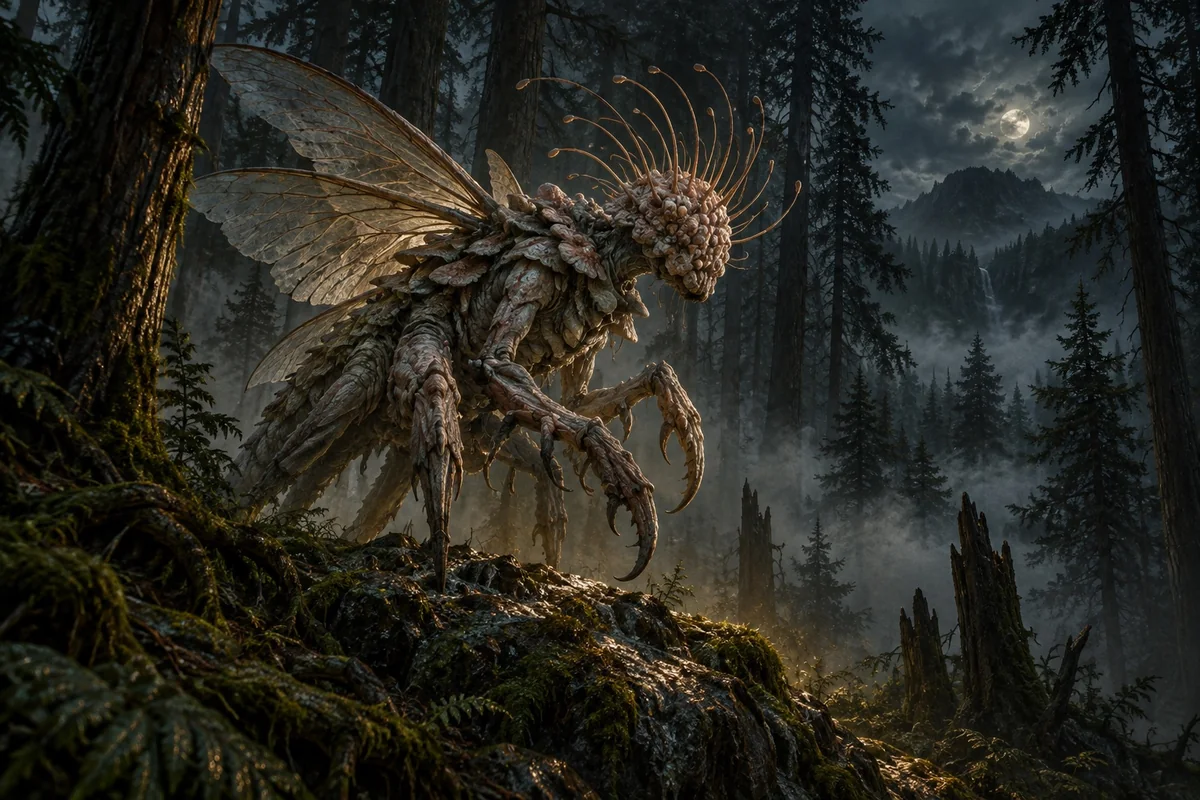
The creature has a globular torso, six flexible clawed limbs, a smaller round head, three eyes, a proboscis and gill-like structures. What looks like fur is a covering of sucking filaments. Jones continues to interpret it as Rogers’ greatest model, although the picture exerts an unusually disturbing fascination.
The dog and the demand for recognition
Rogers uncovers the remains of a dog, collapsed and punctured in a manner he attributes to the being’s feeding. Jones reacts with disgust at what he assumes the owner has done.
Rogers insists that the damage is the creature’s work. He calls it a god and presents himself as its priest. The sacrifice, he claims, has successfully revived something that lay inactive when recovered.
Jones advises him to stop contemplating the object and let Orabona destroy it. To Rogers this is further proof that his visitor will not recognize reality. Their dispute becomes a challenge: Jones will spend the night in the dark museum, and if he remains until morning, the owner will agree to reconsider his conduct.
The overnight vigil
Jones arrives at eleven and is locked into the main exhibition chamber. He has a small light but no comfortable reason to remain beyond the bargain. As time passes, darkness fills the remembered exhibits with apparent movement.
The narration distinguishes these early perceptions from established events. Jones imagines familiar figures changing, hears uncertain sounds and alternates between using the light and avoiding the objects it reveals. His own effort to control fear is part of the scene.
The absence of ordinary animal life also becomes disturbing. Rogers has claimed that even insects and mice avoid the museum. Without small familiar noises, the dark interior seems cut off from everyday London despite the distant clock.
The vigil makes the reader share a practical difficulty: every new impression might be another product of expectation, but treating all impressions as imaginary could become dangerous.
The first attacker is human
A door opens and something approaches. When Jones illuminates it, he sees a huge form combining ape-like and insect-like features. He drops the light, screams and loses consciousness as it seizes him.
He recovers while being dragged through the building. The attacker is chanting in Rogers’ unmistakable voice, announcing an offering to Rhan-Tegoth. Recognition restores Jones’s ability to act because the immediate danger now has a human explanation.
He surprises his captor and struggles with him in the workroom. After overcoming Rogers, he binds him and takes the keys. The disguise appears to be made from an unusual hide, but the demonstrated assailant is the museum owner.
Rogers later calls the covering the skin of a dimensional shambler. The story does not independently show that creature alive. It preserves an additional uncertainty inside an otherwise concrete human attack.
The promised immortality in wax
Bound and enraged, Rogers explains what he intended. After Rhan-Tegoth fed on Jones, he would preserve the remains as an exhibit. The visitor who denied the reality of the collection would become one of its supposed artificial figures.
The owner also reveals that Orabona was another intended victim. His promises of power and immortality are incompatible with the bodily fate he proposes for others, turning artistic preservation into a threat.
Jones prepares to leave and obtain medical help. He still understands the principal event as an attack by a dangerously disturbed man. Rogers’ increasingly desperate calls to the being beyond the door then introduce evidence that exceeds this explanation.
The second threat behind the door
Splashing comes from the concealed chamber. Rogers explains that the being is amphibious and has heard him. Wet footfalls and an animal odor follow, while something tests and then strikes the secured door.
Jones struggles to dismiss the sounds as hallucination, but the physical attack on the planks becomes unmistakable. The barrier breaks, exposing a dark extremity ending in a crablike claw.
His paralysis gives way to flight. He leaves through the courtyard and reaches home without retaining a coherent memory of the journey. He has not witnessed the fate of the bound Rogers, and the narration does not supply that missing scene through another observer.
Recovery and the unexplained absence
Jones spends time under medical care but tells the doctors little. The lack of a newspaper report makes him question how much of his experience was real. After a fortnight he returns to the museum in daylight.
The business appears to be functioning normally. Orabona greets him and says that Rogers has gone to America on sudden business. He describes a disorderly workroom, extensive cleaning and the preparation of an important specimen.
His account also addresses noises that outsiders took for gunshots, presenting them instead as chemical reactions. The explanation is suspicious, particularly in light of his earlier habit of carrying a pistol, but Jones does not obtain a direct confession or a complete reconstruction.
The sacrifice on display
Orabona offers to show a new tableau that police have ordered withdrawn from public view. It depicts Rhan-Tegoth holding a ruined human body. The monster corresponds to the photograph Jones has already seen.
The victim’s face resembles Rogers. That resemblance alone might still be explained as an artist using his own features. The decisive detail is a scratch on the left cheek that matches the wound Jones inflicted during their struggle.
The final recognition links the tableau to a particular event in the living owner’s body. Jones faints while Orabona continues smiling. The narrative ends without an explanatory speech from the assistant, allowing the physical detail to make the implication.
The changing status of evidence
The story offers several successive explanations. The collection may be imaginative sculpture; its maker may be a violent fantasist; a monster may be a disguise; and the apparently lifeless objects may include real organisms or preserved victims.
Each explanation accounts for some evidence while failing to exhaust what comes next. Discovering Rogers beneath the first disguise does not prove that the sounds behind the second door are false. Recognizing the owner’s craftsmanship does not establish that every form began as wax.
The final exhibit gains its force from this sequence. The very skill that has repeatedly supported Jones’s skepticism can also conceal the material evidence that would overturn it.
Art, worship and exploitation
Rogers’ devotion turns other lives into material for a private ambition. He expects power from the being he feeds and converts the remains into objects for public display. His roles as priest, collector and maker reinforce one another.
Orabona understands the practical danger more clearly but emerges as an unsettling survivor rather than a transparent rescuer. His pleasure in presenting the final tableau suggests that the museum can continue exploiting horror after its original owner is gone.
The ending leaves the institution intact. Jones escapes, but the display system that makes violence look like an artistic effect continues to operate. That persistence gives the final scene a colder quality than a simple defeat of the monster would provide.
References
- H. P. Lovecraft Archive — fiction in composition order
Composition dates; question marks and ranges retain the source uncertainty.
- H. P. Lovecraft Archive — fiction in publication order
First publication dates and venues; issue dates can differ from actual release dates.
- The Horror in the Museum — original text
The fictional narrative is evidence for what the story says, not proof of events in the real world.
At a glance
H. P. Lovecraft; Hazel Heald
October 1932
1933, July
Weird Tales, 22, No. 1
Fiction