

Shub-Niggurath
Shub-Niggurath is the invoked power associated with the Black Goat of the Woods and a multitude of young. The name recurs across Lovecraft’s fiction and revisions, acquiring maternal, cultic and protective associations without receiving one sustained eyewitness description of a complete body.
5 min read · 1,023 words

Appearances and attribution
The name appears in The Last Test, Lovecraft’s revision of material by Adolphe de Castro, published in November 1928. It recurs in The Dunwich Horror, The Whisperer in Darkness, The Mound, The Horror in the Museum and Out of the Aeons. Some of these are solo stories and others are revisions published under different originating authors’ names. Their credits are part of the record of how the shared mythology developed.
The appearances are mostly invocations, descriptions of worship or statements about divine relationships. Counting them as though each were a physical encounter would misrepresent the evidence. Shub-Niggurath is influential in the textual network precisely because a short repeated name can suggest a large religious background without stopping each story for a complete exposition.
Sources: The Last Test — original text, The Dunwich Horror — Unspeakable Tales ebook, The Whisperer in Darkness — original text, The Mound — original text, The Horror in the Museum — original text, Out of the Aeons — original text, H. P. Lovecraft Archive — fiction in publication order
The Black Goat and the multitude of young
The Whisperer in Darkness supplies the especially familiar liturgical association with the Black Goat of the Woods and a thousand young. The phrases occur in the recorded ceremony received by Wilmarth, where human and alien voices participate in a shared religious vocabulary. The recording makes an occult name audible within an investigation otherwise conducted through letters, photographs and observations of the Vermont hills.
The epithet joins woodland imagery with prolific generation. It gives later readers and artists a powerful visual starting point, but the scene does not show a giant ordinary goat standing beside the recording equipment. The words belong to a rite. Describing them as a title or invocation preserves the distinction between religious language and observed anatomy.
The number in the epithet also need not function as a census of exactly one thousand individually named offspring. The cited stories supply no such list. Its immediate literary effect is an impression of abundance and a source of life operating at a scale beyond the human family.
The All-Mother in K’n-yan
The Mound places Shub-Niggurath within the temple landscape of the underground civilization K’n-yan. Zamacona’s guide shows him active shrines along the route to Tsath. A former temple of Tsathoggua has been reassigned to Shub-Niggurath, identified there as an All-Mother and the wife of a being called the Not-to-Be-Named One.
The conversion of a shrine suggests a history of religious change rather than one unchanging universal cult. It also places the deity among other named powers worshipped by a sophisticated but disturbing civilization. The account comes through Zamacona, whose own religious commitments shape his response to what he sees.
That local description should be preserved as a statement from The Mound. It does not automatically resolve the identity of every unnamed partner in every later writer’s genealogy. The temple, the title and the relationship are specific evidence; a universal diagram extending them far beyond the work requires additional sources.
Sources: The Mound — original text
T’yog and the opposition to Ghatanothoa
Out of the Aeons supplies one of the most substantial narrative roles associated with Shub-Niggurath. In the ancient land described through von Junzt’s book, T’yog is her high priest and guardian of a copper temple. He believes that powers friendly to humanity can be brought into opposition to Ghatanothoa, whose threat supports a privileged and oppressive priesthood.
T’yog develops a protective formula under the Mother Goddess’s inspiration. He hopes to confront Ghatanothoa without suffering its petrifying effect and to free the population from fear. The project combines a desire for liberation with ambitions for the honors and authority that success might bring. It is not a simple tale in which a purely disinterested priest receives an uncomplicated miracle.
The hostile priesthood sabotages the undertaking by substituting a false scroll. T’yog climbs the mountain believing that he carries the true protection and fails to return. Shub-Niggurath does not appear in a narrated physical duel with Ghatanothoa. Her importance lies in the religious confidence and protective knowledge through which the human challenger attempts the confrontation.
This role complicates a blanket description of every named Mythos power as serving the same kind of evil. T’yog distinguishes friendly from hostile deities within his world. That is a particular character’s religious framework, while the plot’s tragedy also involves human institutions and deception. A detailed entry can preserve those differences without converting the entire tradition into a fixed moral war between two teams.
Sources: Out of the Aeons — original text
Invocations surrounding other threats
The Dunwich Horror includes Shub-Niggurath’s name in the Necronomicon passage associated with Yog-Sothoth and the return of the Old Ones. The immediate plot, however, concerns the Whateley family and its attempted opening. The invocation broadens the religious language without making Shub-Niggurath the identified parent of Wilbur and his brother.
In The Horror in the Museum, George Rogers invokes the name while explaining his new priestly role and attempting to direct power around Rhan-Tegoth. The story’s central preserved creature is Rhan-Tegoth. The fact that its worshipper uses another divine name does not turn the two into the same being.
These examples show how liturgy connects stories. A brief invocation can imply an older or wider system than the immediate scene reveals. It is useful evidence of association, but it does not specify a complete chain of command or prove that a summoned body must be present just outside the narrator’s view.
Sources: The Dunwich Horror — Unspeakable Tales ebook, The Horror in the Museum — original text
Images, offspring and later elaboration
The principal texts leave substantial room between the power suggested by the epithets and a fixed visual form. Woodland darkness, proliferating life and maternal imagery can inform an original illustration. Any added anatomy remains an interpretation unless a particular literary or game source supplies it.
This matters especially when discussing creatures later grouped as Shub-Niggurath’s offspring. The familiar tree-like Dark Young belong to a later layer of Mythos development, treated in their own entry. A modern illustration can depict that later tradition, but it should not be captioned as though the Vermont recording contains a detailed visual account of the same creatures.
Shub-Niggurath’s wider significance is the persistence of a name across different narrative functions. In one context it helps create a frightening soundscape; in another it identifies a temple’s patron; in another it stands behind an effort to resist a rival cult’s power. The recurrence creates continuity while the differences preserve the individual stories’ purposes.
Sources: The Whisperer in Darkness — original text, The Mound — original text, Out of the Aeons — original text, Chaosium — A Time to Harvest Keeper Reference Booklet
Related music
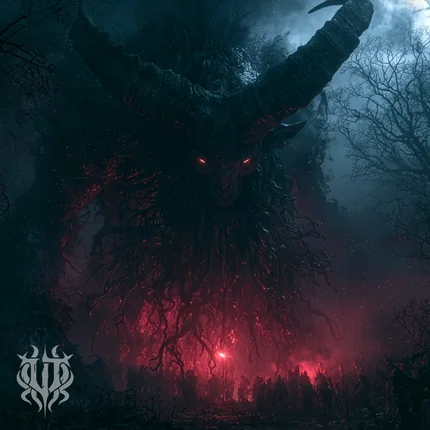
The Black Goat of The Woods is a dark metal tribute to Shub-Niggurath, the ancient woodland deity whose forgotten cults gather beneath twisted trees and indifferent stars.
References
- The Last Test — original text
The fictional narrative is evidence for what the story says, not proof of events in the real world.
- The Dunwich Horror — Unspeakable Tales ebook
The fictional narrative is evidence for what the story says, not proof of events in the real world.
- The Whisperer in Darkness — original text
The fictional narrative is evidence for what the story says, not proof of events in the real world.
- The Mound — original text
The fictional narrative is evidence for what the story says, not proof of events in the real world.
- The Horror in the Museum — original text
The fictional narrative is evidence for what the story says, not proof of events in the real world.
- Out of the Aeons — original text
The fictional narrative is evidence for what the story says, not proof of events in the real world.
- H. P. Lovecraft Archive — fiction in publication order
First publication dates and venues; issue dates can differ from actual release dates.
- Chaosium — A Time to Harvest Keeper Reference Booklet
At a glance
H. P. Lovecraft
The Last Test · November 1928
The Black Goat of the Woods with a Thousand Young
All-Mother in The Mound
T’yog in Out of the Aeons
Invocation, worship and religious relationships
Not supplied by these principal sources