

Yuggoth
Yuggoth is the dark world associated with the Mi-Go in The Whisperer in Darkness and several connected stories. It functions as an outpost and departure point within a far larger extraterrestrial civilization. Its windowless cities, black rivers and older ruins are described to Albert Wilmarth by a speaker whose identity he later has reason to distrust. The place is therefore both a cosmic destination and part of a carefully staged invitation.
6 min read · 1,071 words
An outpost rather than an ultimate origin
Akeley’s correspondence places Yuggoth near the edge of the solar system. It is the immediate home or outpost from which the beings known as the Outer Ones operate, but their ultimate origin lies much farther beyond familiar space.
Sources: [1]
That distinction prevents the planet from becoming a simple explanation of the Mi-Go’s entire history. Their presence there is one stage in a wider network. A human visitor reaching Yuggoth would still stand only at the beginning of the proposed exploration.
The narrative repeatedly enlarges the scale in this way. Vermont first points toward a remote planet; the planet then points beyond the galaxy and even beyond the ordinary framework in which the characters imagine a universe.
Position and the Pluto connection
The reassuring letter sent in Akeley’s name describes a world beyond Neptune, ninth in distance from the Sun and still unknown to astronomers at the time of the correspondence. It suggests that the beings could influence its eventual discovery through directed thoughts or a human intermediary.
Wilmarth’s closing reference to the discovery of Pluto makes the connection unmistakably relevant to the story’s frame. The fictional events in 1928 precede the astronomical news that troubles him when he looks back.
This is a literary identification embedded in a narrated fear. The alien population, buildings and means of discovery are elements of the fiction, not claims this encyclopedia makes about the physical world observed by astronomers.
Sources: [1]
Cities without windows
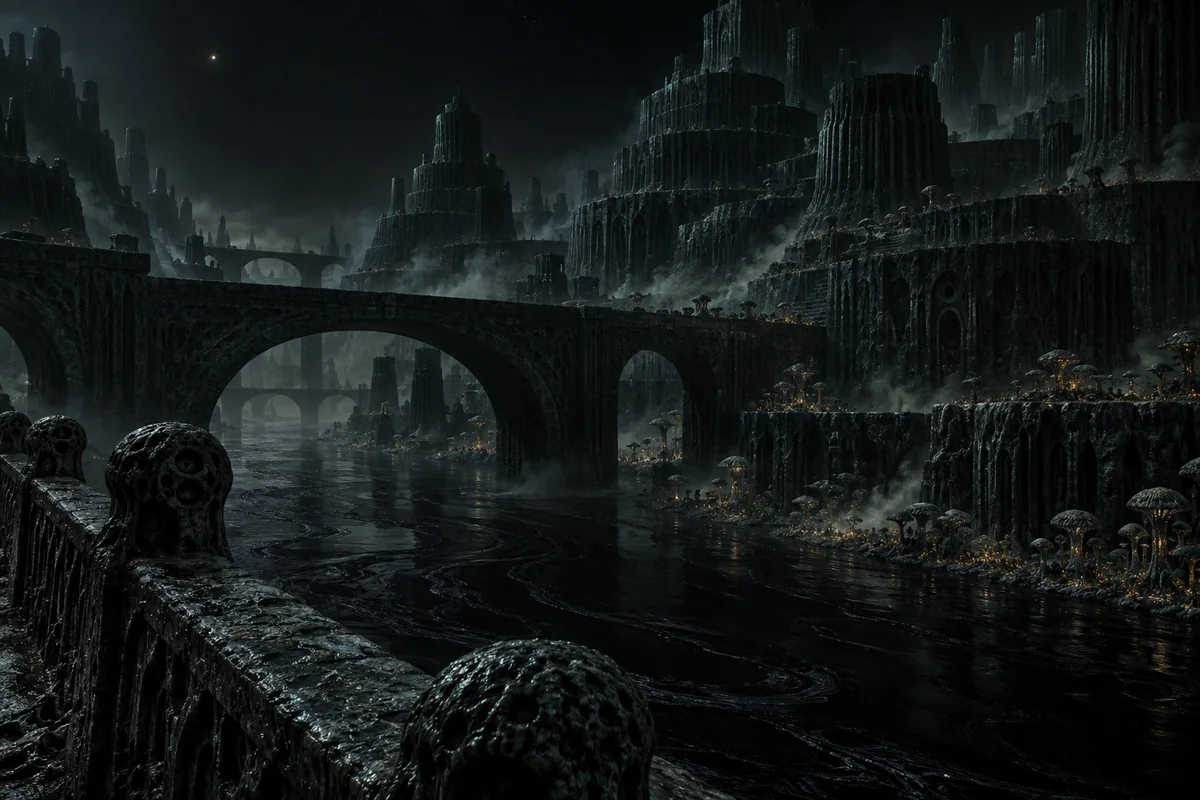
The farmhouse speaker describes cities of tiered towers built from black stone. Houses and temples lack windows because their inhabitants use forms of perception that do not depend on human-style illumination.
The Sun appears little brighter than another star. Rather than describing this darkness as a mere deficiency, the speaker presents it as a condition suited to the beings. Light can disturb and confuse them, while their other senses make a windowless built environment entirely functional.
For Wilmarth, the description is alarming because it removes the assumptions by which a human visitor recognizes an inhabitable place. For the speaker, the same details demonstrate that terror may arise from unfamiliarity rather than an inherently hostile landscape.
Sources: [1]
Rivers, gardens and the earlier builders
The account includes dark rivers resembling flowing pitch, fungal gardens and immense bridges. Some structures are attributed to a civilization already extinct before the present inhabitants arrived from more remote regions.
Yuggoth consequently possesses its own archaeological depth. It is not a new alien settlement existing outside history. The Mi-Go inhabit a world that already contains traces of other beings and earlier construction.
The black stone Akeley tried to send Wilmarth is said to come from this world. Its loss in transit prevents the recipient from using that object to test the speaker’s increasingly elaborate account of the remote landscape.
Sources: [1]
The proposed journey
Wilmarth is told that human bodies cannot simply accompany the winged visitors through space. Instead, a brain can be removed, preserved in a cylinder and connected with apparatus at each destination to receive sensory impressions and speak.
Yuggoth is to be the first stop in a journey that could continue to other planets and more remote regions. The account promises unprecedented knowledge while asking the traveler to surrender ordinary bodily independence.
That exchange is central to the place’s narrative role. The same city can appear as the reward for intellectual curiosity and as a destination from which a person may have no practical means of returning without the cooperation of the hosts.
Sources: [1]
What Wilmarth can and cannot verify
Wilmarth never visits Yuggoth in the story. He receives its description through letters, ritual speech and the farmhouse conversation. His direct experience concerns earthly tracks, recordings, apparatus, voices and the objects left in the supposedly human host’s chair.
The final discovery makes the identity of that host deeply suspect. It does not logically prove that every geographical statement was false, but it prevents the invitation from being treated as disinterested testimony.
A careful account therefore preserves the descriptive detail while acknowledging its source. The city’s black architecture is explicitly reported; the good intentions of those offering to show it are not independently established.
Sources: [1]
Rhan-Tegoth’s reported connection
In The Horror in the Museum, George Rogers claims that Rhan-Tegoth came from Yuggoth and associates that world with cities beneath a warm deep sea. His description serves the explanation of an amphibious being kept in a hidden tank.
This is another interested speaker, one who treats a dangerous organism as the foundation of his own coming power. The tale supplies a physical creature and a reported expedition to Alaska, but does not directly narrate the journey from Yuggoth.
The underwater image can be recorded alongside the dark cities of The Whisperer in Darkness without inventing a detailed planetary map that reconciles every account. The stories offer separate glimpses through separate narrators and claimants.
Yuggoth in Out of the Aeons
The ancient history in Out of the Aeons attributes the fortress on Mount Yaddith-Gho to beings from Yuggoth. They colonized Earth before terrestrial life and eventually vanished, leaving Ghatanothoa behind.
The same account identifies lagh as a metal brought from Yuggoth and used for the cylinder protecting T’yog’s scroll. Its resistance to the museum’s attempts at chemical identification gives the remote world a material trace in the modern investigation.
These additions extend Yuggoth’s connections to prehistoric building and unusual substances. The text calls the earlier colonists the spawn of Yuggoth; it should not be assumed, without further evidence, that every civilization assigned to the planet is identical in all details to the beings of Akeley’s letters.
Sources: [3]
A recurring boundary of human knowledge
Across these stories, Yuggoth joins a recognizable physical direction with an account that exceeds ordinary verification. It is remote enough to conceal other histories, yet connected closely enough to Earth for objects, organisms and invitations to arrive from it.
Its strongest role is relational. The farmhouse, the museum tank and the ancient fortress become local points in a much larger arrangement. The planet allows a specific earthly mystery to open outward without giving readers an exhaustive cosmic survey.
That incompleteness is part of the effect. Yuggoth becomes more suggestive as different texts attach different traces to it, while none of the human investigators gains an unrestricted view of the world itself.
References
- The Whisperer in Darkness — original text
The fictional narrative is evidence for what the story says, not proof of events in the real world.
- The Horror in the Museum — original text
The fictional narrative is evidence for what the story says, not proof of events in the real world.
- Out of the Aeons — original text
The fictional narrative is evidence for what the story says, not proof of events in the real world.
At a glance
The Whisperer in Darkness
Outpost of the Outer Ones; proposed first destination for human brain travelers
The outer solar system, beyond Neptune
Windowless black towers; dark rivers; fungal gardens; older bridges
The Horror in the Museum; Out of the Aeons
None