

’Umr at-Tawil
’Umr at-Tawil, rendered in the story as the Prolonged of Life, is the veiled Guide who receives Carter beyond the first threshold in Through the Gates of the Silver Key. Feared in the Necronomicon, he nevertheless offers Carter a welcome and a choice. His role is to prepare and guide passage toward a reality more disturbing than an ordinary encounter with a monster.
4 min read · 715 words
The warning in the Necronomicon
Carter recalls a passage warning against accepting the Guide’s help. It invokes older authority in the Book of Thoth and describes dangers beyond the known world as greater than other terrors familiar from forbidden lore.
That passage establishes expectation before the encounter. It is a quotation from an invented book within the story, not an extract from a surviving historical Necronomicon. Its reliability is also open to question within the narrative: what Carter actually experiences is not simple immediate hostility.
The contrast between written warning and direct contact becomes part of his decision to continue. He wonders whether the old account reflects fear, envy or an incomplete attempt by an earlier seeker.
Sources: Through the Gates of the Silver Key — original text
A shape adapted to limited perception
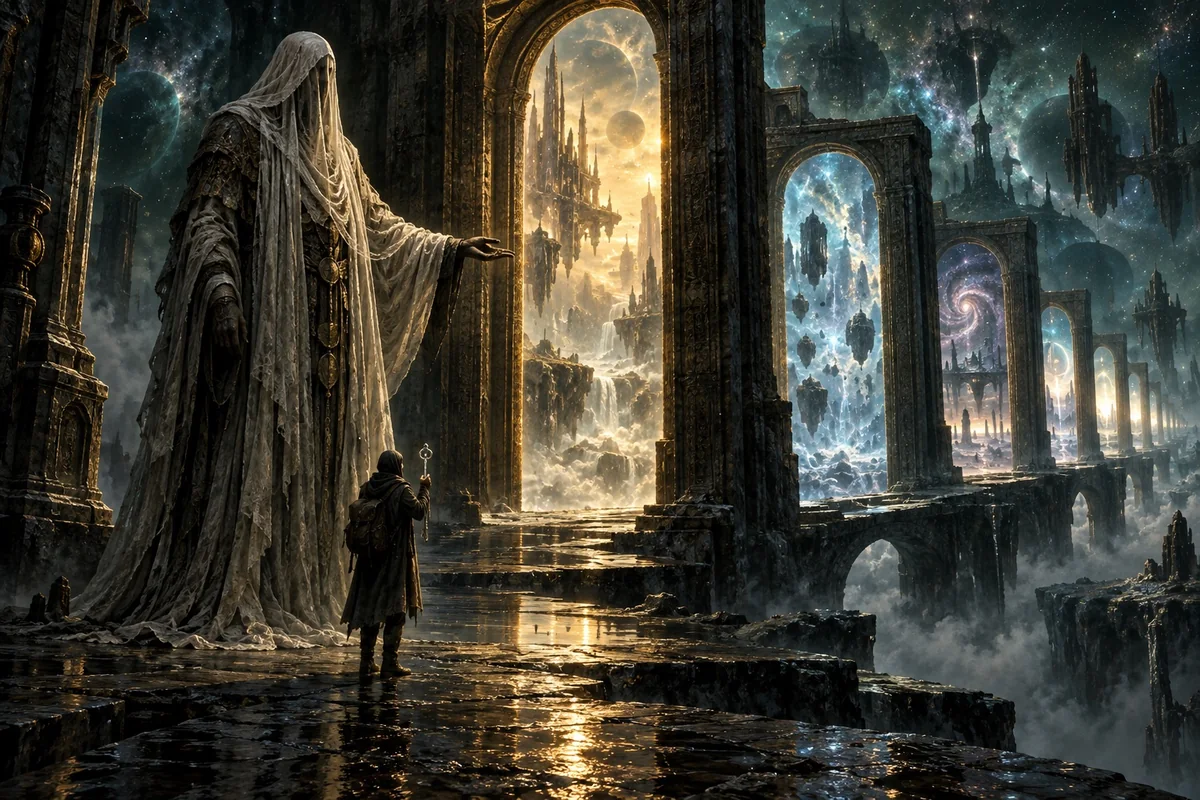
The Guide appears veiled in a neutral-colored material, with no visible openings for eyes. His outline is unstable but suggests something remotely related to a human form and larger than an ordinary person.
The narrative repeatedly cautions that Carter’s mind is translating an existence outside familiar dimensions into images it can apprehend. The robe and bodily suggestions are therefore not a complete anatomical report.
Communication takes place directly between minds without ordinary sound or language. Carter renders the messages into words, just as his perception supplies partial shapes. An illustration of a hooded figure can follow that imagery while acknowledging its interpretive status.
Sources: Through the Gates of the Silver Key — original text
Welcome and the opportunity to retreat
The Guide knows Carter’s purpose and says that he and the Ancient Ones have awaited him. Carter senses no immediate malignity. He is offered the option of going back unharmed rather than crossing the Ultimate Gate.
Carter chooses to proceed from curiosity. The scene therefore gives the traveler agency at a crucial threshold. The Guide does not simply abduct him or force him into the later alien condition.
This does not establish universal benevolence. The Necronomicon’s warning remains in the background, and the consequences of continuing are severe. The specific encounter is welcoming without becoming proof that every seeker would be treated identically.
Sources: Through the Gates of the Silver Key — original text
The pedestals, sphere and directed dreams
The Guide presides over cloaked Ancient Ones seated on roughly hexagonal supports. Carter is welcomed among them and occupies a vacant place. A higher central support belongs to the Guide.
An iridescent sphere or sphere-like object accompanies a rhythm that Carter interprets as chanting. The assembly sways, shines and then enters a special sleep. The Guide remains active, directing the images they dream.
Their coordinated dreaming prepares the manifestation of the Ultimate Gate. Carter uses the silver key in the passage, but the Guide’s work and the assembly’s concentration make the crossing a collective event. It is not merely a doorway that exists unchanged in a room.
Sources: Through the Gates of the Silver Key — original text
Relation to the Being beyond the gates
Beyond the Ultimate Gate, Carter encounters a more encompassing presence tentatively associated with Yog-Sothoth. It calls the Ancient Ones its manifestations on Earth’s extension. This connects the threshold assembly with the greater reality without reducing the whole account to an ordinary hierarchy of separate bodies.
The Guide also protects Carter from the full dissolution of individual identity until the key has been used for the next passage. The protection explains why some destabilization occurs at the first threshold while the more overwhelming recognition of countless selves comes later.
Descriptions that simply label ’Umr at-Tawil a physical monster miss this function. He mediates between a finite traveler and a revelation for which ordinary identity and perception are inadequate.
Sources: Through the Gates of the Silver Key — original text
His responsibility and Carter’s later mistake
Carter receives another warning beyond the gates to be certain of the symbols needed for return. He assumes that possessing the key is sufficient and chooses the journey to Yaddith. The missing parchment later proves essential.
The tale does not show the Guide maliciously removing the instructions or tricking Carter into forgetting them. His omission precedes the journey, and his impatience shapes the later choice. Assigning the entire disaster to a deceit by ’Umr at-Tawil would go beyond the events narrated.
The Guide’s importance lies in the uneasy combination of permission, protection and danger. A traveler can be welcomed, warned and still make a choice whose consequences exceed his understanding.
Sources: Through the Gates of the Silver Key — original text
Related music
The Key and the Gate is a dark metal retelling of The Dunwich Horror, following Wilbur Whateley’s doomed search for forbidden knowledge and the power of Yog-Sothoth.
References
- Through the Gates of the Silver Key — original text
The fictional narrative is evidence for what the story says, not proof of events in the real world.
At a glance
H. P. Lovecraft and E. Hoffmann Price
Through the Gates of the Silver Key
The Prolonged of Life
Guide and Guardian at the threshold
Direct mental communication
The Ancient Ones on the quasi-hexagonal pedestals
Return unharmed or attempt the Ultimate Gate