

Through the Gates of the Silver Key
Through the Gates of the Silver Key continues Carter’s disappearance into a journey beyond ordinary space, time and individual identity. Written by Lovecraft with E. Hoffmann Price, it frames the account as testimony at a meeting about Carter’s estate. The apparent freedom to inhabit other forms becomes a struggle to recover the human body and legal identity the traveler once took for granted.
9 min read · 1,780 words
Collaboration, composition and publication
The story is credited to H. P. Lovecraft and E. Hoffmann Price. The Lovecraft Archive dates its composition to October 1932–April 1933 and records first publication in Weird Tales in July 1934. Its joint authorship should remain visible rather than treating every invention as the work of Lovecraft alone.
It directly revisits the ending of The Silver Key, including the abandoned car, ancestral country, unread parchment and rumors that Carter has returned to childhood. The earlier narrator’s explanation becomes one theory within a new frame instead of the final word on the disappearance.
The result changes scale several times: from an estate conference to an ancestral cave, from there to an encounter outside ordinary dimensions, then to an alien planet and finally back to the room where the conference began.
Sources: H. P. Lovecraft Archive — fiction in composition order, H. P. Lovecraft Archive — fiction in publication order, Through the Gates of the Silver Key — original text, The Silver Key — Unspeakable Tales ebook
Four men and an unsettled estate
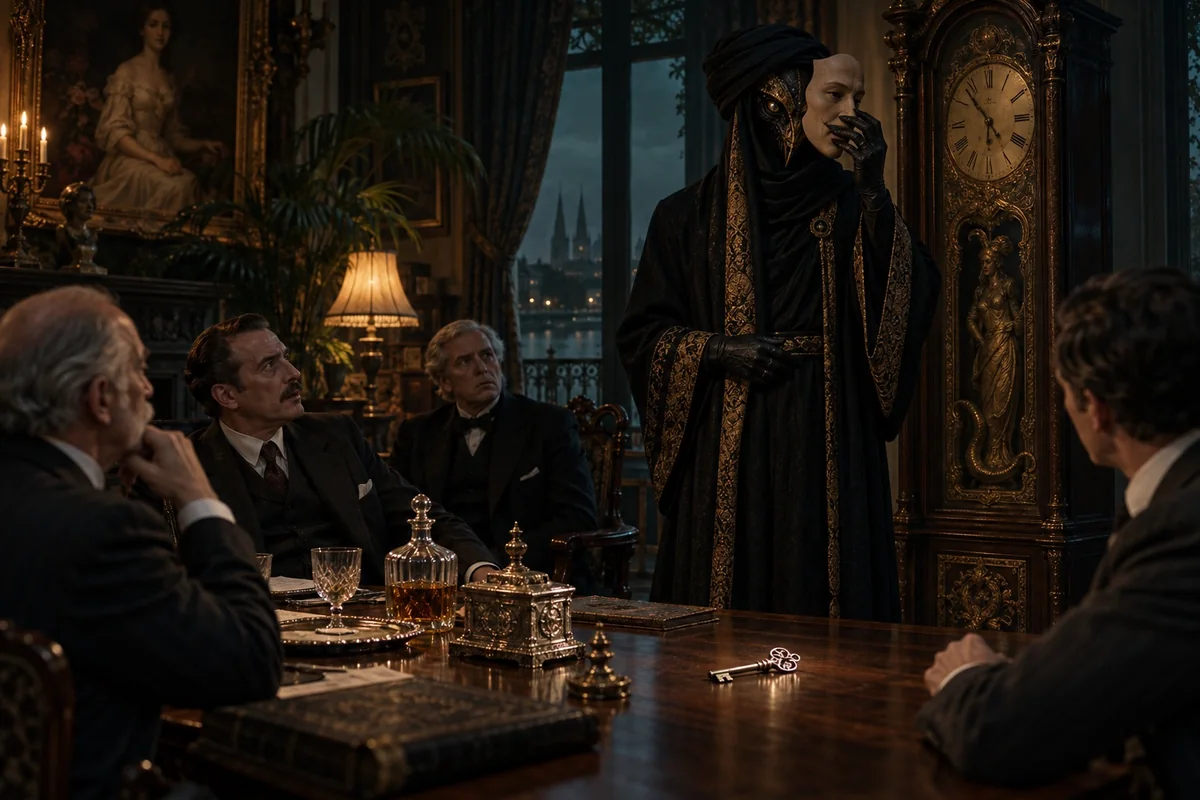
Carter disappeared on 7 October 1928 at fifty-four. Four years later, interested parties gather at the New Orleans home of his literary and financial executor, Etienne-Laurent de Marigny. They include the older cousin Ernest Aspinwall, the Providence writer and mystic Ward Phillips, and a visitor presenting himself as Swami Chandraputra.
Aspinwall wants the property distributed to the heirs. De Marigny and Phillips resist because they consider Carter’s survival possible. Phillips is identified as the author of an account proposing that Carter reigns in Ilek-Vad, connecting the frame with The Silver Key’s conclusion.
The room contains burning incense, old furnishings and a coffin-shaped clock whose four hands follow no recognizable terrestrial system. Its rhythm and the visitor’s awkward clothing, immobile face and strained voice accumulate as details whose significance is initially uncertain.
Sources: Through the Gates of the Silver Key — original text
The missing parchment and the visitor’s claim
De Marigny cannot decipher the parchment left in Carter’s car. He remembers similar characters in the book Harley Warren took underground in 1919. Carter had sent him a photograph of the silver key, whose ornament he considered related to the same cultural tradition.
Chandraputra says that Phillips’s account is incomplete and offers a fuller history of Carter’s journey. He also states that forgetting the parchment mattered. The key alone could begin the passage, but the unread document contained information Carter would later need.
This makes the conference an argument about evidence as well as inheritance. Dreams and correspondence have convinced some participants, while Aspinwall demands something more concrete. The visitor’s narrative must eventually address that demand if it is to prevent distribution of the estate.
Sources: Through the Gates of the Silver Key — original text
The return to 1883 and the first threshold
According to Chandraputra, Carter uses the key near the ancestral property while facing the setting sun. The rite brings him into the childhood world of 1883. Benijah calls him home, and he spends the night with his great-uncle and aunt before returning to the Snake-Den.
Inside a hidden chamber beyond the outer cave, the boy recognizes a suggestion of a monumental arch and a sculptured hand. Another use of the key removes the ordinary significance of age and location. He remains Carter, but his body and surroundings become unstable impressions.
The passage reaches an extension of Earth outside its familiar time. It is not yet the Ultimate Gate. The story carefully distinguishes this first threshold from the later passage beyond all ordinary worlds and matter.
Sources: Through the Gates of the Silver Key — original text
The Guide and the Ancient Ones
Carter encounters a veiled figure identified as ’Umr at-Tawil, the Prolonged of Life. The Necronomicon has warned of this Guide in terrifying terms, but the presence that addresses Carter appears welcoming. He is explicitly offered a chance to turn back unharmed.
Choosing to continue, Carter joins cloaked figures seated on roughly hexagonal pedestals. Their shapes and equipment are described as approximations through which his mind interprets something it cannot fully perceive. The Guide directs a ritual involving an iridescent sphere, rhythm and the figures’ collective dreaming.
Those dreams help bring the Ultimate Gate into manifestation. The silver key serves as Carter’s means of passage, but the event also depends on the Guide and the sleeping assembly. The story does not reduce the crossing to inserting an ordinary key into a material lock.
Sources: Through the Gates of the Silver Key — original text
The loss of a single self
Beyond the Ultimate Gate, Carter discovers that he exists as many beings across different times and worlds. The boy in 1883, the figure seated beyond the first threshold and the consciousness now in the abyss are only some of the manifestations he recognizes as himself.
Other forms include nonhuman life, unfamiliar organisms and beings in remote cosmic settings. The terror comes from losing a dependable distinction between the self that observes and the others it observes. Continued awareness offers no comfort when the boundaries of the individual have ceased to hold.
This is different from ordinary travel or a simple exchange of bodies. The experience questions whether the single person Carter considered fundamental was ever more than one limited manifestation of a larger existence.
Sources: Through the Gates of the Silver Key — original text
The informing Being and the theory of archetypes
An encompassing presence then addresses him. The narration tentatively relates it to what some earthly cults call Yog-Sothoth, while stressing that any such name expresses only a fragment of its nature. Its communication initially overwhelms Carter, then restores enough apparent individuality for him to understand.
The Being explains lower-dimensional existence through intersections with higher-dimensional forms. Changes in the angle of consciousness produce what local beings experience as separate bodies, ages and histories. Time itself is described as motionless, with past and future coexisting beyond the limited perspective that experiences succession.
These statements are the story’s fictional metaphysics, not established results of mathematics or physics. Geometrical analogies make the claims imaginable, but the narrative uses them to construct a cosmology and a crisis of identity.
Carter and his ancestral manifestations are related to an eternal archetype, and the Being identifies itself as the supreme archetype from which his questing nature derives. This is not a conventional family tree in which an alien god simply fathers a human child.
Sources: Through the Gates of the Silver Key — original text
Choosing Yaddith
Offered further knowledge, Carter asks to enter a world that has repeatedly appeared in his dreams. It has five suns, strange metal architecture and clawed beings with snouts. The informing presence warns him to be certain of the symbols needed for return.
Carter assumes that the key supplies what is necessary and agrees impatiently. He arrives on Yaddith in the body of the wizard Zkauba. The perspective initially reverses: the human Carter can seem like an intrusive dream in the alien’s established life.
Soon both sets of memories become active. Zkauba is disturbed by the thought of the human mammal, while Carter recoils from the alien body. Their relation is reciprocal revulsion within one occupied form, rather than a straightforward human observer calmly controlling an empty vehicle.
Sources: Through the Gates of the Silver Key — original text
A long struggle in an alien civilization
Zkauba’s work includes helping keep the burrowing bholes under control. His world possesses libraries, other learned minds and vehicles described as light-beam envelopes that permit travel among many worlds. Carter inherits access to knowledge and experience while remaining trapped in a body he cannot simply dismiss.
The key can change his position in time, but its unaided power over personal form applies to human consciousness-angles. A supplementary spell on the parchment left on Earth would have extended that ability. Understanding the omission does not help him retrieve the missing text from Yaddith.
The two identities alternate in dominance through immense periods. Carter studies possible routes home and practices human speech with incompatible vocal organs. Eventually he finds an alien drug that suppresses Zkauba while leaving the useful memories available. His escape plan depends on that suppression, not on a reconciliation between the two perspectives.
Sources: Through the Gates of the Silver Key — original text
The voyage back to Earth
Carter prepares an unusually durable travel envelope, provisions, gold, a disguise and means of surviving the long journey. He also studies the conditions his alien body will meet on Earth. Changing the time-angle first brings him to a dead future Yaddith overrun by bholes, making departure itself dangerous.
His protective measures permit escape. Suspended animation carries him through the enormous voyage. The account sketches a passage through the solar system before he reaches the country near Arkham that he left.
He lands in 1930, two years later than the intended arrival. The body remains Zkauba’s. He hides the vehicle, uses the wax mask and clothing to pass as human, changes gold into money and eventually takes rooms in Boston’s West End. Homecoming has restored the location without restoring the person other people can recognize.
Sources: Through the Gates of the Silver Key — original text
The parchment recovered and the disguise under strain
Carter obtains a copy of the parchment and resumes decipherment. Chandraputra identifies its language as R’lyehian, a translation from a much earlier Hyperborean original in Tsath-yo. Progress depends on additional research, including a book from Nepal.
The supply of the drug that restrains Zkauba runs out. Carter is usually dominant, but excitement can bring the other personality forward. Reports of frightening appearances in Boston accompany these episodes. The travel envelope is hidden again so that Zkauba cannot readily use it to return to Yaddith.
The estate meeting forces action before the process is complete. The visitor claims to represent Carter and asks for postponement, saying that a return to human form may soon be possible. That promised restoration is prospective; the story never shows it taking place.
Sources: Through the Gates of the Silver Key — original text
Proof, assault and the opened clock
Chandraputra produces the silver key and papers in Carter’s style. Aspinwall suspects forgery or murder and attacks the visitor with explicitly racist insults. De Marigny proposes testing private knowledge, but Aspinwall notices the mask and tries to remove it.
The visitor admits that he is Carter and warns that what lies beneath is not human. Aspinwall nevertheless pulls the face covering away. He alone receives the direct view and dies in shock. The others see only partial evidence, including a dark claw after a mitten falls.
The figure’s speech becomes an alien buzzing, suggesting that Zkauba has become dominant. It approaches the anomalous clock, opens the case, enters and closes the door. When de Marigny opens it, no one is inside.
Sources: Through the Gates of the Silver Key — original text
The unresolved aftermath
A year later Carter has not returned and the estate remains unsettled. Inquiries confirm a masked-looking visitor’s Boston residence and a bank transaction involving unusual gold in Arkham in October 1930. No travel envelope is found.
The survivors can still formulate ordinary objections: a forged key, indecisive papers, a criminal disguise or a shared hallucination under stress. Neither living witness clearly saw the uncovered face. Yet Aspinwall’s death from shock and parts of the visitor’s knowledge resist easy dismissal.
The ending leaves de Marigny listening to the clock rather than granting a restored Carter or a final judicial finding. The outer journey’s elaborate account thus returns to the narrower question with which it began: what evidence can establish the continued identity of a person whose familiar body is gone?
Sources: Through the Gates of the Silver Key — original text
Related music
The Key and the Gate is a dark metal retelling of The Dunwich Horror, following Wilbur Whateley’s doomed search for forbidden knowledge and the power of Yog-Sothoth.
References
- H. P. Lovecraft Archive — fiction in composition order
Composition dates; question marks and ranges retain the source uncertainty.
- H. P. Lovecraft Archive — fiction in publication order
First publication dates and venues; issue dates can differ from actual release dates.
- Through the Gates of the Silver Key — original text
The fictional narrative is evidence for what the story says, not proof of events in the real world.
- The Silver Key — Unspeakable Tales ebook
The fictional narrative is evidence for what the story says, not proof of events in the real world.
At a glance
H. P. Lovecraft; E. Hoffmann Price
October 1932–April 1933
July 1934
Weird Tales, 24, No. 1
The Silver Key
7 October 1928, aged fifty-four
1930
De Marigny’s house, New Orleans
Carter remains missing; estate unsettled