

The Witch House
The Witch House is the decaying Arkham lodging-house where Walter Gilman rents a room once associated with Keziah Mason. Its unusual angles, sealed spaces and ordinary rat infestation become the physical setting for journeys and crimes that the later demolition exposes only in fragments.
5 min read · 1,020 words
Location and reputation
The house stands in the older, poorer part of Arkham. It has long been associated with Keziah Mason, the witch who disappeared from confinement during the fictional account of the 1692 proceedings. Its reputation makes rooms difficult to rent, so it survives as inexpensive accommodation rather than a prestigious historic property.
Sources: [1]
Local stories connect it with sightings of an old woman, a rat-like familiar, a violet light and strange odors after particular seasonal rites. These reports matter to the plot because the tenants have a framework for recognizing danger before Gilman accepts that his dreams may involve more than illness.
The narrative does not give a precise street address for the building. It names the Walnut Street property to which Dombrowski later moves, but that destination should not be mistaken for the Witch House’s own address. Nor is the fictional building simply interchangeable with a real museum house associated with Salem’s history.
The eastern attic room
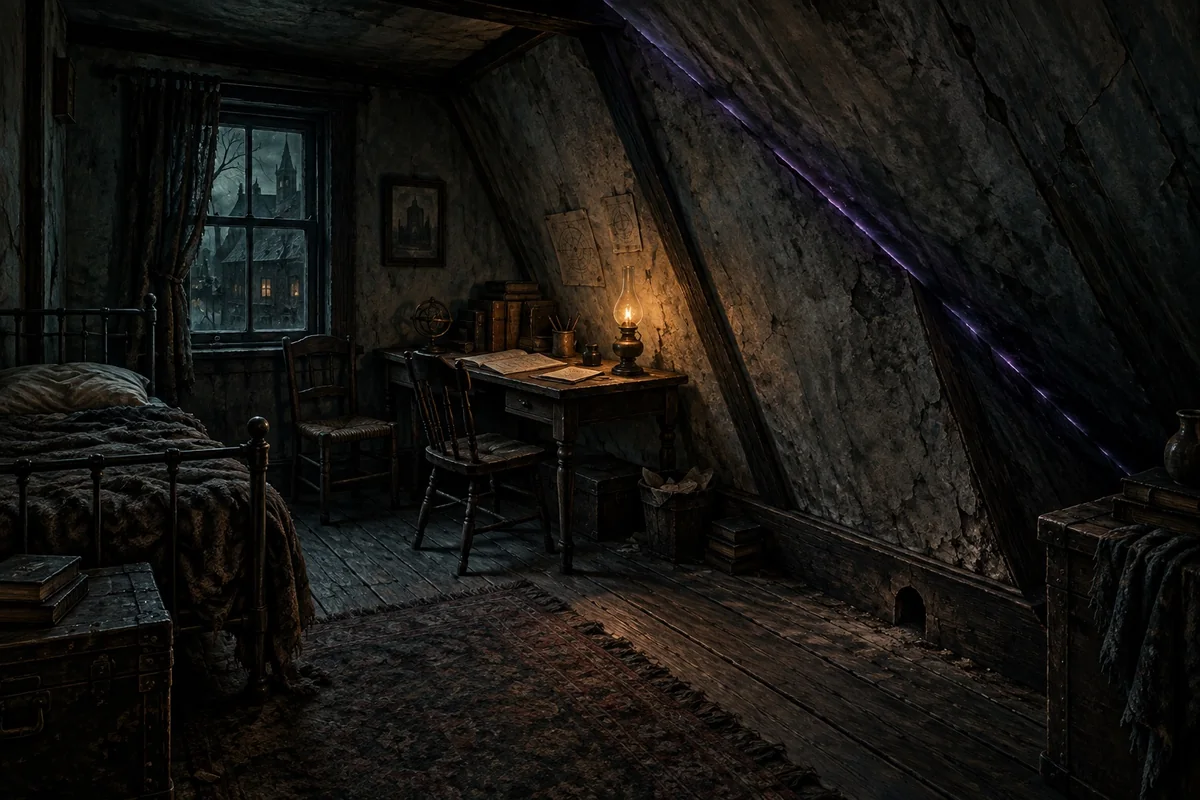
Gilman obtains the eastern attic room after renting in the building. Its north wall leans inward, and the low ceiling slopes in the same direction. The convergence of these surfaces becomes his principal object of study.
There must be space between the angled partition and the building’s straight outer wall. An old boarded window can be recognized from outside, but no ordinary access remains visible within the room. Another closed area lies above the sloping ceiling.
Gilman finds evidence of an old opening from the adjoining loft, covered with heavy planks and wooden pegs. The landlord refuses to let him investigate further. This leaves two kinds of possible explanation in play: hidden physical chambers and spatial properties that might permit movement without an ordinary doorway.
Sources: [1]
The household and its inhabitants
Dombrowski manages the lodging-house with his wife. Frank Elwood, another Miskatonic student, lives on a lower floor, while Joe Mazurewicz, Desrochers, Paul Choynski and other lodgers occupy rooms around them.
The house’s thin boundaries make private experience partially audible. Residents hear footsteps above, scratching within partitions, prayers below and occasional noises they cannot explain. Their different positions provide observations that Gilman cannot obtain from his own bed.
Its poverty also affects responses to danger. The building remains occupied despite its reputation because it offers cheap rooms. Later, officials decline to break open the closed spaces to investigate the smell, assuming that dead rats explain it and treating the district as unworthy of elaborate intervention.
Sources: [1]
Angles as routes
Gilman’s research leads him to regard the room’s geometry as more than accidental distortion in an old structure. Keziah’s reported use of lines and curves suggests that the arrangement may relate to passage beyond familiar space.
In his experiences she appears near the meeting point of the slanting surfaces, and he is taken through intermediate regions to other destinations. Eventually he tries to use the same kind of knowledge to return unaided.
The narrative’s spatial mechanism remains fictional and incomplete. There is no usable set of measurements by which a reader could reconstruct the room as an actual working portal. An illustrative floor plan should therefore be labeled interpretive, particularly if it adds doors, dimensions or routes not described in the story.
Sources: [1]
The hidden chamber
During the journeys, Gilman reaches a cramped space with a peaked roof and sloping floor. Low cases hold old books, a table and bench are fixed in position, and strange objects occupy the room. A dark triangular opening leads downward at one side.
He increasingly believes that this is the sealed loft above his rented chamber. The apparent nearness makes the horror more disturbing: an inaccessible room in the same house may require passage through alien spaces to reach.
The Black Man’s book scene and the attempted sacrifice both occur in this setting. The building consequently contains not only a haunted bedroom but a continuing place of work, storage and ritual. Its ordinary walls conceal activity rather than merely preserving memories of something long finished.
Sources: [1]
Failed precautions
Gilman blocks rat-holes and tries to detect sleepwalking by spreading flour. Dombrowski covers openings and lays poison. Elwood offers a couch in his own room so that Gilman will not sleep alone.
The measures produce limited relief and useful observations, but they do not end the danger. New openings appear, journeys continue and tracks are found without a corresponding trail through the hall. Brown Jenkin ultimately reaches Gilman even after he has left the original attic room.
These failures are specific to the building and the beings using it. They do not make every practical action meaningless: the flour, shared lodging and witness observations all help establish that the events exceed Gilman’s initial explanation. What they fail to provide is lasting protection.
Sources: [1]
Abandonment and the 1931 destruction
After Gilman’s death, Dombrowski abandons the lease and moves with the older tenants. The house is never rented again. The increasing odor around the attic adds to its reputation, and the building is eventually condemned.
A gale in March 1931 damages the roof and chimney, sending debris through the attic. Demolition begins in December. These dates concern the later destruction; the main narrative does not state Gilman’s death year with the same precision.
Clearing the wreckage exposes remains that the intact walls had hidden. Police, a physician and university scholars become involved, extending the inquiry beyond the former tenants’ private experiences.
Sources: [1]
What the demolition reveals
The fallen loft material contains bones attributed to a child and an elderly woman, old books and papers, a stained bowl, the broken crucifix and unfamiliar artifacts. One stone object resembles the metal figure Gilman had previously given to Miskatonic’s museum.
The space behind the slanting wall contains children’s bones from many periods, an ornate knife and a strange rat-like skeleton. The mixture supports the suggestion of repeated activity extending far beyond one modern episode.
Several questions remain unresolved. Papers of widely different ages show the same handwriting, modern remains occupied supposedly inaccessible spaces, and the rat-like skeleton resists ordinary classification. The building’s destruction supplies evidence without reducing the entire history to an accepted explanation.
Sources: [1]
References
- The Dreams in the Witch House — original text
The fictional narrative is evidence for what the story says, not proof of events in the real world.
At a glance
Arkham, Massachusetts
Cheap lodging-house
Dombrowski
Eastern attic chamber with slanting wall and ceiling
Keziah Mason
Walter Gilman
March 1931
December 1931