

Brown Jenkin
Brown Jenkin is Keziah Mason’s rat-like familiar in The Dreams in the Witch House. Its human-looking face, grasping paws and ability to travel with the witch make it a far more capable adversary than its small size suggests. It survives the encounter that defeats Keziah and carries the story’s danger into the apparent aftermath.
5 min read · 938 words
Appearance and scale
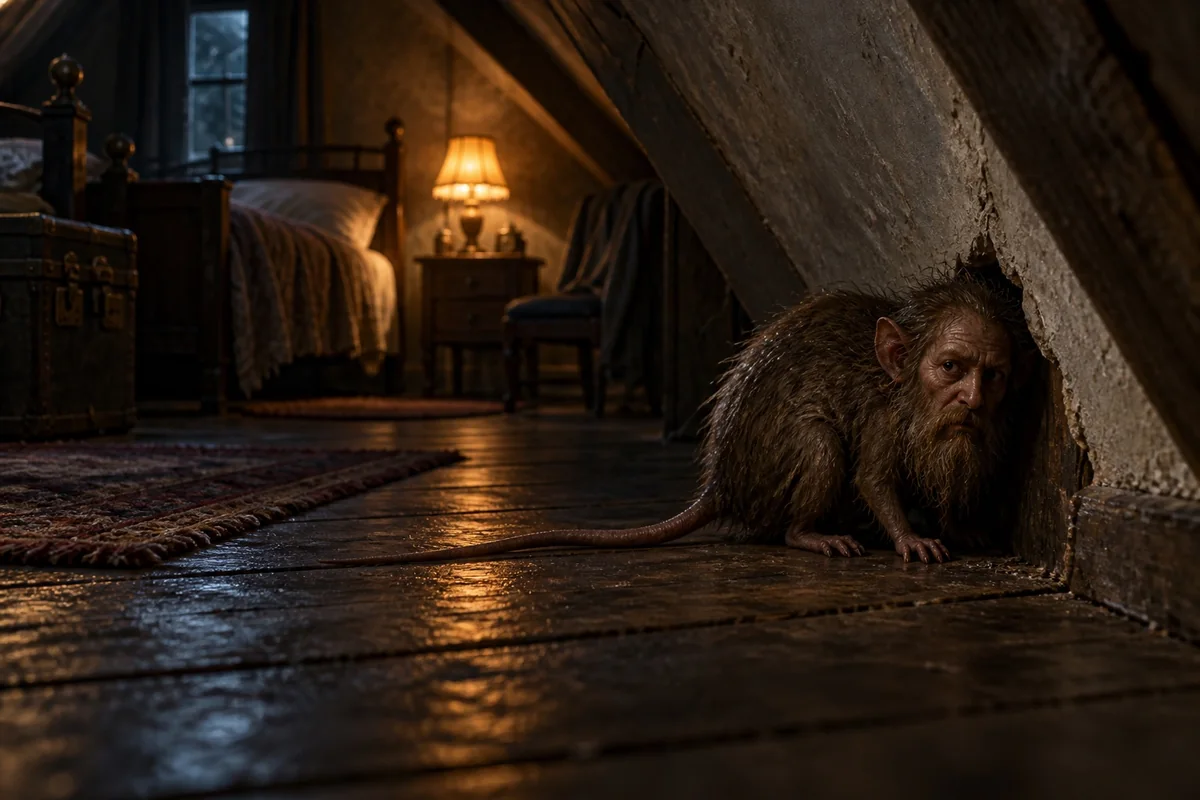
Brown Jenkin is approximately the size of a large rat, with long hair and a sharply toothed, bearded face that resembles a human one. Its paws resemble miniature hands. The combination produces a disturbing mismatch between a familiar household pest and signs of human expression and dexterity.
The teeth are repeatedly important to the action. They can draw blood for a ritual, injure Gilman and inflict fatal wounds. The familiar’s small body also lets it use openings in the walls through which a larger adversary could not pass.
The narrative eventually associates its face with Keziah’s. That resemblance is part of Gilman’s recognition of the pair’s connection. It is not accompanied by a confirmed account of parentage, manufacture or a transformation from a named human being.
The familiar in local testimony
Gilman encounters Brown Jenkin in the old records and in Arkham’s contemporary stories before his own experiences become decisive. The account of Keziah’s 1692 escape includes the jailer’s report of a small furry creature. Other witnesses describe the familiar with an unusual degree of agreement.
Local lore says that it carries messages between Keziah and the devil, feeds on the witch’s blood and can speak every language. Its voice is described as a repellent titter. These details are introduced as testimony and tradition, not as results of a controlled investigation by the student.
Later scenes demonstrate speech-like ritual participation and purposeful cooperation. They do not test the universal language claim. A careful description can record the reputation while distinguishing it from abilities directly shown in the narrative.
Rat-holes and the approach to Gilman
In Gilman’s early dreams, Brown Jenkin emerges from a hole near the sloping wall and approaches his bed through a violet glow. The student repeatedly tries to close the opening. Ordinary rats appear to undermine those efforts, and a new hole eventually replaces one covered with metal.
The resulting uncertainty is effective because the house really is infested. Scratching and movement can have an ordinary cause, yet they also provide cover for a creature that looks sufficiently rat-like to be dismissed at a glance.
Moving to Elwood’s room gives Gilman temporary relief, but another hole appears there. The familiar’s access is not limited to the first attic chamber. Rat poison and a change of sleeping place do not prove sufficient to end the visits.
Travel through unfamiliar spaces
Brown Jenkin accompanies Keziah and Gilman on journeys beyond ordinary space. In the intermediate regions it corresponds to a small polyhedron whose angles and colors continually change. At destinations where Gilman again perceives ordinary bodies, its rat-like form returns.
It directs Gilman on the green hillside and appears with the witch in the city under three suns. These episodes connect the creature to the same routes that make Keziah dangerous, while preserving its role as an intermediary rather than identifying it as the ruler of those worlds.
The geometric appearance is a change in how the traveler encounters the being across dimensions. The story does not supply a mechanical diagram of its anatomy or a rule allowing readers to infer every possible form from a specific number of sides.
The book and the kidnapped child
During the scene before the Black Man’s open book, Brown Jenkin climbs Gilman’s clothing and bites his wrist. The blood appears to serve the demanded initiation. Gilman later finds the wound and stained cuff but remains uncertain about what followed it.
The familiar is present again during the abduction of Ladislas Wolejko. It moves around the Black Man’s feet outside the building. The child’s mother had already reported seeing it and feared that her son had been selected for the approaching May Eve rites.
At the attempted sacrifice, Brown Jenkin participates in the spoken ritual. When Gilman prevents Keziah from using the knife, the familiar completes the killing during their struggle. Its grasping limbs and teeth make it independently capable of carrying out the crucial act.
Survival after Keziah’s fall
Gilman kicks Brown Jenkin into the adjoining dark space when it attacks his ankle during the struggle with Keziah. He hears it below, so the fall does not establish its death. The witch’s apparent defeat and the loss of the violet light leave the smaller threat unresolved.
After Gilman returns, the familiar attacks him in bed in Elwood’s room. Witnesses see a large rat-like shape escape after the fatal injuries. Mazurewicz interprets the bloody tracks as prints from four tiny hands, though others do not fully agree.
This final attack makes Brown Jenkin essential to the plot rather than an ornamental companion. The creature survives the confrontation that appears to close the central danger and destroys the person who has just found a way back from it.
The skeleton in the ruined house
Years later, after the 1931 storm and subsequent demolition, workmen discover a partly crushed rat-like skeleton among the material behind the attic partition. Its grasping paw structure and anomalous, almost human skull disturb the university anatomists and the people who found it.
The find corresponds closely to the familiar’s descriptions, but the story does not provide a clear witnessed account of its final death. Poison, decay and the building’s destruction are not interchangeable explanations that can be selected without evidence.
Rumors of tittering had continued around the deserted property. The workers regard the discovery with relief, believing the sound will not return. That belief belongs to the final human response to the remains, while the narrative leaves the exact end of the living creature unobserved.
Related music
A Thousand Masks is a dark metal song inspired by Nyarlathotep, the Crawling Chaos who walks among humanity, hiding behind countless faces and whispered lies.
References
- The Dreams in the Witch House — original text
The fictional narrative is evidence for what the story says, not proof of events in the real world.
At a glance
The Dreams in the Witch House
Familiar of Keziah Mason
Comparable to a large rat
Long hair; bearded human-like face; sharp teeth; grasping paws
A small shifting polyhedron
Guiding, biting, ritual participation and lethal attacks
Messenger role and knowledge of all languages, according to local testimony
An anomalous rat-like skeleton found during demolition