

The Dreams in the Witch House
The Dreams in the Witch House brings witchcraft, advanced mathematics and the physical consequences of nightmare into one story. Walter Gilman’s attempt to understand an old Arkham room leads from disturbing dreams to an alien artifact, a coerced initiation, a child’s abduction and a catastrophe that later discoveries in the building partly corroborate.
11 min read · 2,150 words
Composition and first publication
Lovecraft composed the story between January and 28 February 1932. It first appeared in the July 1933 issue of Weird Tales, volume 22, number 1. The gap between writing and publication distinguishes it from works actually composed later in the same period.
The narrative follows Gilman closely but is not his first-person statement. After his death it can continue through Frank Elwood’s experience, the departure of the lodgers and the building’s eventual destruction. This structure allows objects and remains to outlast the consciousness through which the principal events were experienced.
The main catastrophe occurs before the explicitly dated destruction of the house in 1931. The story does not give an equally explicit calendar year for Gilman’s death. Treating the writing date or publication year as the year of his experiences would contradict the narrative’s own retrospective sequence.
Sources: H. P. Lovecraft Archive — fiction in composition order, H. P. Lovecraft Archive — fiction in publication order, The Dreams in the Witch House — original text
A student chooses the Witch House
Walter Gilman comes from Haverhill and studies at Miskatonic University. In Arkham he begins connecting mathematical research with accounts of witchcraft. His reading includes the Necronomicon, the Book of Eibon and von Junzt’s Unaussprechlichen Kulten, until university authorities restrict his access and reduce his academic load.
He deliberately rents in the house associated with Keziah Mason. According to the fictional records he studies, she escaped confinement during the 1692 witch trials after describing ways to pass between regions of space. Her cell bore strange curves and angles, and testimony mentioned the familiar known as Brown Jenkin.
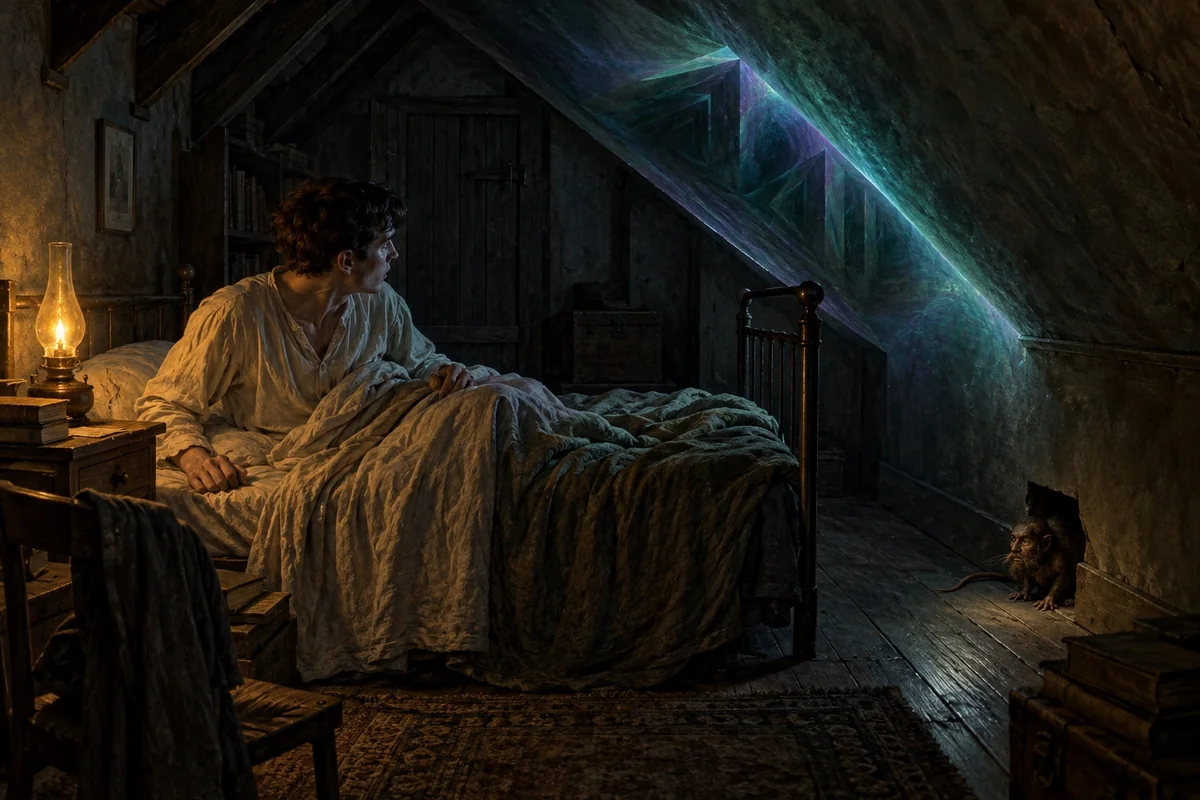
Gilman secures the eastern attic room where Keziah supposedly worked. A slanting wall and ceiling create an irregular corner that increasingly absorbs his attention. Closed spaces lie beside and above the room, but the landlord will not permit him to open them. The student gradually becomes more interested in the geometry of the surfaces than in discovering an ordinary hidden chamber.
Fever, hearing and the first dreams
The dreams begin in early February alongside fever and abnormal sensitivity to sound. Gilman stops his clock because its ticking has become intolerable. Rats in the walls, creaking timbers and noises he cannot identify prevent the house from offering any reliable quiet.
He dreams of movement through spaces whose colors, materials and directions do not correspond to ordinary experience. Some forms appear organic, others architectural or geometric. He cannot see or understand his own body in the same way he does while awake.
In a shallower stage of sleep, a violet glow illuminates the attic and Brown Jenkin approaches from a rat-hole. The familiar has a rat-like body, human-looking face and grasping extremities. By March an old woman appears as well. Gilman connects her with a figure he has actually seen in Arkham’s lanes, allowing him to explain the dream as a distorted memory even while its force increases.
Mathematics and travel between dimensions
Gilman’s formal work suffers, but his intuitive mathematical ability improves. Professor Upham is impressed by his handling of problems involving higher dimensions. Gilman proposes that a traveler might leave familiar space and re-enter it at a distant location without crossing all the ordinary distance between the two points.
The theory includes an important distinction between reaching a place and surviving there. A mathematically accessible destination might still possess conditions fatal to the traveler. Later discussion also considers regions without ordinary time, offering a possible explanation for survival across centuries.
These are speculative devices within the fiction. The story invokes contemporary scientific names and concepts to reframe witchcraft as access to laws beyond current human understanding. It does not provide a real mathematical demonstration that room angles open portals or that quantum physics validates magical practices.
Sleepwalking and warnings from the lodgers
Frank Elwood, another poor student living in the house, finds Gilman absent from his room at night even though his clothes remain there. Other residents report footsteps and unusual light. Gilman considers sleepwalking and decides that a trail of flour might reveal where he goes.
Joe Mazurewicz, a loomfixer, warns that the approach of May Eve makes the house particularly dangerous. He connects the witch and her familiar with missing children and urges Gilman to obtain religious protection. Desrochers and other lodgers add observations that the students initially interpret as superstition.
This difference in interpretation drives the investigation. The tenants possess local expectations about the season and the building, while Gilman possesses a theory that could account for movement through impossible spaces. Neither kind of knowledge, by itself, gives him an effective way to stop what is happening.
The green hillside and the pull from the stars
On the night of 19–20 April, Gilman’s passage through the strange spaces ends on a rocky hillside under green light. Movement is difficult, and Keziah and Brown Jenkin direct him back through a particular arrangement of gestures and angles.
After waking, he feels an attraction toward a point that changes its apparent direction over the day. He eventually recognizes that the source lies in the sky, between Hydra and Argo Navis. The changing terrestrial bearing is consistent with his sense that he is being drawn toward something beyond Earth.
He also sees the old woman on an island in the Miskatonic where he had previously examined standing stones. The story keeps bringing remembered research, apparently ordinary observation and dream experience into contact. Gilman’s earlier curiosity now gives him enough recognition to be frightened, but not enough control to remain safe.
The city under three suns
Another journey brings Gilman onto a terrace above an immense alien city illuminated by three differently colored suns. Unfamiliar towers, platforms and architectural forms stretch below him. Heat affects his bare feet, and he clutches the balustrade when the height makes him dizzy.
A small metal figure breaks away in his hand. It represents a ridged, barrel-shaped organism with radiating appendages and star-like structures at either end. Keziah and Brown Jenkin then approach with three living beings corresponding to the figures, each about eight feet high. Gilman loses consciousness.
He wakes with painful, sunburn-like marks. Later he finds the broken ornament on his table. Mrs. Dombrowski confirms that she discovered it in his bed while making the room. An object associated with the dream has now entered the experience of another person.
The artifact becomes independent evidence
Gilman and Elwood take the figure to museums and professors, claiming it came from a public rubbish bin. None can identify its origin. Professor Ellery analyzes a detached portion and finds familiar metals mixed with substances that the story’s chemists cannot place within their periodic system.
The narrative states that the object remains in Miskatonic’s museum. Unlike evidence that a frightened narrator destroys or loses, it survives for continued examination. Its presence does not tell the investigators everything about Gilman’s journey, but it resists an explanation confined to private dreams.
The living beings and ornament resemble the star-headed, barrel-bodied forms associated elsewhere with Lovecraft’s Elder Things. This story’s immediate scene leaves its city unnamed and does not supply a planetary label. It should not be assigned to Yith, Yuggoth or Antarctica simply to complete a map.
The Black Man and the book
Keziah brings Gilman to a cramped, peaked chamber with books, strange objects and a table. A silent, black-robed figure points to a large open volume. Brown Jenkin bites Gilman’s wrist, apparently providing blood for the demanded signature.
Gilman later remembers hints of a further passage toward the ultimate chaos associated with Azathoth. His recollection is incomplete, and he remains unsure whether he actually signed the book. The narrative connects the witch-cult’s Black Man with Nyarlathotep through the students’ discussion and Gilman’s reading.
The figure’s appearance uses the story’s charged language of color and race, but he is a supernatural intermediary, not evidence for a real ethnic identity. His role is to turn Gilman’s independent search for knowledge into submission to powers that claim authority over the routes he has discovered.
Temporary relief and the abduction
Moving to Elwood’s room gives Gilman several nights of relief. The landlord lays poison for the rats, and the students continue investigating the metal image. New holes and sightings eventually show that the change of room has not ended the threat.
In another dreamlike episode, Keziah drags Gilman into a muddy alley while the Black Man waits outside. She enters a room and emerges with a small unconscious child, which she tries to make Gilman carry. He attempts to escape, but the waiting figure seizes him by the throat.
On 29 April Gilman wakes in his former attic room with mud on his feet and clothes and marks on his neck. The tracks include forms unlike his own and do not continue through the corridor. A newspaper reports the disappearance of two-year-old Ladislas Wolejko from Orne’s Gangway. Witnesses describe a group corresponding to the figures in his experience, including a young man in nightclothes.
May Eve and the failed rescue
The students stay awake the following night but cannot indefinitely resist exhaustion. As May Eve arrives, Mazurewicz insists that Gilman wear the crucifix he has supplied. Distant chanting becomes audible to Gilman’s extraordinarily sensitive ears, and Keziah and Brown Jenkin reach him again.
In the hidden chamber, the child lies on a table. Keziah gives Gilman a bowl and prepares a knife. His revulsion breaks through his paralysis, and he prevents the knife from descending. During the struggle he displays the crucifix, which momentarily frightens her, then uses its chain to strangle her.
Brown Jenkin intervenes and is kicked into the adjoining gulf. Gilman then discovers that the familiar has already completed the killing while he fought Keziah. His resistance has stopped the witch’s action but has not saved the child. The scene denies an uncomplicated heroic resolution even before the later attack on Gilman himself.
Return, deafness and Gilman’s death
Gilman attempts to use his own knowledge of the angles to return unaided. The journey exposes him to the overwhelming cosmic sound he has long feared. The lodgers find him in the attic, injured and largely unconscious.
Dr. Malkowski discovers that both eardrums have ruptured. Gilman, whose hearing had made ordinary sounds unbearable, is now deaf. He communicates with Elwood through written questions and resolves to leave the house as soon as possible.
That night he screams in agony on Elwood’s couch. A rat-like creature emerges from the bloodied bedclothes and escapes into a hole. The doctor finds Gilman dead with catastrophic internal injuries. Mazurewicz believes the tracks resemble tiny human hands, although other witnesses are unwilling to accept that interpretation. Killing Keziah has not immediately removed her familiar.
The house after the catastrophe
Dombrowski and the older tenants abandon the property. A terrible odor develops around the closed attic spaces, which officials attribute to poisoned rats. No one opens the areas then, and the building remains empty before being condemned.
In March 1931 a storm wrecks the roof and chimney. Demolition follows in December. Workmen discover the bones of a child and an elderly woman among the fallen material, together with books, unfamiliar objects, a metal bowl and the broken crucifix.
The adjoining sealed space contains a much larger accumulation of children’s bones from different periods and an ornate knife. A partly crushed skeleton of a large rat-like animal has unusually grasping paws and a skull that disturbingly resembles a distorted human one. These discoveries echo details of Gilman’s experiences without producing an accepted explanation for how the sealed spaces remained in use.
What the ending confirms and leaves open
The ending supplies several kinds of surviving evidence: the museum figure, bones, writing across papers of very different ages and objects matching the hidden chamber. It therefore goes beyond a simple claim that Gilman imagined everything during a fever.
At the same time, the investigators do not establish a complete history. The narrative does not give an exact account of Keziah’s movements through every intervening century, explain Brown Jenkin’s origin or reveal a usable method for repeating the journeys safely.
The crucifix also works in two distinct ways: its appearance disrupts Keziah’s attack, and its chain becomes a physical weapon. That episode concerns this witch in this encounter. It does not demonstrate that every cosmic entity in Lovecraft’s fiction can be defeated with the same symbol.
Local knowledge and cosmic horror
The horror operates at several scales at once. A student’s rented room connects with other worlds; an old prosecution record suggests advanced spatial knowledge; an apparently small familiar survives the defeat of a more imposing adversary. The domestic environment remains dangerous even after the narrative has opened onto immense cosmic distances.
The treatment of the immigrant lodgers is also revealing. The narration repeatedly belittles their beliefs, yet their warnings and observations anticipate events the students struggle to understand. Recognizing this tension allows the reader to discuss the story’s prejudice without repeating its dismissive judgments as neutral description.
Gilman’s failure is not simply lack of intelligence. He recognizes patterns, gathers evidence, seeks help and resists the intended murder. The catastrophe arises because knowledge of a route does not confer control over the beings using it, and an act of resistance can succeed locally while leaving another threat alive.
Related music
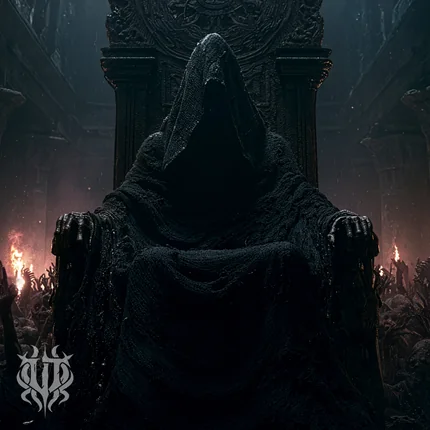
A Thousand Masks is a dark metal song inspired by Nyarlathotep, the Crawling Chaos who walks among humanity, hiding behind countless faces and whispered lies.
References
- H. P. Lovecraft Archive — fiction in composition order
Composition dates; question marks and ranges retain the source uncertainty.
- H. P. Lovecraft Archive — fiction in publication order
First publication dates and venues; issue dates can differ from actual release dates.
- The Dreams in the Witch House — original text
The fictional narrative is evidence for what the story says, not proof of events in the real world.
At a glance
H. P. Lovecraft
January–28 February 1932
1933, July
Weird Tales, 22, No. 1
Fiction