

Azathoth
Azathoth is an unfinished prose fragment about an unnamed city dweller who reaches the worlds of dream through prolonged contemplation of the night sky. Although its title is shared with a major Mythos entity, the surviving passage does not describe or name that being within its narrative.
2 min read · 409 words
The surviving fragment
The Archive dates Azathoth to June 1922. It was first published posthumously in Leaves, number 2, in 1938, on page 107.
The surviving text is a short opening rather than a completed quest. Its endpoint places the dreamer on a distant shore; it supplies no subsequent adventure or confrontation. An encyclopedia synopsis must stop where the fragment stops.
A world that has lost wonder
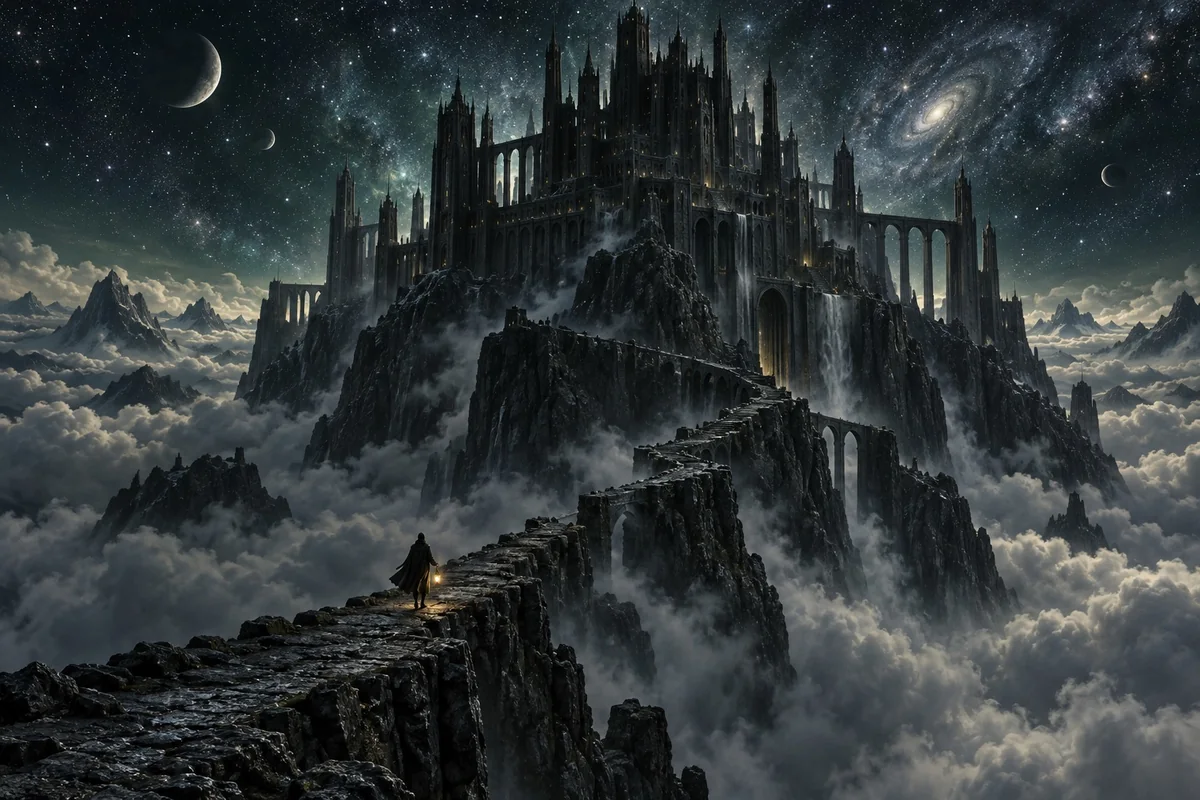
The opening describes an age in which cities, utilitarian learning and impoverished imagination have displaced beauty and wonder. The unnamed protagonist works amid urban noise and returns to a room overlooking an enclosed court.
His window offers walls and other windows rather than open country. Only by leaning out can he glimpse passing stars above. That limited opening becomes the point through which a larger life remains imaginable.
The story does not name the city or provide enough geographical evidence to identify it as a particular place in Lovecraft's biography. Its function is to constrain the dreamer, not to establish a documentary address.
Sources: [3]
The expansion of vision
Night after night the man watches the stars, learns their names and follows them imaginatively after they leave his narrow field of view. Repeated attention eventually opens vistas unavailable to ordinary perception.
The boundary between room and sky then gives way. Streams of color, dust, fire and strange oceanic imagery surround him. The movement carries his dreaming awareness away while the body remains at the window.
Time ceases to be measured by an ordinary calendar. After a long passage through remote regions, he is left asleep on a green shore among flowers at sunrise.
Sources: [3]
Title, deity and incomplete promise
The name Azathoth occurs as the title, but the surviving prose offers no account of a cosmic ruler, a court of musicians or a monstrous body. Those features must be studied through other texts and the separate entity entry.
Likewise, the unnamed dreamer should not automatically be relabeled Randolph Carter. Shared motifs of confinement, longing and passage into dream establish a meaningful comparison without establishing personal identity.
The fragment is valuable as an expression of escape from a narrowed modern world. Its gentle final movement also cautions against assuming that every voyage beyond ordinary perception must already have reached the hostile cosmic center suggested by the title.
Sources: [3]
Related music
References
- H. P. Lovecraft Archive — fiction in composition order
Composition dates; question marks and ranges retain the source uncertainty.
- Azathoth — publication data
- Azathoth — original text
The fictional narrative is evidence for what the story says, not proof of events in the real world.
At a glance
H. P. Lovecraft
June 1922
1938
Leaves, 2
Fragment / unfinished fiction