

Azathoth
Azathoth is the mindless central power associated with ultimate Chaos, strange music and the Other Gods. Lovecraft uses the figure in dream narrative, poetry, witchcraft lore and the final fears of Robert Blake, while leaving much of its nature deliberately unresolved.
6 min read · 1,233 words
Three different kinds of source
The name Azathoth belongs to an unfinished prose fragment, a sonnet in Fungi from Yuggoth and references within longer stories. Those sources are related but not interchangeable. A work carrying the name as its title does not necessarily contain a physical description of the being. A poem can present cosmic images whose relation to prose-world geography remains suggestive rather than fixed.
Sources: [1], [2], [3], [4], [5], [6], [7]
The prose fragment was written in June 1922 and published in 1938. The Dream-Quest of Unknown Kadath, composed in 1926–1927, gives Azathoth a prominent place in warnings about what lies beyond the Dreamlands and in the danger threatened for Randolph Carter. The Fungi sequence was principally composed at the end of 1929 and beginning of 1930. The Dreams in the Witch House and The Haunter of the Dark supply later narrative contexts for the same name.
The 1922 fragment: escape from a city
The surviving Azathoth fragment concerns an unnamed man whose urban life has become intolerably narrow. He works amid noise and shadow, then returns to a room whose window faces other walls. The visible stars provide a small opening beyond that enclosure. Years of looking outward gradually become an imaginative passage into a much larger reality.
The room is finally filled by a visionary influx from beyond the ordinary world. Streams of color, dust, strange oceans and unearthly life surround the dreamer. He is carried toward a fragrant shore after a journey whose duration cannot be measured by the usual calendar. The surviving text stops there. It neither introduces a speaking Azathoth nor stages an encounter with a cosmic throne.
The fragment is valuable for the contrast between confinement and imaginative release. Its title connects it with the later name, but the relationship cannot be completed by inventing the missing remainder. A detailed encyclopedia should describe what survives and its publication history rather than supply an ending as if Lovecraft had written one.
Beyond the ordered universe in Dream-Quest
The priests Nasht and Kaman-Thah warn Carter that his intended journey may lead outside the region in which ordinary dreams can sustain him. Azathoth belongs to that ultimate danger. Its surroundings are described through darkness, shapelessness, gnawing movement and the monotonous music of drums and flutes. The accompanying Other Gods move in a manner that makes their immense power appear disconnected from human reason or dignity.
The location is expressed as a center of infinity while also lying beyond time and the ordered universe. These are imaginative descriptions of extremity, not coordinates that can be transferred to a modern astronomical map. The story places the danger beyond the navigable territories Carter knows. Its remoteness is conceptual as well as geographical.
Nyarlathotep later directs Carter toward this region under the pretense of helping him return to his desired city. The shantak carrying him is part of that deception. Carter recognizes the trap and escapes through an act of remembering and awakening before the intended journey concludes. Azathoth is the threatened destination; it does not hold a conversation with Carter at Kadath or pursue him through the castle in a measured body.
The difference between the two figures gives the episode its structure. Nyarlathotep can understand and manipulate Carter’s desire, while the remote central power offers no expectation of recognition or mercy. The messenger’s intelligibility makes the final unintelligibility more frightening.
Sources: [5]
The sonnet and the making of cosmic law
Sonnet XXII of Fungi from Yuggoth takes a speaker beyond familiar space to a formless region. Azathoth mutters about dreams it cannot understand. Nearby beings move to a damaged flute, and the poem associates the accidental combination of its waves with the laws of individual universes. The guide identifies himself as a messenger and treats his master with contempt.
The poem therefore contains a more particular account of cosmic order than the general phrase blind chaos suggests. Order can emerge from an aimless process; the laws that appear permanent inside a cosmos need not originate in a wise intention. The contrast between the formal control of a sonnet and the disorder it depicts also sharpens the effect.
This passage does not say that the whole universe is one coherent dream being knowingly maintained by Azathoth. Nor does it set out an event in which waking the being necessarily deletes all existence. The poem includes dreams, a cosmic master and the generation of laws, but those elements should be described in the relationships actually given. The familiar modern formulation about reality disappearing at awakening goes beyond what this particular source establishes.
Sources: [8]
The book and throne in The Dreams in the Witch House
Keziah Mason presses Walter Gilman toward an initiation that includes signing a book in blood and accepting a new name. The destination she invokes is Azathoth’s throne at the center of Chaos. Brown Jenkin and the Black Man connect the local witchcraft encounter with the wider names Gilman has read in forbidden books.
Gilman’s dreams include strange geometries, altered sensory experience and a remote suggestion of piping. He sometimes tries to explain the imagery through his previous reading of the Necronomicon. The reader is given both those rationalizing explanations and physical traces that make a purely private dream increasingly difficult to maintain. Azathoth’s name helps connect an Arkham room with the threatening exterior of the known world.
The book of initiation should not automatically be treated as another title for the Necronomicon. One is the object associated with the demanded pledge; the other supplies Gilman with prior knowledge. The story does not furnish a complete copy of the first book or a list of everyone who has signed it. Its immediate significance lies in the obligation Keziah attempts to impose.
Sources: [6]
Robert Blake’s final invocation
In The Haunter of the Dark, Blake’s connection with the presence in the church produces visions of remote darkness and cosmic structures. He recalls accounts of Azathoth surrounded by mindless dancers and the sound of a flute. Near the end he appeals to Azathoth for mercy while the protective conditions around him fail.
The appeal is evidence of Blake’s terror and the religious vocabulary available to him. It is not followed by a narrated compassionate intervention. The central irony is that a threatened human consciousness reaches for mercy from a power elsewhere described through mindlessness. The scene allows the language of prayer to survive after confidence in a responsive divine order has broken down.
Sources: [7]
Form, attendants and the limits of an illustration
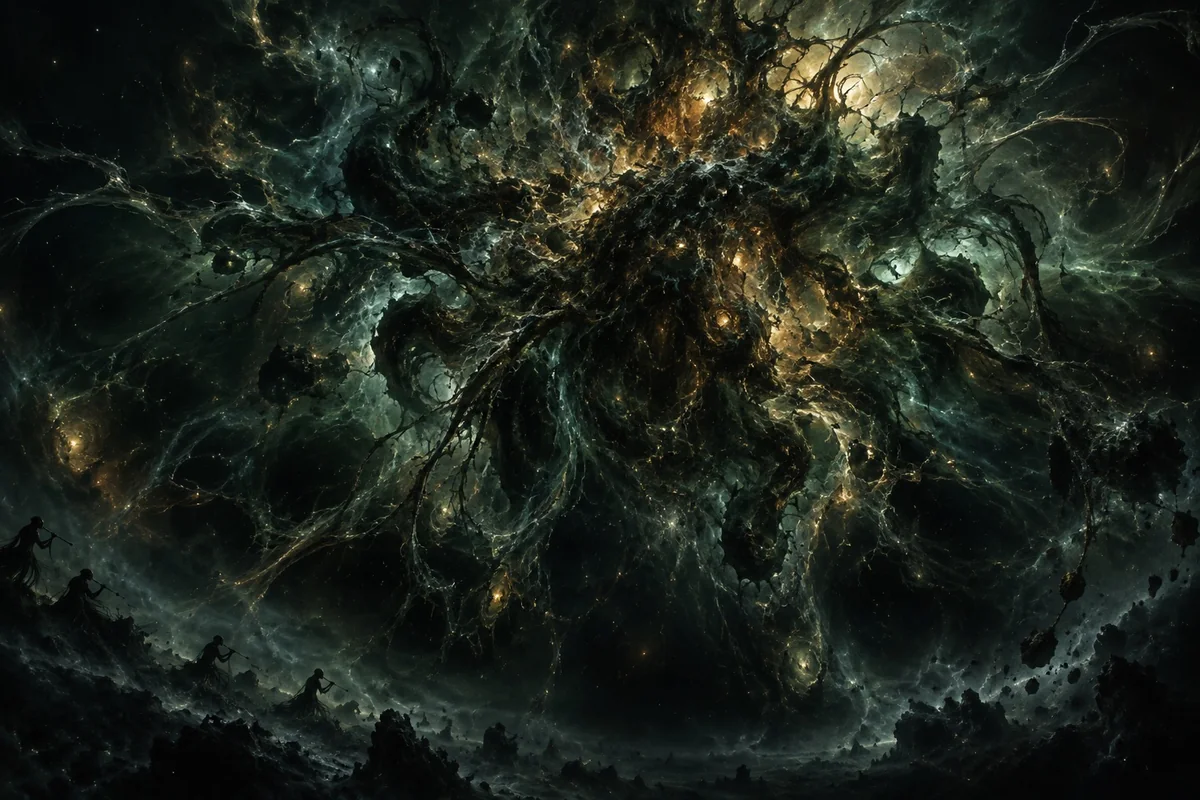
The principal descriptions emphasize an amorphous presence, chaotic surroundings and music. They do not specify a stable species, measured size, set of limbs or human-like face. The bat-like or shapeless attendants in the poetry and the dancing powers in Dream-Quest belong to the surrounding scene. They should not be merged into a single anatomical diagram of Azathoth itself.
A visual interpretation can use immense turbulence, partial forms and remote musicians to suggest the textual setting. Its arrangement of bodies and instruments remains the artist’s construction. The most faithful feature may be the inability to distinguish a complete outline, rather than a highly detailed invented monster with a fixed number of eyes.
Azathoth also remains distinct from the fragment called Azathoth, from Nyarlathotep and from every use of the phrase Other Gods. Linking those entries helps reconstruct the literary network without turning shared imagery into identity. The figure’s importance lies in what happens to the idea of ultimate authority when unlimited scale no longer guarantees understanding, intention or moral concern.
Related music
References
- H. P. Lovecraft Archive — fiction in composition order
Composition dates; question marks and ranges retain the source uncertainty.
- H. P. Lovecraft Archive — fiction in publication order
First publication dates and venues; issue dates can differ from actual release dates.
- Fungi from Yuggoth — bibliographical data
- Azathoth — original text
The fictional narrative is evidence for what the story says, not proof of events in the real world.
- The Dream-Quest of Unknown Kadath — original text
The fictional narrative is evidence for what the story says, not proof of events in the real world.
- The Dreams in the Witch House — original text
The fictional narrative is evidence for what the story says, not proof of events in the real world.
- The Haunter of the Dark — Unspeakable Tales ebook
The fictional narrative is evidence for what the story says, not proof of events in the real world.
- Fungi from Yuggoth — original sonnet sequence
At a glance
H. P. Lovecraft
Azathoth · June 1922 fragment
Ultimate Chaos beyond ordinary time and space
Amorphous presence; drums; flutes; mindless dancers
Fungi from Yuggoth · XXII
Nyarlathotep
Not supplied by the cited texts