

Discarded Draft of The Shadow over Innsmouth
The discarded draft of The Shadow over Innsmouth preserves portions of an abandoned version, not an alternative complete novella. Its opening, jewelry-shop scene and encounter with Zadok show how the familiar town took shape through revision. The narrator’s home, the retrospective destruction of Innsmouth and the presentation of the Marsh business differ from the finished story.
5 min read · 894 words
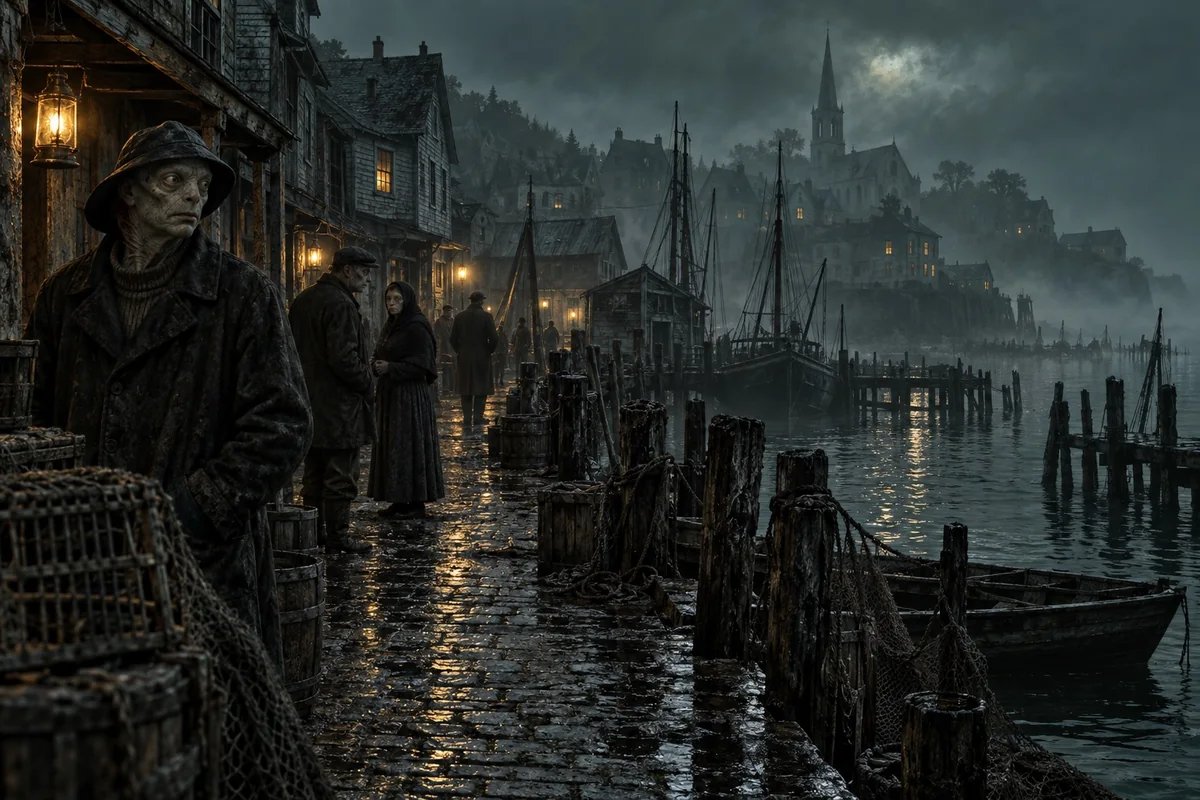
A fragmentary working text
The composition catalog places the draft in 1931. The Archive presents surviving material labeled pages 1–6, page 17 and page 21. Those labels expose gaps in the surviving sequence; they are not chapter numbers or a complete continuous plot.
The work-specific bibliography lists publication in The Acolyte, volume 2, number 2, Spring 1944, on pages 3–7. The project's original chronological catalog had instead recorded the 1994 Necronomicon Press edition. This article follows the earlier publication listed on the dedicated data page while retaining the raw catalog for provenance.
A discarded draft is evidence of composition. Its differences can illuminate revision, but they do not automatically supplement the final story as events that happened offstage.
Sources: H. P. Lovecraft Archive — fiction in composition order, Discarded Draft of The Shadow over Innsmouth — publication data, Discarded Draft of The Shadow over Innsmouth — original text
A different retrospective opening
The narrator says that he cut short a New England tour in the summer of 1927 and returned to Cleveland under severe strain. A recent newspaper report has made him more willing to discuss the experience.
That report describes a sweeping waterfront fire and a simultaneous explosion that destroys the offshore reef to great depth. The narrator welcomes the destruction, especially the loss of the jewelry works and the Order of Dagon hall. He hints that Father Iwanicki could explain more, but the surviving opening does not establish a complete account of responsibility.
The finished novella's retrospective frame uses different circumstances. Reading the two openings side by side reveals an altered way of disclosing the town's fate; it does not authorize combining the fire, explosion and later version's government action into one exhaustive chronology.
Sources: Discarded Draft of The Shadow over Innsmouth — original text, The Shadow over Innsmouth — Unspeakable Tales ebook
Transport, curiosity and local testimony
The draft already contains the economical route through Newburyport and the ticket agent's reluctant recommendation of Joe Sargent's bus. The narrator's curiosity grows because ordinary guides and local people seem to exclude the town.
The agent supplies information about Innsmouth's maritime past, decline, isolation and unusual inhabitants. His talk mixes practical observation, hearsay, commercial knowledge and explicit racial prejudice. Those categories are not interchangeable forms of reliable evidence.
He refers to the Marsh family's ancestry, the epidemic of 1846 and alarming experiences reported by visitors. Such remarks establish what the traveler hears before arrival. They should not be converted wholesale into independently confirmed history, particularly where the speaker acknowledges that he has never visited the place himself.
Sources: Discarded Draft of The Shadow over Innsmouth — original text
The Marsh jewelry business
The trade in unusual jewelry receives sustained attention. The factory allegedly uses a secret precious-metal alloy, and its products circulate widely enough to appear in advertising and collections. Questions arise about whether the operation really manufactures the goods it sells.
The agent describes inspections that found old machinery, few workers and disorderly books. The quantity and character of incoming supplies appear difficult to reconcile with the business's output. His explanation remains unresolved at this stage of the draft.
At the Newburyport library, the narrator studies printed advertisements and images of the ornaments. Their elaborate workmanship and aquatic designs attract him before he sees original pieces. The commercial paper trail makes the town's strangeness available at a distance.
Sources: Discarded Draft of The Shadow over Innsmouth — original text
The surviving retail-office scene
On the preserved page 17, the narrator enters the Marsh sales office. A young clerk's appearance and voice provoke unease. To disguise his curiosity, the narrator improvises a claim that he buys jewelry for a Cleveland firm.
The illuminated cases intensify the fascination established by the library images. The real objects appear more extraordinary than their reproductions. Their patterns suggest deep spaces and marine forms without yet providing a fully stated origin.
The passage breaks off while describing a disturbing sense of recognition. That interruption should remain visible in an account of the draft. The reader cannot supply a complete exchange with the clerk merely by extrapolating from the finished story.
Sources: Discarded Draft of The Shadow over Innsmouth — original text
Zadok and the last preserved passage
The preserved page 21 takes up an encounter with the elderly Zadok. The narrator obtains whiskey and leads him toward an abandoned portion of the waterfront, carefully controlling the amount he drinks in order to encourage speech without incapacitating him.
Zadok's nervous attention to the reef gives the setting an immediate significance beyond picturesque decay. The narrator finds the old man's fear more persuasive than expected, even while doubting the stories themselves. Father Iwanicki is mentioned again as someone susceptible to such testimony.
The surviving extract stops before it supplies a complete equivalent of the final novella's extended revelation. It preserves the arrangement of a conversation and the listener's changing response, not an alternative finished explanation of the Deep Ones.
Sources: Discarded Draft of The Shadow over Innsmouth — original text
Using the draft within the encyclopedia
This material belongs beside textual history, the Marsh ornaments and the finished Innsmouth narrative. Stable elements include the bus approach, an isolated town, uncertain testimony, the family's unusual commerce and the attraction of marine designs. Changed details reveal choices about pacing, evidence and the narrator's distance from the events.
The Cleveland identity and the hinted involvement of Father Iwanicki should be labeled as draft features. They are not corrections to the final narrator's biography or proof of an omitted conspirator in the published novella.
The gaps also place a limit on interpretation. One can compare what survives and identify changes; one cannot confidently reconstruct every missing page or claim that the draft would have ended in the same way as the completed work.
Sources: Discarded Draft of The Shadow over Innsmouth — original text, The Shadow over Innsmouth — Unspeakable Tales ebook
Related music
The Esoteric Order of Dagon is a dark metal descent into the world of Innsmouth, where ancient bloodlines, forgotten covenants and the call of the sea endure through countless generations.
References
- H. P. Lovecraft Archive — fiction in composition order
Composition dates; question marks and ranges retain the source uncertainty.
- Discarded Draft of The Shadow over Innsmouth — publication data
- Discarded Draft of The Shadow over Innsmouth — original text
The fictional narrative is evidence for what the story says, not proof of events in the real world.
- The Shadow over Innsmouth — Unspeakable Tales ebook
The fictional narrative is evidence for what the story says, not proof of events in the real world.
At a glance
H. P. Lovecraft
1931
Spring 1944; The Acolyte 2, no. 2, pp. 3–7
The Shadow over Innsmouth, Necronomicon Press
Discarded draft
Necronomicon Press, 1994
1–6, 17 and 21