

History of the Necronomicon
History of the Necronomicon is Lovecraft’s fictional bibliography of the forbidden book attributed to Abdul Alhazred. It traces imagined translations, suppressions, printings and surviving copies in the manner of a reference document. The dates inside it belong to the invented book’s history, not to evidence that the Necronomicon existed outside fiction.
4 min read · 807 words

A fictional reference document
Composed in 1927, the piece organizes a recurring literary invention into a compact historical account and a closing chronology. It is not a surviving chapter from an authentic ancient occult manual.
Its first publication was a posthumous pamphlet issued by Wilson H. Shepherd's Rebel Press in Oakman, Alabama. There is a bibliographical discrepancy in the consulted records: the Archive's individual data page gives November 1937, while its publication-order catalog used for this project's initial import gives 1938. Brown University's manuscript record likewise assigns the pamphlet a bracketed 1938. This entry presents the individual bibliography's date with the competing catalog attribution, rather than silently treating the dates as identical.
The real publication history must also remain separate from the fictional dates assigned to Arabic, Greek and Latin texts. A date such as 1228 describes Lovecraft's invented transmission history, not an edition that the wiki has authenticated.
Sources: H. P. Lovecraft Archive — fiction in composition order, History of the Necronomicon — publication data, H. P. Lovecraft Archive — fiction in publication order, Brown University — History of the Necronomicon manuscript
Alhazred and Al Azif
The account identifies the original work as Al Azif and explains its title through a sound associated with nocturnal insects and imagined demons. It attributes the text to Abdul Alhazred, a poet from Sanaá whose travels include Babylon, Memphis and the Arabian desert.
Alhazred is said to have spent a decade in the desert before living in Damascus. The closing chronology places the composition of Al Azif around 730. The prose gives 738 as the year of his reported death or disappearance and presents competing stories rather than an ordinary documented death record.
The account also associates him with Irem, a nameless desert town and the records of a prehuman race. Yog-Sothoth and Cthulhu are named as objects of his worship. These are particulars of the invented biography; they do not make the piece a reliable account of Islam, Arabian geography or medieval scholarship.
Translation and suppression
Theodorus Philetas is assigned a Greek translation in 950, with Necronomicon as its title. A subsequent suppression by Patriarch Michael is dated 1050 in the concluding chronology.
The Latin translation is attributed to Olaus Wormius in 1228. Pope Gregory IX is then said to have prohibited the Latin and Greek versions in 1232. The Arabic original is already unavailable by the time of the Latin translator's prefatory note.
These stages create a textual lineage in which each surviving form depends on an earlier, less accessible one. The narrative can therefore refer to a particular copy without implying that the reader possesses an intact original or every version of the work.
Printings and uncertain identification
The account distinguishes a fifteenth-century Latin printing, probably German, from a seventeenth-century Latin printing tentatively assigned to Spain. Their dates and places are inferred from typography because identifying publication marks are absent.
A Greek printing is placed in Italy between 1500 and 1550. No securely observed copy is reported after the destruction of a Salem collection in 1692, although a later rumor complicates that absence.
John Dee's English translation is described as unprinted and surviving only in manuscript fragments. A modern summary should not turn this into a complete commercially published English edition within Lovecraft's account.
The repeated qualifications matter. Probable printing places, approximate dates and rumors are part of the documentary effect, and they should remain qualified when transferred into an encyclopedia table.
Libraries, private copies and Pickman
The text assigns Latin copies to the British Museum, the Bibliothèque Nationale, Harvard's Widener Library, Miskatonic University and a university library in Buenos Aires. The mixture of real institutions and an invented university makes the list sound verifiable while remaining fictional.
Private holdings are less certain. One rumored fifteenth-century copy belongs to an unnamed wealthy American. Another report concerns a Greek text preserved by the Pickman family in Salem and subsequently lost with the disappearance of the artist R. U. Pickman in early 1926.
The distinction between stated holdings and rumors gives the imaginary book a wider circulation than the named library list alone. It does not authorize a claim that the real institutions listed possess the forbidden work described by Lovecraft.
The Chambers reference and the illusion of authority
The closing prose claims that rumors of the Necronomicon inspired Robert W. Chambers's The King in Yellow. This is part of Lovecraft's fictional bibliographical performance, not evidence establishing that real literary influence.
Names of writers, clerics, cities and libraries lend authority to a history whose central object is invented. The form is especially effective because it discusses ordinary problems of textual survival: translation, damaged evidence, uncertain imprints, censorship and private collecting.
For readers of the wider Mythos, the piece is a source for one author's version of the book's history. It is not a warrant for merging every later commercial Necronomicon, game supplement or fictional edition into a single authenticated lineage.
Related music
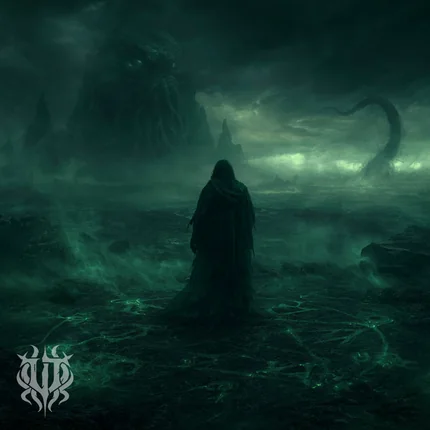
The Dead But Dreaming is a dark folk metal song inspired by The Call of Cthulhu, evoking R’lyeh, forbidden worship and the ancient dream beneath the sea.
References
- H. P. Lovecraft Archive — fiction in composition order
Composition dates; question marks and ranges retain the source uncertainty.
- History of the Necronomicon — publication data
- H. P. Lovecraft Archive — fiction in publication order
First publication dates and venues; issue dates can differ from actual release dates.
- Brown University — History of the Necronomicon manuscript
Manuscript description and the catalog’s supplied [1938] pamphlet date; compare the Archive individual bibliography’s November 1937 date.
- History of the Necronomicon — original text
The fictional narrative is evidence for what the story says, not proof of events in the real world.
At a glance
H. P. Lovecraft
1927
November 1937 on the individual bibliography; 1938 in the imported chronological listing
A History of the Necronomicon, The Rebel Press
Fictional bibliography