

The Festival
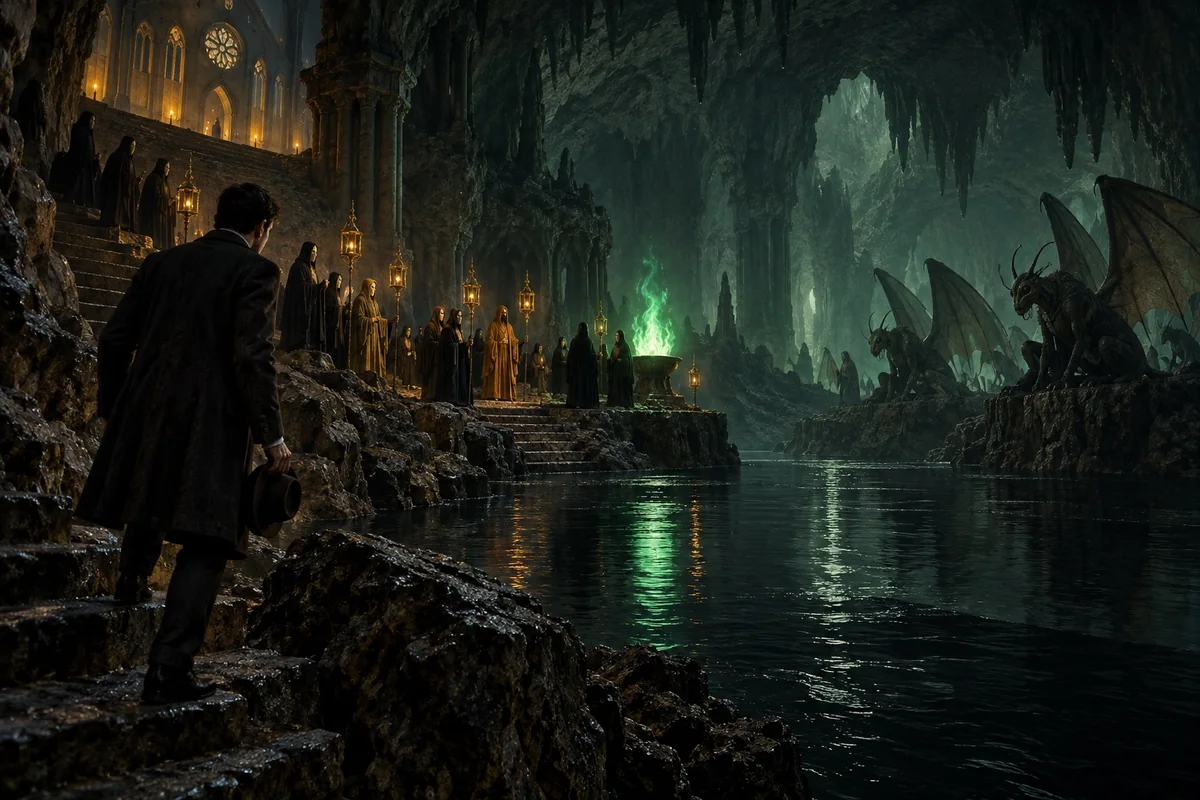
The Festival follows an unnamed visitor who comes to Kingsport to honor a family summons and joins a nocturnal procession into caverns beneath the town. An apparently ancestral welcome becomes an encounter with disguised bodies, an underground rite and a horrifying account of what may persist after death. The hospital ending preserves conflicting evidence rather than offering a straightforward return to certainty.
5 min read · 1,039 words
Composition and first publication
Lovecraft wrote The Festival in October 1923. It first appeared in the January 1925 issue of Weird Tales. Its first-person narration begins with a journey toward an ancestral community and ends with the narrator trying to understand what he has encountered through the Necronomicon.
The story treats the winter festival as older than familiar religious observances and even older than humanity. That claim belongs to its fictional ritual history, not to a substantiated account of the real origins of Christmas.
Sources: H. P. Lovecraft Archive — fiction in composition order, H. P. Lovecraft Archive — fiction in publication order, The Festival — Unspeakable Tales ebook
The summons to Kingsport
The narrator has never visited the town, but inherited instructions require descendants to keep the old festival once each century. He arrives alone in winter, describing his people as dispersed and their mysteries as no longer understood by the living.
From the hill he sees a snow-covered maze of old roofs, chimneys, steeples and narrow streets. Four relatives were executed for witchcraft in 1692, but he does not know where. Family obligation attracts him even while the setting creates unease.
The town seems too completely ancient. There are no visible trolley wires, the lanes are empty and the fresh snow lacks reassuring footprints. He repeatedly offers provisional explanations rather than immediately accepting that something is wrong.
The house in Green Lane
Old maps guide him through Back Street and Circle Court to the seventh house on the left in Green Lane. The building predates 1650 and has an overhanging upper floor, small windows and a deeply preserved seventeenth-century interior.
An old man greets him by writing on a wax tablet. A woman silently spins beside an unlit fireplace. The room feels damp, and the apparent host’s motionless eyes and smooth skin gradually suggest a mask.
The narrator notices possible occupants of a settle and a strange whirring near a window, but cannot establish what moved. These uncertain perceptions prepare the later revelation without providing a complete inventory of the household.
Books and the procession
Among the books are the fictional Marvells of Science, historical demonological works and the Necronomicon in the forbidden Latin translation attributed to Olaus Wormius. The narrator becomes absorbed in a disturbing passage before the old man returns dressed for the ceremony.
At eleven, the hosts lead him into streets filling with hooded figures. Nobody speaks, and bodies brushing against him seem abnormally soft. The procession converges on a white church at the central hilltop.
Looking back before entering, he thinks the remaining patches of snow bear no footprints, including his own. This observation extends the uncertainty beyond the strangers: his account of his own physical passage also becomes difficult to reconcile with ordinary evidence.
The descent beneath the church
The congregation passes through a trapdoor near the pulpit, into the crypt and through an opening in a tomb. A spiral stairway descends through masonry that eventually gives way to cut rock and side passages.
No footfalls echo. The narrator becomes convinced that they have passed below the hill and beneath the town itself. The route terminates near an enormous underground river and a shore covered with fungi.
A green flame illuminates the cavern but gives no comforting heat or ordinary shadows. An indistinct figure plays a thin flute away from the light. The ceremony transforms the familiar components of winter celebration into something the narrator finds profoundly alien.
The rite and the winged mounts
The celebrants form a semicircle, bow before the flame and throw pieces of vegetation into the water. The old man raises the Necronomicon as part of the ritual. The narrator participates because he still feels bound by the ancestral summons.
A change in the flute’s sound brings a group of trained winged creatures from the darkness. Their mixed features resist the narrator’s comparisons with familiar animals and human remains. The congregation mounts them and travels along the underground river.
These creatures are not explicitly called byakhee in the story. A later taxonomy should not replace the source’s deliberately unstable description without identifying that later layer.
The proof that becomes unbearable
The narrator refuses to mount. His guide writes that he is the authorized representative of the ancestors and produces a seal ring and watch bearing the family arms.
The watch is especially disturbing because old papers say it was buried with the narrator’s ancestor in 1698. The object authenticates a connection while making that connection more horrifying. A claimed family resemblance in the face offers no reassurance because the narrator already suspects a wax mask.
When the guide turns suddenly toward a restless creature, the mask slips. The narrator does not directly describe what is exposed. With the stairs blocked, he escapes into the oily river rather than remain beside the figure.
The modern town and the hospital account
At the hospital, he is told that he was found in the harbor at dawn, clinging to a spar. Footprints suggest that he took the wrong fork and fell from Orange Point. This offers an ordinary sequence radically different from his recollection.
Outside the window, Kingsport contains modern buildings, traffic and trolley sounds absent from the town he remembers entering. When he learns that the hospital is near the churchyard on Central Hill, he becomes distressed and is transferred to St. Mary’s in Arkham.
The competing account is not simply dismissed. It has physical evidence, while his own narrative includes the inexplicable absence of footprints in the processional town. The story lets both remain before the reader.
The final Necronomicon passage
With medical assistance, the narrator obtains access to Miskatonic University’s copy of the Necronomicon. He recognizes the passage he read in Kingsport and translates part of it for the reader.
The passage describes a sorcerer’s lingering influence nourishing and instructing the organisms that consume the corpse, until thought continues in bodies that ought not walk. It provides an interpretive key to the soft figures, burrows and fallen mask without identifying each participant by name.
The ending is therefore a textual revelation as much as a visual one. The narrator’s survival does not remove his fear, because the book connects the family’s persistence with a form of embodied continuation more disturbing than an ordinary ancestral ghost.
References
- H. P. Lovecraft Archive — fiction in composition order
Composition dates; question marks and ranges retain the source uncertainty.
- H. P. Lovecraft Archive — fiction in publication order
First publication dates and venues; issue dates can differ from actual release dates.
- The Festival — Unspeakable Tales ebook
The fictional narrative is evidence for what the story says, not proof of events in the real world.
At a glance
H. P. Lovecraft
October 1923
1925, January
Weird Tales, 5, No. 1
Fiction