

Carcosa
Carcosa is a vanished city in Ambrose Bierce’s An Inhabitant of Carcosa and an uncanny city associated with the forbidden play in Robert W. Chambers’s The King in Yellow. The shared name creates a literary connection, while the stories give it different landscapes, narrative functions and degrees of explanation.
5 min read · 972 words
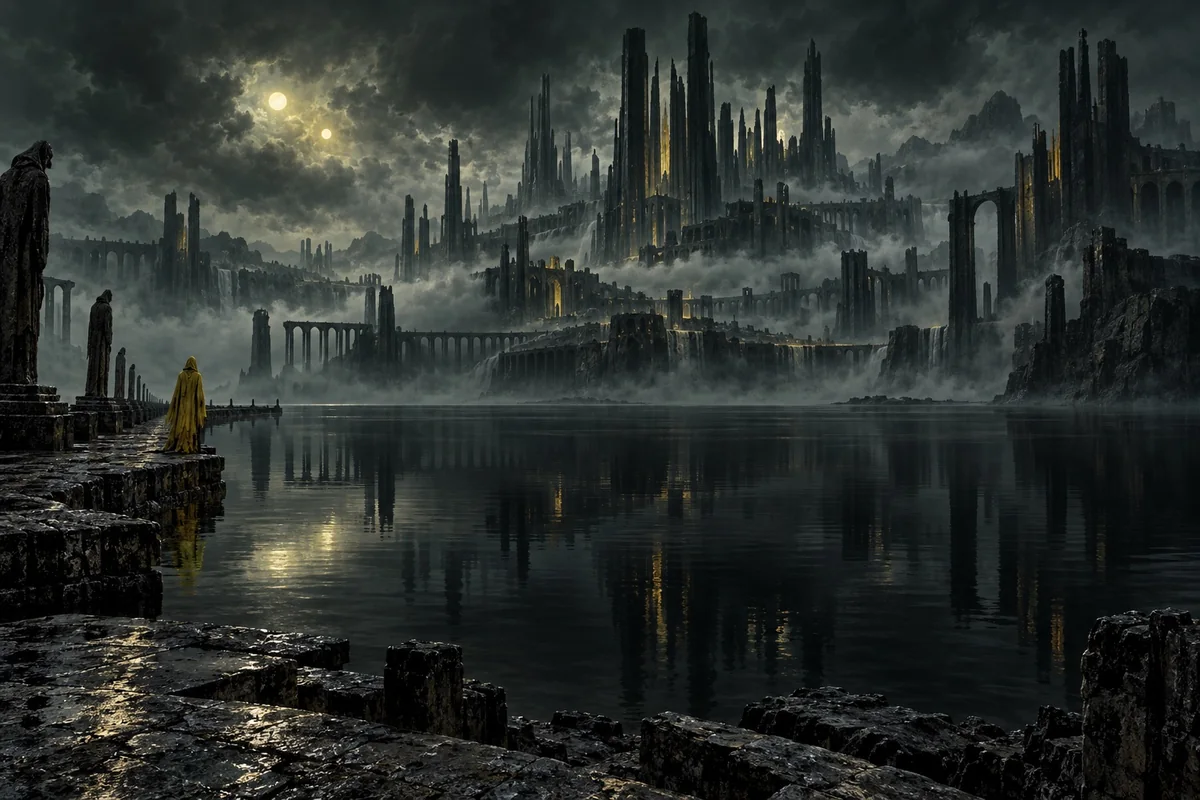
The city remembered by Bierce’s narrator
An Inhabitant of Carcosa begins with a traveler contemplating words attributed to Hali about several kinds of death. Becoming aware of his surroundings, he finds himself in a desolate landscape with dead trees, high grass and stones that seem disturbingly purposeful. He eventually recognizes the stones as remnants of graves.
Sources: [1]
The narrator remembers having been ill with a fever. His family had restrained him when delirium made him demand escape into the open air. He therefore supposes that he has slipped past his attendants and wandered far from the city where he lives. That city, Carcosa, exists in his mind as an ancient, celebrated and still inhabited home.
The landscape initially seems too old and neglected to have anything to do with his own life. Ruined monuments suggest a forgotten people. The possibility that his familiar civilization has become such a people is withheld until the story’s final recognition.
The grave, the sunrise and the ruins
Encounters disturb the narrator’s explanation. A lynx passes close without reacting to his attempt to frighten it. A torch-bearing man ignores his request for directions and speaks an unfamiliar language. Owls and visible stars suggest night, although the narrator can see his surroundings without ordinary darkness.
At the roots of an enormous tree he finds a weathered grave marker. A gust clears debris from its inscription, revealing his own full name and the dates of his birth and death. Sunrise brings another confirmation: standing between the sun and the tree, he casts no shadow.
Wolves are visible on mounds extending toward the horizon. He now understands that these are the ruins of Carcosa. The city was not simply out of sight beyond the plain; he has been moving within the remains of the world he expected to return to. An external closing sentence identifies the account as information transmitted by the spirit Hoseib Alar Robardin through the medium Bayrolles.
Sources: [1]
What the original story does and does not locate
Bierce supplies no map, modern country or historical dynasty for Carcosa. The narrator’s references to his family, faith and illness give his vanished life a human texture without turning it into an identifiable archaeological civilization. Aldebaran and the Hyades appear in the sky, but their appearance does not place the city on either star or star cluster.
Hali is the person to whom the introductory reflections are attributed. There is no Lake Hali in this story. The King in Yellow is absent, as is any explanation involving his conquest of the city. Hastur does not appear in this account either, even though Bierce uses that name in a different tale.
The city’s disappearance serves an encounter with the narrator’s own death and the destruction of his historical perspective. Readers learn that a great span has passed without receiving a measurement of it. That uncertainty is central to the force of the revelation.
Sources: [1]
Chambers’s lakeside city
The opening song of The King in Yellow places Carcosa among twin suns, strange moons, black stars and lengthening shadows. Lake Hali becomes a recurring feature of the same imaginative field. These details are presented through invented dramatic fragments, remembered passages and the troubled perceptions of characters who have read the play.
The Repairer of Reputations draws Carcosa into Mr. Wilde’s account of an imperial dynasty and Hildred’s claims to succession. The Mask gives Alec visions of its towers beyond the moon while he is ill. In the Court of the Dragon culminates in a vision of those towers after the apparent security of a Parisian church disappears.
The settings do not assemble into a consistent navigational chart. A relation expressed through an image, such as towers behind the moon, is not sufficient evidence for literal astronomical distances. Chambers is constructing an ominous imaginative geography whose partial visibility is part of its effect.
Carcosa and the disputed imperial history
Mr. Wilde’s manuscript in The Repairer of Reputations connects a dynasty in Carcosa with American succession. Hildred considers the manuscript authoritative because it places him near the crown and explains his enemies as obstacles to a rightful inheritance. Carcosa consequently becomes a source of legitimacy within his political obsession.
The story repeatedly undermines his ability to judge evidence. What he calls a jeweled gold crown is dismissed by Louis as cheap theatrical ornament, and his supposed secure strongbox is described as a biscuit box. At the end, people he believes have been murdered stand before him alive. The manuscript’s royal history cannot be extracted from this framework and treated as an independently verified chronicle.
This does not require treating every unsettling element as a harmless mistake. It requires distinguishing the city’s evocative recurrence from the specific genealogical claims of two compromised speakers. The names can retain their menace even where their explanatory system fails.
Sources: [2]
Death, memory and the inaccessible city
The differences between Bierce and Chambers are as useful as the borrowings. Bierce makes Carcosa a home recognized too late, after its inhabitants and monuments have passed into ruin. Chambers makes its name a recurring pressure on lives that seem at first to be taking place elsewhere, among studios, shops, churches and city streets.
In both constructions, a familiar human world becomes unstable through contact with another scale of existence. Bierce’s recognition looks backward across death and historical oblivion. Chambers’s fragments suggest an order of meaning that intrudes through reading, desire, guilt and delusion. The same name helps readers feel continuity while allowing very different stories.
An illustration may draw from the graveyard, the lakeside towers or the black-starred sky. Its caption should identify which author’s treatment it interprets. Combining all of them into a dramatic scene can be a valid artistic choice, but the resulting image is not documentary evidence for a single original description.
Related music
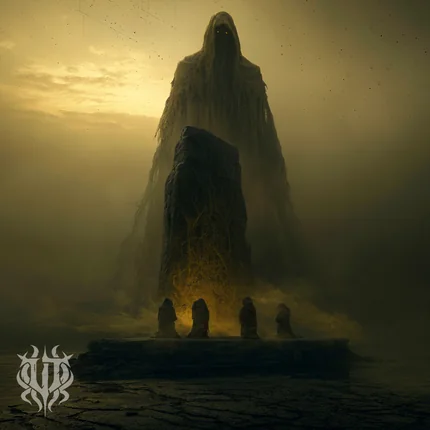
The King In Yellow is a dark metal journey into Carcosa, where Hastur’s influence spreads through dreams, madness and the cursed symbol that can never be forgotten.
References
- Ambrose Bierce — Can Such Things Be?
Public-domain collection, including An Inhabitant of Carcosa, Haïta the Shepherd, The Damned Thing and Moxon’s Master.
- Robert W. Chambers — The King in Yellow, Standard Ebooks text
Public-domain transcription. Its contents omit In the Court of the Dragon; this wiki uses a separate verified text for that story.
- Robert W. Chambers — In the Court of the Dragon
Public-domain 1895 text, checked separately because the Project Gutenberg 8492 transcription omits this story.
At a glance
Ambrose Bierce
An Inhabitant of Carcosa
Robert W. Chambers, The King in Yellow (1895)
Hoseib Alar Robardin, identified in the closing frame
Graveyard and ruins of the narrator’s former city
Lake Hali, towers, black stars, twin suns and strange moons
Not established by these stories