

An Inhabitant of Carcosa
An Inhabitant of Carcosa is Bierce’s short account of a man who believes he has wandered away from his sickbed and gradually discovers that his familiar city has passed into ruin. Its reversal depends on the difference between what the narrator can perceive and what he understands. Chambers later reused several of its names in The King in Yellow.
5 min read · 893 words
Publication and the later collection
The story appeared in the San Francisco News Letter and California Advertiser on 25 December 1886. The bibliography in Donald T. Blume’s study records that original newspaper appearance. The public-domain text used here is the version collected in Can Such Things Be?.
Its importance to the later Mythos tradition comes partly from names: Carcosa, Hali, Aldebaran and the Hyades recur in Chambers’s work. The original story nevertheless stands independently as an encounter with death and the disappearance of a civilization. It contains no King in Yellow or Yellow Sign.
Sources: Donald T. Blume — Ambrose Bierce’s Civilians and Soldiers in Context, Ambrose Bierce — Can Such Things Be?
The words attributed to Hali
The opening reflects on different kinds of death. Body and spirit may disappear or remain in different combinations, and the spirit may revive at the place where its body decayed. The narrator ponders words attributed to Hali without fully understanding their significance for his own condition.
This opening supplies an interpretive possibility before the plot makes it necessary. The reader receives a framework for an existence that the narrator will initially misidentify as delirium. Hali’s words are part of the story’s fiction, not a quotation from a verified historical philosopher supplied with a real bibliography.
The name’s later transformation into Lake Hali in Chambers can obscure this original function. In Bierce, the important relation is between a statement about death and the narrator’s belated recognition of what has happened to him.
Sources: Ambrose Bierce — Can Such Things Be?
A landscape mistaken for somewhere else
The narrator notices a bleak plain covered with dry grass, dead trees and strangely suggestive stones. The stones prove to be grave markers, worn and displaced by immense neglect. Larger ruins indicate monuments whose apparent ambitions have failed against time.
He remembers a sudden fever and his family’s attempts to keep him from wandering outside. That memory gives him an initially reasonable explanation: he has escaped while delirious and become lost far from Carcosa. He calls for members of his family and seeks signs of ordinary human life.
His explanation depends on treating his own last memories as recent. The landscape challenges that assumption through its age, but he initially attributes the disturbing atmosphere to illness. The tension comes from the gap between what is before him and the history he expects to occupy.
Sources: Ambrose Bierce — Can Such Things Be?
The unresponsive animal and traveler
A lynx approaches and ignores his attempt to frighten it. A man carrying a torch passes without answering his greeting or request for directions. The man’s language is unfamiliar, and his clothing suggests a society different from the one the narrator expects.
Owls and the torch imply night, while Aldebaran and the Hyades become visible through the clouds. Yet the narrator has not experienced the scene as ordinary darkness. He can see, but other beings apparently neither see nor hear him.
These details are clues to his altered condition rather than a separate series of monsters. Even his physical well-being is strange: remembered fever coexists with an unusual sense of vigor and heightened perception. He is increasingly unable to reconcile experience with his initial account of escape from a sickroom.
Sources: Ambrose Bierce — Can Such Things Be?
The inscription and the missing shadow
At a large tree, the narrator notices a stone enclosed by its roots. Wind removes leaves and twigs from the exposed surface. The inscription reveals his name and the dates of his birth and death.
As the sun rises, he sees that his body casts no shadow on the tree. Wolves on distant mounds become visible, and he realizes that those mounds are the remains of Carcosa. The unknown burial ground and the vanished city are parts of his own world after a span he had not understood.
The discovery combines personal and historical loss. His death alone would not account for the ruined civilization; the city’s disappearance alone would not account for his unseen presence. The two recognitions arrive together.
Sources: Ambrose Bierce — Can Such Things Be?
The medium and the final frame
A final sentence attributes the account to the spirit Hoseib Alar Robardin speaking through the medium Bayrolles. That change of voice names the narrator only after his own story has reached recognition. It also presents the preceding narrative as a reported communication rather than an ordinary memoir written by a traveler who returned.
The frame belongs to the fictional construction. It does not make the text evidence that a real medium recovered a lost civilization. Within the story, however, it reinforces the explanation that the narrator could not accept until the final scene.
The structure offers a useful comparison with other weird tales built around testimony. The apparent source of a narrative can be withheld until the end, and that disclosure can change how every earlier observation is understood.
Sources: Ambrose Bierce — Can Such Things Be?
What passes into Chambers
Chambers preserves the evocative power of several names while using them for a different imaginative purpose. His Carcosa belongs to fragments of a dangerous play and visions that intrude into later characters’ lives. His Hali is a lake. The inherited words help create a sense of a world larger than any single account.
Bierce’s original should therefore be read before importing Chambers’s imagery into it. Its graveyard contains no explicit tattered king, no forbidden play and no definitive explanation for the city’s destruction. The horror lies in the narrator discovering his own place in a history that has already ended.
Sources: Ambrose Bierce — Can Such Things Be?, Robert W. Chambers — The King in Yellow, Standard Ebooks text
Related music
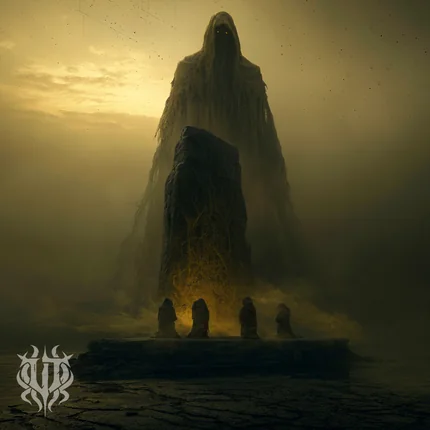
The King In Yellow is a dark metal journey into Carcosa, where Hastur’s influence spreads through dreams, madness and the cursed symbol that can never be forgotten.
References
- Donald T. Blume — Ambrose Bierce’s Civilians and Soldiers in Context
Kent State University Press, 2004. Publisher preview, bibliography pp. 387–389: original newspaper dates for Carcosa and Haïta; edition chronology requires care.
- Ambrose Bierce — Can Such Things Be?
Public-domain collection, including An Inhabitant of Carcosa, Haïta the Shepherd, The Damned Thing and Moxon’s Master.
- Robert W. Chambers — The King in Yellow, Standard Ebooks text
Public-domain transcription. Its contents omit In the Court of the Dragon; this wiki uses a separate verified text for that story.
At a glance
Ambrose Bierce
25 December 1886
San Francisco News Letter and California Advertiser
Can Such Things Be? collected version
Hoseib Alar Robardin
Bayrolles
The ruins of Carcosa