

Lake Hali
Lake Hali belongs to the suggestive geography surrounding Chambers’s fictional play The King in Yellow. Its shores, cloud-waves and relation to Carcosa recur in poems, conversations and visions. The name Hali comes from an earlier literary context in Bierce, where it identifies an author of reflections on death rather than a lake.
3 min read · 545 words
Hali before the lake
An Inhabitant of Carcosa opens with words attributed to Hali about different relations between body, spirit and death. The narrator considers their meaning before becoming aware of the desolate landscape around him. Hali is treated as a deceased person whose words can be contemplated, not as the name of a body of water.
Bierce’s story also supplies Carcosa, Aldebaran and the Hyades. Chambers reuses a recognizable set of names while changing their relationships. The connection is literary borrowing, not evidence that Bierce had already written a complete history of the lakeside city described in Chambers’s fragments.
Sources: Ambrose Bierce — Can Such Things Be?, Robert W. Chambers — The King in Yellow, Standard Ebooks text
Suns, shores and towers
The Repairer of Reputations associates Hali with the twin suns sinking near Carcosa. Hildred’s memories of the play and Wilde’s dynastic exposition make it part of a geography that seems to explain their imperial ambitions. The references remain filtered through those speakers.
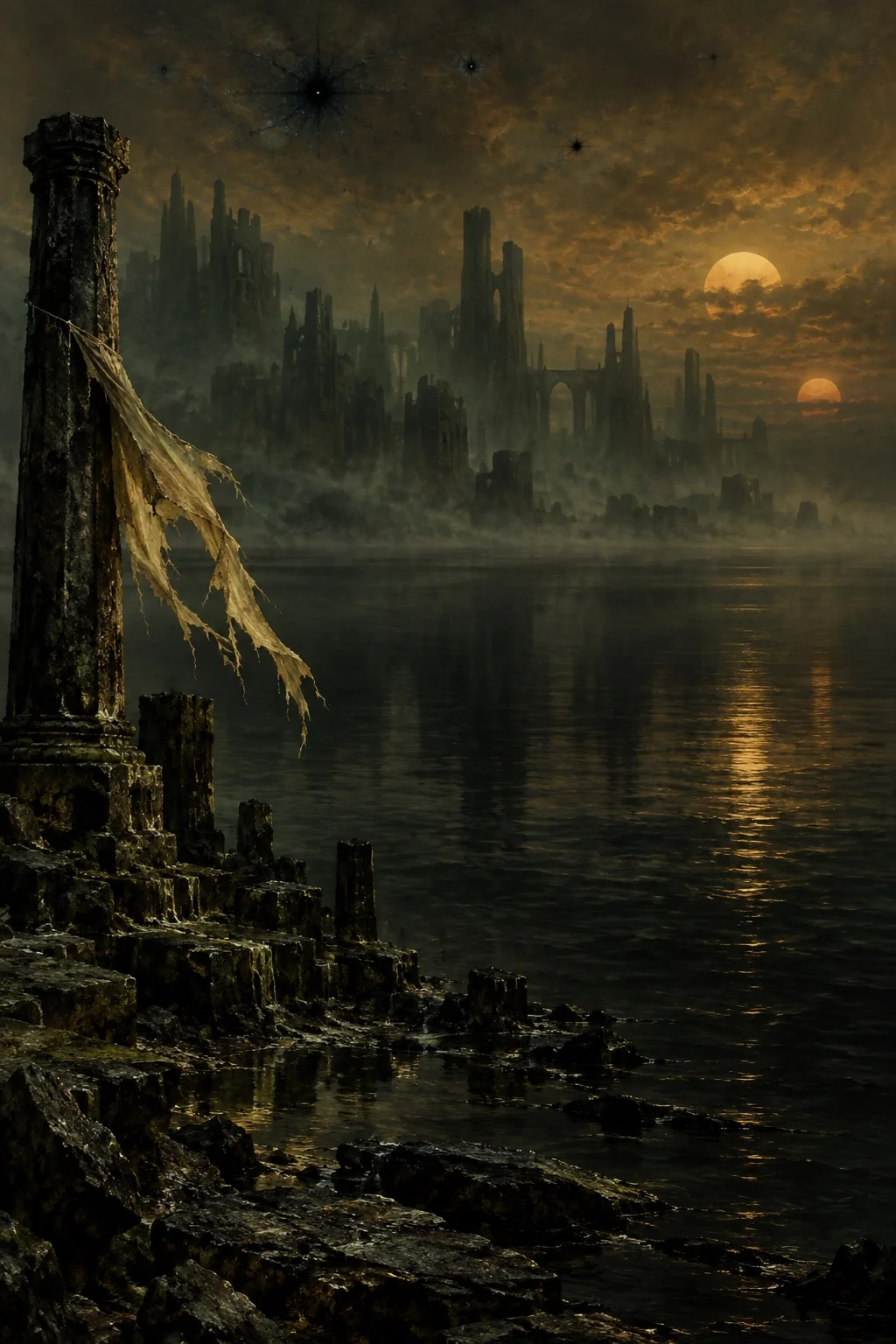
In The Mask, Alec’s illness includes a vision of a still, thin-looking lake and towers beyond the moon. In The Yellow Sign, the fog outside Scott’s windows is compared with the cloud-waves along Hali. The same name can therefore enter a visionary landscape or a comparison with ordinary weather.
These passages supply recurring sensory relationships without surveying a shoreline. They establish a lake within the imagined world, but they do not state its dimensions, depth, climate or exact position on an astronomical map.
Sources: Robert W. Chambers — The King in Yellow, Standard Ebooks text
The final landscape of the Dragon story
In the Court of the Dragon gives the lake a direct role in the narrator’s final experience. When the church disappears from his perception, wet wind from Hali strikes his face. Beyond moving cloud-waves, he sees a moon and the towers of Carcosa.
The episode replaces the security of a known Parisian interior with an impossible vista. It is not presented as a planned expedition or a repeatable crossing. The narrator’s recognition of guilt and the King’s final voice frame the transition as a catastrophe of the self as much as a change of place.
For visual interpretation, the wet atmosphere, distant towers and darkened sky provide grounded motifs. A precise map, indigenous ecosystem or established route through the lake would require material from a separately identified later work.
The name in Lovecraft and in reference work
The Whisperer in Darkness names Lake Hali among references that disturb Albert Wilmarth. Lovecraft does not take his narrator there or describe a new survey of the lake. The allusion helps connect his story with the older vocabulary of the weird.
A reference entry should consequently distinguish a mention from an appearance. Hali’s inclusion in a list does not establish that the Mi-Go inhabit its shores or that the lake has become part of the geography of Yuggoth. Such combinations may occur in later creative work, but they cannot be inferred simply because two names share a paragraph.
Lake Hali is most clearly understood by following its changing textual uses: a transformation of Bierce’s name, a recurring feature in Chambers’s fragments and a recognizable allusion in Lovecraft. Its incompleteness is part of that history rather than a gap to fill with invented measurements.
Sources: The Whisperer in Darkness — original text, Robert W. Chambers — The King in Yellow, Standard Ebooks text, Ambrose Bierce — Can Such Things Be?
Related music
The King In Yellow is a dark metal journey into Carcosa, where Hastur’s influence spreads through dreams, madness and the cursed symbol that can never be forgotten.
References
- Ambrose Bierce — Can Such Things Be?
Public-domain collection, including An Inhabitant of Carcosa, Haïta the Shepherd, The Damned Thing and Moxon’s Master.
- Robert W. Chambers — The King in Yellow, Standard Ebooks text
Public-domain transcription. Its contents omit In the Court of the Dragon; this wiki uses a separate verified text for that story.
- Robert W. Chambers — In the Court of the Dragon
Public-domain 1895 text, checked separately because the Project Gutenberg 8492 transcription omits this story.
- The Whisperer in Darkness — original text
The fictional narrative is evidence for what the story says, not proof of events in the real world.
At a glance
Robert W. Chambers
The King in Yellow, 1895
Carcosa
A cited speaker or author in Bierce’s An Inhabitant of Carcosa
The Whisperer in Darkness
Not supplied by the original stories