

Moon-beasts
The moon-beasts are the pale, changeable masters of the black-galley trade in The Dream-Quest of Unknown Kadath. Carter encounters them as strong, eyeless, tentacle-faced inhabitants of a lunar city whose commerce depends on disguised intermediaries, captive labor and predation.
4 min read · 725 words
Bodies and movement
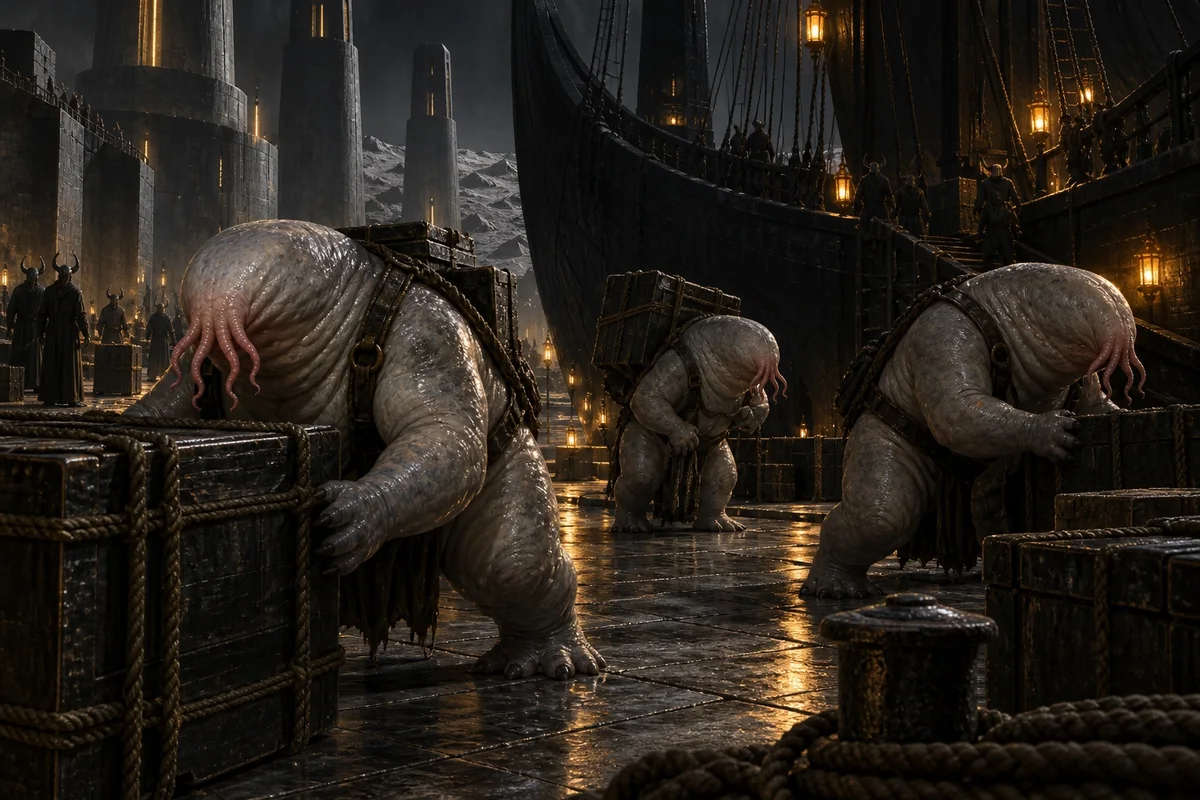
The primary narrative describes large gray-white bodies with a slippery surface and a general resemblance to toads. Their forms can expand and contract. The blunt head has no visible eyes; short pink tentacles move at the end of the snout. The comparison with an earthly animal is therefore only a starting outline, not an identification with ordinary amphibians.
Sources: [1]
Carter sees them handle heavy cargo, move between quays and ships, and operate the galleys. Their strength greatly exceeds that of the subordinate population. They can navigate and act in complete darkness, so the absence of eyes does not prevent effective perception within their own environment.
The creatures themselves do not speak aloud in the scenes Carter witnesses. They use musical instruments during a procession, while their almost-human servants can converse and trade with people. This division contributes to the distance between the rulers’ hidden existence and the public face of their commerce.
The lunar port and the black galleys
At Dylath-Leen, people see the traders and the valuable rubies but not the real crews concealed aboard the black galleys. Carter learns the missing part when he is carried to the moon. The pale beings serve as officers, navigators and rowers, while the clothed intermediaries perform work that requires a plausible human appearance.
The lunar port contains wharves, warehouses, vehicles, tiled streets and high windowless buildings. It is a working settlement with organized transport and distribution. The horror comes partly from the recognizability of those arrangements: cargo handling and commercial efficiency are being applied to living captives.
The traders’ resemblance to humans allows the system to connect with ordinary Dreamlands markets. Turbans, shoes and clothing conceal features that Carter later sees openly among the people of Leng. The moon-beasts can therefore maintain profitable contact without showing themselves to their customers.
Sources: [1]
Captives and subordinate peoples
The almost-human population is not identical with the lunar masters. Carter sees its members herded, assigned tasks and sorted according to their bodies. Some are used for labor or trade; others are packed into crates and removed under circumstances that imply a more terrible destination.
The system also receives captives of other kinds. Carter’s own seizure places a human dreamer among beings already treated as transportable goods. The story’s later connection with Leng reveals that the trade reaches across several regions rather than remaining confined to one lunar city.
These distinctions matter when illustrating a black galley. A merchant on deck and a hidden rower are different kinds of being with different positions in the hierarchy. A scene can make that contrast visible without giving every participant the same tentacled anatomy.
Sources: [1]
Carter’s imprisonment and the cats
After landing, Carter is imprisoned in a dark circular chamber. He cannot determine how long he remains there. When removed, he is placed within a guarded procession moving from the city toward the surrounding hills. He fears that Nyarlathotep awaits him, although the expected meeting does not take place before his rescue.
The cats attack the procession and overwhelm its guards. Their claws and numbers prove effective against the moon-beasts, which bleed green material while remaining silent. Carter’s friendship with the cats enables his return to Dylath-Leen.
This scene demonstrates a limit to the beings’ power. Their strength, unusual perception and organized society do not make them invulnerable. The local defeat frees Carter, but it does not establish the destruction of the entire lunar population or the end of the black-galley system.
Sources: [1]
Later conflict and narrative function
Carter encounters the consequences of the same network again around Leng and the places connected with the captured ghouls. The rescue organized with Pickman and the night-gaunts turns knowledge of the enemy’s transport and strongholds against it. The moon-beasts’ role thus spans both Carter’s own captivity and his later effort to free others.
They represent an alien power whose danger is institutional as well as bodily. Concealed crews, intermediaries, slave populations and markets allow their influence to move through otherwise inhabited and commercially active regions. The associated horror is not limited to what their faces look like.
The common reference label Moon-beasts is used here for the toad-like lunar beings described in the narrative. Their observed actions are kept separate from Carter’s expectations about Nyarlathotep and from later game statistics or genealogies.
Sources: [1]
Related music
A Thousand Masks is a dark metal song inspired by Nyarlathotep, the Crawling Chaos who walks among humanity, hiding behind countless faces and whispered lies.
References
- The Dream-Quest of Unknown Kadath — original text
The fictional narrative is evidence for what the story says, not proof of events in the real world.
At a glance
The Dream-Quest of Unknown Kadath
Lunar city and associated trading network
Pale, eyeless, changeable, broadly toad-like; pink facial tentacles
Black galleys
The almost-human people associated with Leng
Cats; later the ghoul and night-gaunt alliance