

Chorazin and the Van der Heyl Estate
Chorazin is the fictional settlement near Attica, New York, associated with the van der Heyl mansion in The Diary of Alonzo Typer. The decaying house, obstructive vegetation, locked cellar and neighboring stone circle form a connected landscape that directs the investigator toward an inherited obligation. The surviving diary and a later examination of the ruins provide different, incomplete views of the site.
6 min read · 1,141 words
Geographical setting and source
The location belongs to the story written by H. P. Lovecraft for William Lumley. It is situated in relation to the real places Batavia and Attica, but the named village and supernatural estate should not be treated as a documented destination with verified coordinates.
Alonzo Typer is last recognized at a Batavia hotel on 17 April 1908. His diary records walking from Attica to the house that evening because nobody would provide transport. The reluctance of local people precedes his own discovery of the danger.
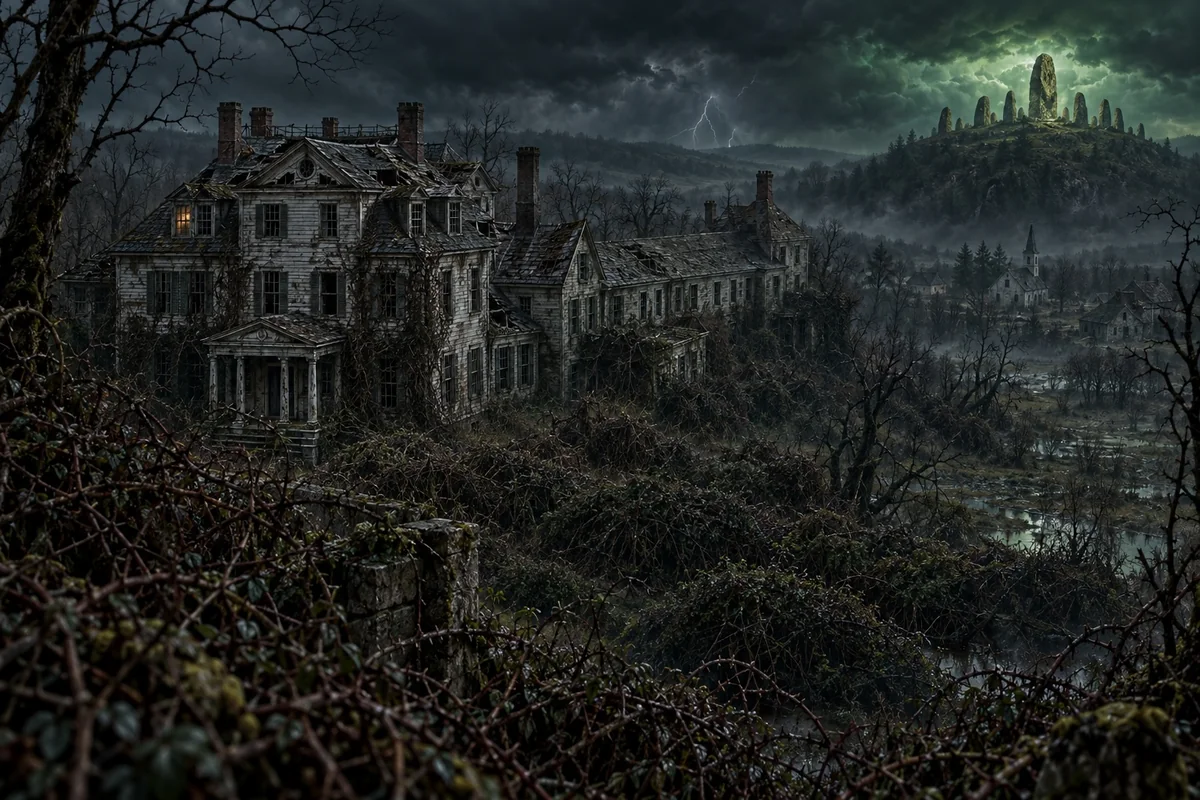
The village occupies a small valley, with the house in an overgrown park and a steep hill nearby. The hill's stone circle is visible from the estate and becomes increasingly important as the investigation progresses.
The van der Heyl occupation
The editorial introduction says the family moved from Albany in 1746 under suspicion of witchcraft and tentatively dates the mansion to about 1760. Its members remained aloof, educated children privately or abroad and acquired an ominous reputation.
The entire household disappeared in 1872. Later attempts to remain in the building produced additional deaths, disappearances and episodes described as insanity. Eventually the property passed to owners who left it neglected and warned others against visiting.
The source also describes the village population through racialized and hereditary judgments. Those hostile descriptions belong to the fictional account. They do not establish an actual relationship between ancestry, rural life and supernatural practices.
Typer's discoveries suggest that the family's choice of location was purposeful. A document by Claes van der Heyl links the construction of a house and installation of a special lock with an obligation passing through his descendants.
Sources: [1]
The changing architecture
Typer encounters a wooden house whose original square colonial form is obscured by numerous later additions. Its small porch, long hall and curving staircase provide the first recognizable features before he chooses an upstairs front room for his camp.
The building remains furnished but badly deteriorated. Dust records his movement through unfamiliar corridors, while the ease with which he learns their arrangement contributes to his unwanted feeling that he already knows the place.
A long northern wing ends in a small locked room. Behind damaged paneling there is a steep passage descending into darkness without normal steps or handholds. Its exact use is never demonstrated through a completed journey.
The northern alignment matters because the hill and the secured cellar space lie in the same general direction. The narrative invites a connection among the structures while withholding a surveyed plan of the underground routes.
Sources: [1]
Portraits and the library
The portrait collection preserves faces and names from the family. Typer reads some figures as reptilian or otherwise inhuman, and later believes that corresponding presences move through the rooms. Their apparent familiarity becomes part of the genealogical puzzle rather than merely another visual fright.
Books are distributed between the ground-floor library and attic chests. The holdings include the Pnakotic Manuscripts, Eltdown Shards, Necronomicon, Livre d'Eibon and De Vermis Mysteriis. The story names particular volumes without providing a complete catalog.
The most operationally important documents are two notebooks by Claes van der Heyl and an associated drawing. Their separated information must be combined to interpret the signs connected with the cellar lock and the hidden guardian.
The house thus functions as an archive that gradually implicates its reader. Typer arrives to examine another family's secrets and discovers that the family history includes him.
Sources: [1]
Briers and controlled movement
The vegetation behaves as a barrier whose restrictions are selective. A path Typer clears closes again, and the surrounding growth prevents him from leaving the property. Supplies nevertheless continue to appear indoors through an agency he cannot identify.
When he becomes interested in the hill, the briers permit movement in that direction. They still obstruct routes away from the house, so reaching the circle is not equivalent to escaping confinement.
This pattern makes the landscape part of the pressure exerted on him. He is allowed to obtain information and approach the ritual site while being denied an ordinary withdrawal from the investigation.
The diary records that effect but does not identify a botanical species, a complete magical procedure or a single visible being responsible for every movement of the plants.
Sources: [1]
The hill and the standing stones
The hill carries a ring of unusual yellow-green stones surrounding a central menhir. Typer describes variable coloration and a cold, clammy, reptilelike surface. These impressions establish the stones' material strangeness within the fiction without supplying a scientific identification.
A stone-rimmed hollow nearby appears to be a blocked opening. On the final evening, villagers dig in that area, apparently reopening it. The diary does not follow anyone through it to confirm the full course of a tunnel.
Wind, piping and hissing sounds accompany Typer's visits. As Walpurgis Eve approaches, clouds and lightning intensify the sense that the place is responding to an appointed time.
At midnight the villagers gather and invoke Shub-Niggurath. The ritual associates the site with that name; it does not give the reader a direct description of the deity arriving at the circle.
Sources: [1]
The cellar vault and ancient key
A brick enclosure beneath the northern part of the house is secured by an iron door. The lock appears much older than the surrounding construction and bears unfamiliar signs. Typer hears movement and distant reverberations from beyond it.
The matching key is found in the northern room. Claes's message associates the mechanism with Yian-Ho and a task that he or his descendants must complete. The diary suggests that passage through the enclosure is necessary to reach the ancient being below.
The distinction between the secured room and the ultimate gateway is important. Opening the cellar door would begin an approach; it is not shown to place a traveler instantly at the final destination.
Typer never narrates that complete passage. After recognizing his descent from the van der Heyls, he refuses the obligation and records being dragged toward the cellar by materializing dark paws.
Sources: [1]
The collapse and what survives
The mansion falls during a severe gale on 12 November 1935. A state policeman obtains Typer's diary four days later from a villager who claims to have found it near the surface of the debris.
The cellar enclosure remains intact enough to require forced entry. Investigators find incised markings, a large opening blocked by fallen material and an apparently recent trail of foul black residue. Those observations partly corroborate the diary's architecture and atmosphere while leaving the occupants unidentified.
The collapse does not yield a complete explanation of the 1908 disappearance or a recovered account of the gateway beyond. The estate remains a place known through damaged structures, a surviving document and traces that exceed what the investigators can interpret.
Sources: [1]
Related music

The Black Goat of The Woods is a dark metal tribute to Shub-Niggurath, the ancient woodland deity whose forgotten cults gather beneath twisted trees and indifferent stars.
References
- The Diary of Alonzo Typer — original text
The fictional narrative is evidence for what the story says, not proof of events in the real world.
- The Diary of Alonzo Typer — publication data
At a glance
The Diary of Alonzo Typer
Near Attica, New York
1746, according to the editorial frame
About 1760; tentative
1872
17–30 April 1908
12 November 1935