

The Diary of Alonzo Typer
The Diary of Alonzo Typer records an occult investigator’s confinement in a decaying New York mansion as he approaches a revelation about his own ancestry. Books, portraits, a locked cellar and a neighboring stone circle gradually disclose a task inherited from the van der Heyl family. Written by Lovecraft for William Lumley, the story joins a found-document frame to an investigation whose apparent observer becomes its intended participant.
11 min read · 2,288 words
Authorship and publication
The Archive dates Lovecraft's work with William Lumley to October 1935 and presents the text as written by Lovecraft for Lumley. The story first appeared in the February 1938 Weird Tales, volume 31, number 2, on pages 152–166.
Robert M. Price's introduction to Black Forbidden Things distinguishes Lumley's original version from Lovecraft's rewriting and identifies the earlier text as one of the materials assembled in that collection. This article examines the published Lovecraft text rather than treating the two versions as identical.
The main narrative takes the form of dated entries from 17 to 30 April 1908. An editorial introduction, set after the recovery of the manuscript in 1935, supplies a second body of evidence. Neither layer should be confused with a real archival report about an actual missing person.
Sources: The Diary of Alonzo Typer — original text, H. P. Lovecraft Archive — fiction in composition order, The Diary of Alonzo Typer — publication data, Robert M. Price — introduction to Black Forbidden Things
The missing investigator
Alonzo Hasbrouck Typer is fifty-three when he disappears. He comes from Kingston, New York, and is described as the last survivor of an old Ulster County family. His education includes Columbia and Heidelberg, while his private research concerns phenomena rejected or distrusted by more conventional investigators.
The introduction attributes to him papers on vampirism, ghouls and poltergeists, as well as a resignation from the Society for Psychical Research after bitter disputes. His extensive travels include Asian destinations and a prolonged stay on Easter Island.
He was last recognized around noon on 17 April 1908 at the Hotel Richmond in Batavia. The diary later records his arrival at the van der Heyl house that evening. An unsuccessful search leads to the division of his estate among distant relatives.
This background makes him more than an accidental traveler caught in a storm. His arrival follows a lifelong pursuit of dangerous knowledge, informed by contacts and previous experiences that he does not fully explain to the reader.
The house, Chorazin and the vanished family
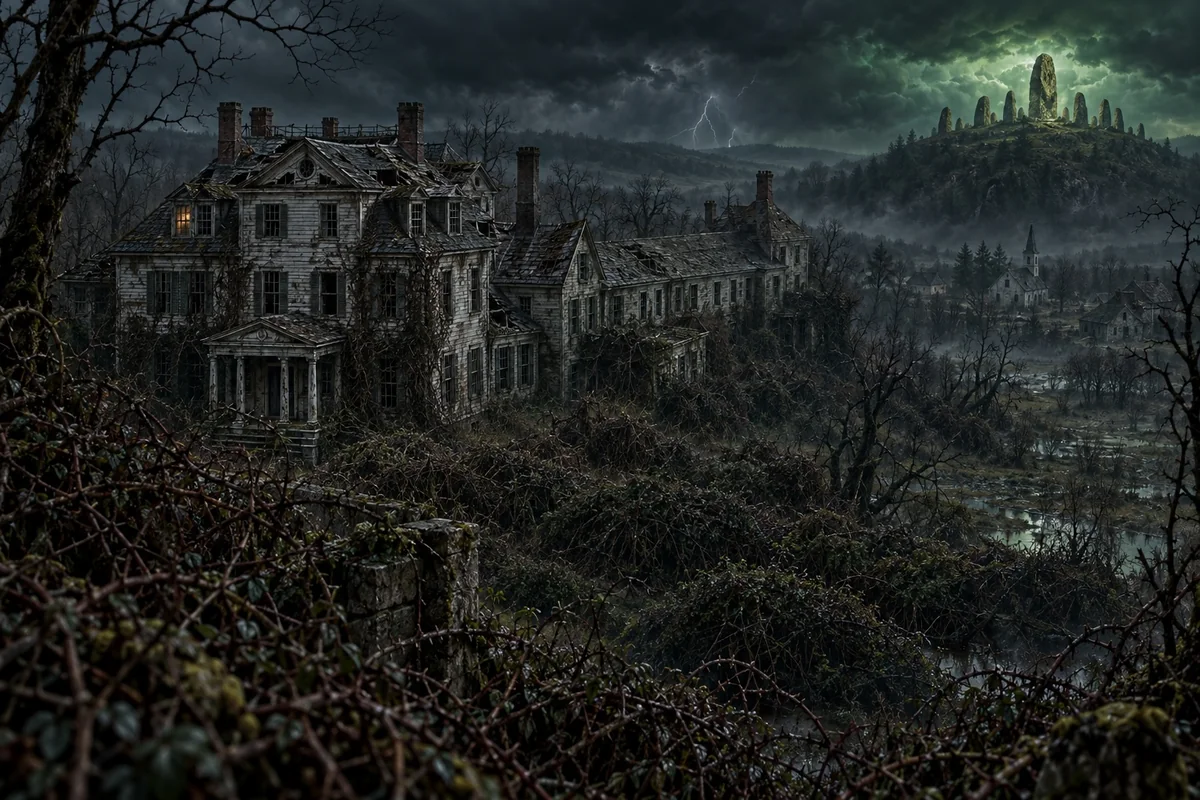
The mansion stands near Attica, beside the small settlement called Chorazin. A nearby hill carries an ancient circle of standing stones. The editorial frame says that the van der Heyls moved from Albany in 1746 and tentatively dates the house to about 1760.
The family's secluded life, foreign education and reported occult associations set it apart in the narrator's account. In 1872 the entire household disappears. Later attempts to occupy or investigate the house result in additional deaths, disappearances and episodes of mental collapse.
Successive owners eventually leave the property neglected and warn people away. Typer nevertheless approaches it deliberately. He finds a wooden building expanded by numerous wings, a dust-covered interior and an overgrown park whose vegetation becomes a physical obstacle.
The account repeatedly degrades the villagers through racial and hereditary language. Those judgments belong to the fictional narrators' prejudices. They should not be adopted as an explanation of real Indigenous communities, mixed ancestry or rural populations.
17–18 April: arrival and recognition
Unable to hire transport from Attica, Typer walks to the estate through an approaching storm. He establishes a camp in an upstairs front room and arranges for food to be left near the park gate. A villager appears to recognize him, while the house itself gives him an unwelcome sense of familiarity.
He soon feels unseen presences, including an immense hostile will that seems too large for the rooms containing it. A nighttime incident on the stairs appears to involve a gigantic dark paw, though he initially tries to attribute what happened to the wind.
The portrait gallery supplies more specific disturbances. Faces display serpentlike or porcine traits, and some seem to alter in the changing light. Names and appearances are partly familiar from information supplied by an unnamed contact, but other resemblances trouble him without immediately yielding an explanation.
In a room at the end of the northern wing he discovers a steep, concealed passage descending behind damaged paneling. A portrait of a beautiful woman suggests an almost scaly complexion. The attic contains strange books, including unfamiliar variants of the Aklo formulas.
19–20 April: the limits of departure
The path Typer cuts through the vegetation closes again. His sense of enormous unseen occupants grows stronger, and he believes that a ritual found in the attic could make them physically perceptible. Knowing a possible method does not mean he has yet performed it.
The cellar contains a passage toward the northern wing and a brick enclosure secured by an iron door. Its lock seems older than the surrounding construction and carries signs he cannot read. Returning at night, he hears movements beyond it: pacing, muttering, a heavy sliding noise and distant reverberations.
Dark paws appear between him and the exit. The flashlight disperses their visible forms sufficiently for him to retreat, but the episode does not establish that light is a complete or permanent defense.
Outside, the briers now prevent departure in every direction he tries. Food nevertheless appears inside the hall. When he later scatters dust to discover who delivers it, the surface is cleaned before it can preserve useful tracks.
The library adds the Pnakotic Manuscripts and the Eltdown Shards to his evidence. Their contents convince him that the approaching Walpurgis observance is relevant to his confinement. He now understands himself as someone being kept for a purpose.
21–23 April: portraits and paired notebooks
The name Trintje van der Heyl Sleght disturbs Typer because he has encountered Sleght elsewhere in a more personal context. He cannot immediately recover the association. Meanwhile, figures resembling the portraits seem to move through the house, though he cannot observe a figure and its corresponding canvas clearly at the same time.
An attic chest contains a Greek Necronomicon, a Norman-French Livre d'Eibon and an early edition of De Vermis Mysteriis. The crucial documents, however, are handwritten notebooks by Claes van der Heyl. One covers the years 1560–1580 and contains a drawing of a beaked, tentacled entity with clawed extremities and yellow eyes.
The figure stands or sits upon a hieroglyph-bearing pedestal. Typer notices that the writing resembles the signs on the cellar lock. The drawing is not captioned in a way that identifies the creature as Cthulhu or another familiar named deity.
Some passages require a second notebook, which Typer finds in a desk in the small northern room. The books refer to one another, so the solution depends on correlating separated evidence. Even together they offer a difficult key to further decipherment rather than an instantly readable set of instructions.
The wider occult geography
Claes's papers describe Shamballah, the Book of Dzyan and beings from Venus within an extravagant prehuman chronology. They also repeatedly name Yian-Ho, a hidden city associated with knowledge that ordinary people should not possess.
These statements are claims made by fictional occult documents. The story draws them into its cosmology, but they should not be presented as established archaeology or planetary history. The enormous timescales mark the investigator's widening horizon of dread.
Yian-Ho is especially important because the papers connect it with actual travel by Claes and with the lock and key later used by his descendants. The reader receives no dependable real-world coordinates for the city.
Names from different strands of the Mythos accumulate around the investigation. Their presence creates relationships among texts and traditions without requiring every referenced place or power to appear directly in the action.
24–26 April: the hill becomes accessible
Typer hears unfamiliar piping and hissing from the stone circle and notices that both the northern wing and the cellar enclosure extend in its direction. This spatial arrangement encourages him to suspect a connection beneath the visible landscape.
The vegetation allows him to move toward the hill while continuing to block routes away from the estate. His confinement is therefore selective: he can advance toward the ritual center, but cannot use that excursion to escape.
The stones have an unusual yellow-green appearance, a variable coloration and a texture he compares with reptilian skin. Near the central stone lies a rimmed hollow that may be a blocked well or tunnel. At this stage that identification remains a possibility.
Wind around the circle seems increasingly like speech. Unseasonable lightning and a sound interpreted as inhuman laughter intensify his expectation of an approaching event. The landscape becomes an active part of the mechanism directing him toward the appointed night.
27–28 April: a guardian and an incomplete method
Deciphering the picture's signs leads Typer to believe that an ancient being lies beneath the house. He identifies it by titles such as the Forgotten One and the guardian of an ancient gateway, not by a stable personal name.
The knowledge includes signs, words and a chant intended to transform or evoke the being. A trial at the hill produces only uncertain phenomena, leaving Typer to consider whether his pronunciation is wrong or the proper time has not arrived.
He also recognizes a major defect: the chant calls the power forth but supplies no specific means of controlling it. General signs and gestures might help, yet he cannot know that they will. The gap between access and control becomes a central danger.
He concludes that reaching the hidden presence requires passage through the locked cellar enclosure. The audible movements behind the door suggest other occupants or guardians, but the narrative does not give a complete count or taxonomy of everything below the house.
29 April: the key and Claes’s obligation
Typer finds the key in the northern room's desk, wrapped in a newspaper dated 31 October 1872 and an older piece of skin bearing a Latin message. The newspaper associates the concealment with the year of the household's disappearance, without explaining every event of that year.
Claes's message says that he visited Yian-Ho bodily and brought away forbidden knowledge. What followed him would not rest until he or his descendants completed a task. If he failed to perform it, the obligation would pass to the generations after him.
The lock was obtained in that city for installation at the entrance to the place his family was to find. A house would accommodate the outer guardians. The account also invokes the Lords of Yaddith, but does not show those beings intervening.
The key and lock share an unfamiliar greenish metal. Its heavy end fits the unusual mechanism, and its handle suggests a nonhuman image. Typer senses a faint pulse when holding it and deciphers only the beginning of an inscription. These impressions make the implement seem implicated in the agency directing him, rather than merely a neutral tool.
30 April: Walpurgis Eve
Greenish light, ominous weather and sounds from the village accompany the final day. Typer briefly regains confidence, persuading himself that his newly acquired knowledge can compel the powers he is about to encounter. That confidence exceeds his own earlier recognition that the chant gives no reliable control.
At six in the evening he sees villagers digging near the central stone, apparently reopening the rimmed hollow. The expanded form of Trintje's name, identifying her as the wife of Adriaen Sleght, brings him closer to the memory he has resisted.
Around midnight the storm breaks over a gathering in the circle. The villagers chant an invocation of Shub-Niggurath while movements and reverberations sound from the cellar. The invocation establishes a ritual association; it does not provide an eyewitness description of the deity appearing.
Typer finally remembers the genealogical connection. Through the Sleght line, he himself descends from the van der Heyls. His persistent familiarity with the house and the apparent purpose of his detention acquire a personal explanation.
He rejects the inherited task and refuses to open the way willingly. The last broken lines report black paws becoming material and dragging him toward the cellar. The diary ends before any successful entry through the ancient gateway is described.
What the 1935 investigation confirms
The frame records the mansion's collapse during a gale on 12 November 1935. Four days later a state policeman obtains the diary from John Eagle, a villager who says he found it near the surface of the ruins. Its unusual metal binding has helped the small volume survive.
The cellar enclosure remains sufficiently intact that investigators must force its door with explosives. They find incised signs, a large rear opening blocked by the collapse, and an apparently recent trail of foul black material across the floor. The smell is compared with that of a reptile enclosure.
Handwriting specialists authenticate the diary, and genealogists confirm Typer's belated recollection concerning Adriaen Sleght. These points support specific parts of his account. They do not independently verify every vision, translate the signs or identify the exact source of the residue.
The editor leaves the interpretation open while making an entirely dismissive explanation difficult. Typer's disappearance remains unresolved, and the account does not supply a recovered body or a report from the other side of the gateway.
Knowledge, ancestry and coerced participation
The story repeatedly turns research into an instrument of capture. Typer thinks that reading another volume, decoding another sign or finding another object will place him closer to mastery. Each discovery also brings him nearer to carrying out the purpose for which he has been preserved.
The delayed recognition of Sleght is therefore more than a surprise genealogy. It overturns the role from which he has narrated the investigation. The dangerous family is not simply the subject of his inquiry; its unfinished obligation includes him.
His final refusal matters even though it fails to free him. The ending shows a difference between inheriting a connection and consenting to an ancestor's purpose. The force that takes him to the cellar must act against his declared will.
The diary format preserves that resistance while limiting what can be known afterward. The last page records an abduction, not a completed cosmological revelation. Maintaining that boundary prevents later encyclopedic summaries from turning the story's terrifying uncertainties into events it never narrates.
Related music
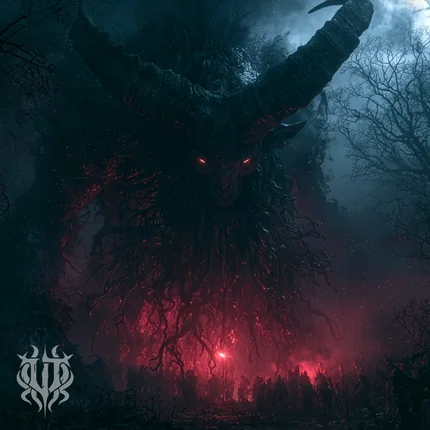
The Black Goat of The Woods is a dark metal tribute to Shub-Niggurath, the ancient woodland deity whose forgotten cults gather beneath twisted trees and indifferent stars.
References
- The Diary of Alonzo Typer — original text
The fictional narrative is evidence for what the story says, not proof of events in the real world.
- H. P. Lovecraft Archive — fiction in composition order
Composition dates; question marks and ranges retain the source uncertainty.
- The Diary of Alonzo Typer — publication data
- Robert M. Price — introduction to Black Forbidden Things
At a glance
H. P. Lovecraft, written for William Lumley
October 1935
1938, February
Weird Tales, 31, No. 2
Fiction