

The Dunwich Horror
The Dunwich Horror is the otherwise unnamed twin brother of Wilbur Whateley in H. P. Lovecraft’s The Dunwich Horror. Born to Lavinia Whateley and associated with Yog-Sothoth, it develops into an enormous, normally invisible being concealed inside the Whateley farmhouse. Its escape transforms the family’s secret into a public catastrophe. The final revelation identifies it as a member of that family rather than an unrelated monster summoned at the last moment.
7 min read · 1,373 words
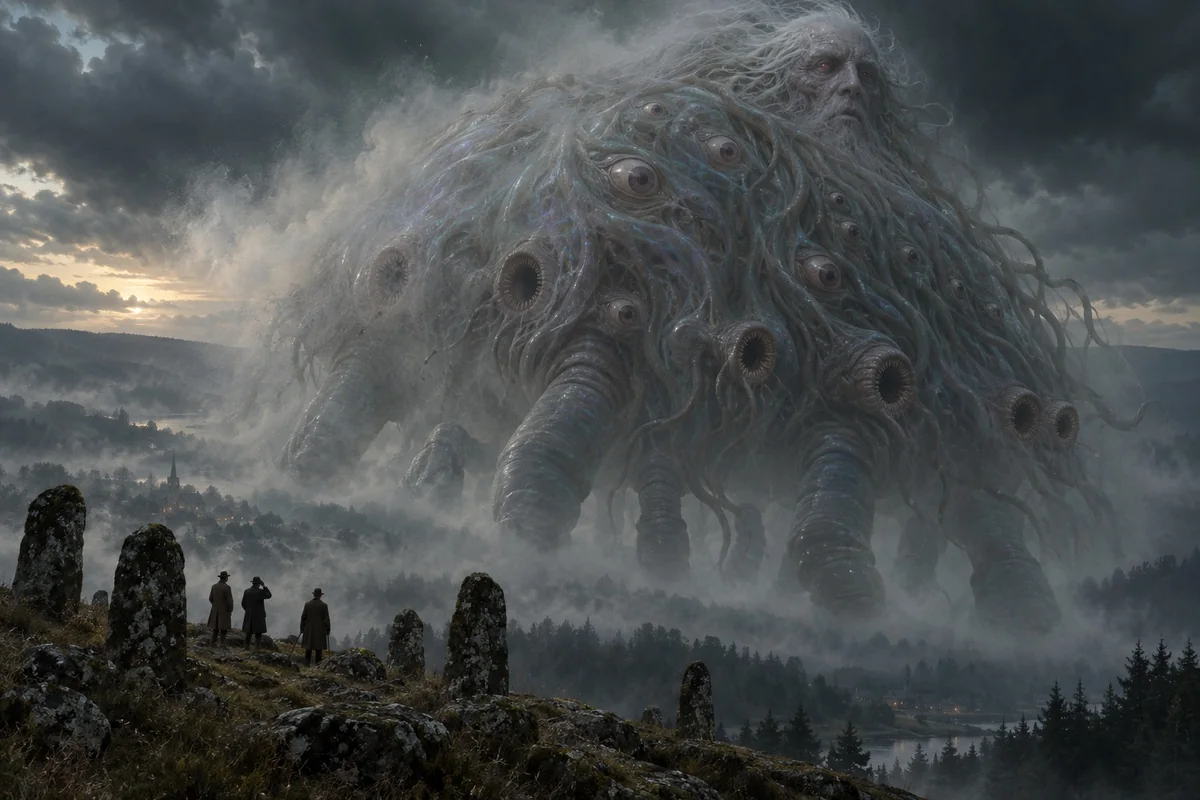
An unnamed member of the Whateley family
The narrative withholds the creature’s parentage until its last exchange. Henry Armitage explains that it was Wilbur’s twin and that both brothers possessed a partly nonhuman inheritance. The concealed twin had developed a much greater share of the nature that came from outside the ordinary world.
Lavinia is therefore its mother, Old Whateley its maternal grandfather and Wilbur its brother. Yog-Sothoth is the father identified through the story’s ritual language, the creature’s final cry and Armitage’s explanation. The Horror is not simply another name for Yog-Sothoth.
No personal name is supplied. The familiar designation names both the creature and the wider calamity in Dunwich. Keeping those uses distinct helps explain why an account of the being has a narrower subject than a summary of the complete story.
The hidden life inside the farmhouse
The early narrative follows Wilbur’s conspicuous growth while presenting the other child indirectly. The Whateleys buy cattle repeatedly, but their visible herd remains surprisingly small and unhealthy. Marks on the animals and unusual activity within the house suggest that the livestock serves a purpose the neighbors do not understand.
Alterations to the building gradually surrender more space to the unseen occupant. Rooms, partitions and living arrangements become evidence of something growing beyond an ordinary domestic scale. The family’s architectural changes are thus a physical record of development that cannot be watched directly.
Wilbur’s diary eventually helps Armitage interpret these clues. The household has been supporting an organism connected with a larger plan to admit outside beings into the terrestrial world. The text reveals parts of that plan through documents and conversations; it does not narrate the concealed twin’s entire upbringing from its own point of view.
Wilbur’s role as keeper
Wilbur’s ability to pass in public, however imperfectly, gives him practical responsibilities that his brother cannot perform. He acquires books, seeks information and maintains the secrecy surrounding the farmhouse. His increasingly adult appearance conceals his extraordinary chronological youth.
His unsuccessful intrusion into the Miskatonic University library removes this keeper. A dog attacks him, and the discovery of his partly nonhuman body makes his death an immediate concern for the scholars who encounter it.
The larger twin remains alive at Dunwich. Its subsequent escape is not Wilbur’s resurrection or transformation. The two beings have existed alongside one another, and the final explanation makes their different bodies the result of different proportions of the same mixed inheritance.
Escape and the evidence of movement
The concealed being breaks loose during the night of September 9, 1928. Its passage leaves crushed vegetation, damage to the farmhouse and immense impressions in the road. The tracks suggest many feet, and their radiating markings resist comparison with a familiar animal.
Smell becomes another means of following it. People encounter a powerful stench where there is no visible body to account for the disturbance. Dogs and cattle react violently, allowing animal behavior to announce a presence that human eyesight misses.
These signs make invisibility a practical problem rather than an absence of evidence. The creature can remain unseen while exerting force on buildings, ground and living bodies. The countryside records its size and direction of travel through destruction.
The attacks on farms
The Horror attacks livestock and breaks through farm structures. At the Frye property, sounds outside the house develop into splintering timber and the cries of cattle. The family’s ordinary defensive options are almost useless because going outside means approaching a thing they cannot see.
Telephone calls carry the emergency from one isolated household to others. Later destruction at the Frye home makes clear that hiding indoors does not provide lasting protection. The rural community can report the attacks but cannot organize an effective response through ordinary weapons and pursuit.
The narrative does not give a scientific account of the creature’s diet. Cattle blood and the Whateleys’ earlier activities are important clues, but reducing every attack to a neatly defined feeding requirement goes beyond the evidence. Its connection with the family’s cosmic project remains as important as its immediate appetite.
How the invisible body becomes visible
Wilbur’s diary refers to the Voorish sign and the powder of Ibn Ghazi as methods by which the upstairs being can be perceived. Visibility therefore depends on special procedures, not on the creature being permanently transparent in every possible circumstance.
During the pursuit on Sentinel Hill, one of the Arkham scholars releases powder from a spraying apparatus. Curtis Whateley, watching through a telescope from below, briefly sees the revealed body and collapses.
That short observation supplies the story’s most detailed physical description. Other witnesses see the scholars moving on the hill, but the powder’s effect does not turn the climax into a prolonged public examination. The reader receives the body through a frightened witness’s fragmented recollection.
The witnessed anatomy
Curtis describes a being larger than a barn, with an overall outline resembling an enormous egg. Its gray, gelatinous substance appears to consist of separate, continually moving strands pressed together. Blue or purple rings mark its surface.
Numerous thick legs support it. They are compared with large barrels and appear to fold partly inward as they move. Bulging eyes occupy the body, while many tubular mouths or trunks extend along its sides and open and close independently.
The description combines a rough silhouette with unstable internal movement. It does not specify a fixed anatomical diagram, an exact number of eyes or a permanent arrangement of every appendage. Illustrations can follow the stated features while acknowledging that their final arrangement is an interpretation.
The human face
The most disturbing feature for Curtis is a huge, incompletely formed human face on top. Its red eyes, pale crinkled hair and lack of a distinct chin recall the Whateley family, particularly the old wizard. The likeness makes the monster’s relationship to the household visually legible before Armitage explains it.
This face should not be confused with Wilbur’s own appearance. Wilbur is described as dark and goatlike, while the larger twin carries a different and distorted familial resemblance. Their kinship does not mean that one is merely an enlarged duplicate of the other.
The face also changes the meaning of the apparition. Until this moment, the unseen force might be imagined as wholly external to the community. A recognizable family likeness makes it an intimate continuation of the human history that the story has been tracing.
Defeat on Sentinel Hill
Armitage, Professor Rice and Dr. Morgan confront the being near the hilltop altar. Their preparation combines textual study, translated or deciphered information and practical equipment. The scene depends on coordinated application of knowledge rather than a spontaneous act of physical strength.
The creature’s final vocalization calls on Yog-Sothoth. The resulting disturbance includes violent atmospheric effects and an enduring blight on the vegetation. The text presents the event through observers at a distance, preserving the difference between what the scholars perform and what the villagers can understand.
Afterward, Armitage says the being has been separated into its original constituents and cannot exist again in that form. Much of it has returned to its father outside the material universe. This is the story’s explanation of the defeat; it is more specific than simply saying that the monster was shot, burned or driven away.
What its nature implies
Armitage characterizes the Horror as largely a kind of force subject to laws outside the familiar order of nature. Only a small part of it was matter in the ordinary sense. The apparent contradiction between its enormous physical effects and its alien composition is central to the account.
The twin’s growth also gives the Whateleys’ project a generational form. Their attempted cosmic invasion is pursued through a household, an inheritance and a birth. The threat is produced within domestic life long before it becomes visible across the countryside.
At the same time, the story offers no comprehensive theory explaining every hybrid, every possible child of Yog-Sothoth or the precise limits of the powder. Those questions belong to later interpretation or adaptation. The original tale establishes this particular creature through its family, its material traces, its brief visibility and its final dissolution.
Related music
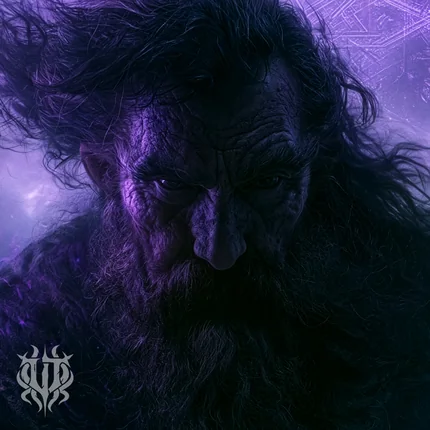
The Key and the Gate is a dark metal retelling of The Dunwich Horror, following Wilbur Whateley’s doomed search for forbidden knowledge and the power of Yog-Sothoth.
References
- The Dunwich Horror — Unspeakable Tales ebook
The fictional narrative is evidence for what the story says, not proof of events in the real world.
At a glance
The Dunwich Horror
None supplied
Lavinia Whateley
Wilbur Whateley
Yog-Sothoth
Invisible without special means
Sentinel Hill, Dunwich
Dissolved through the intervention of Armitage, Rice and Morgan