

The Snake-Den
The Snake-Den is a cave in the wooded country of Carter’s family near Arkham. Its hidden inner chamber becomes the site of a passage opened by the silver key. The childhood place and its forbidden reputation connect Carter’s longing for the past with a route beyond ordinary time and space.
3 min read · 525 words
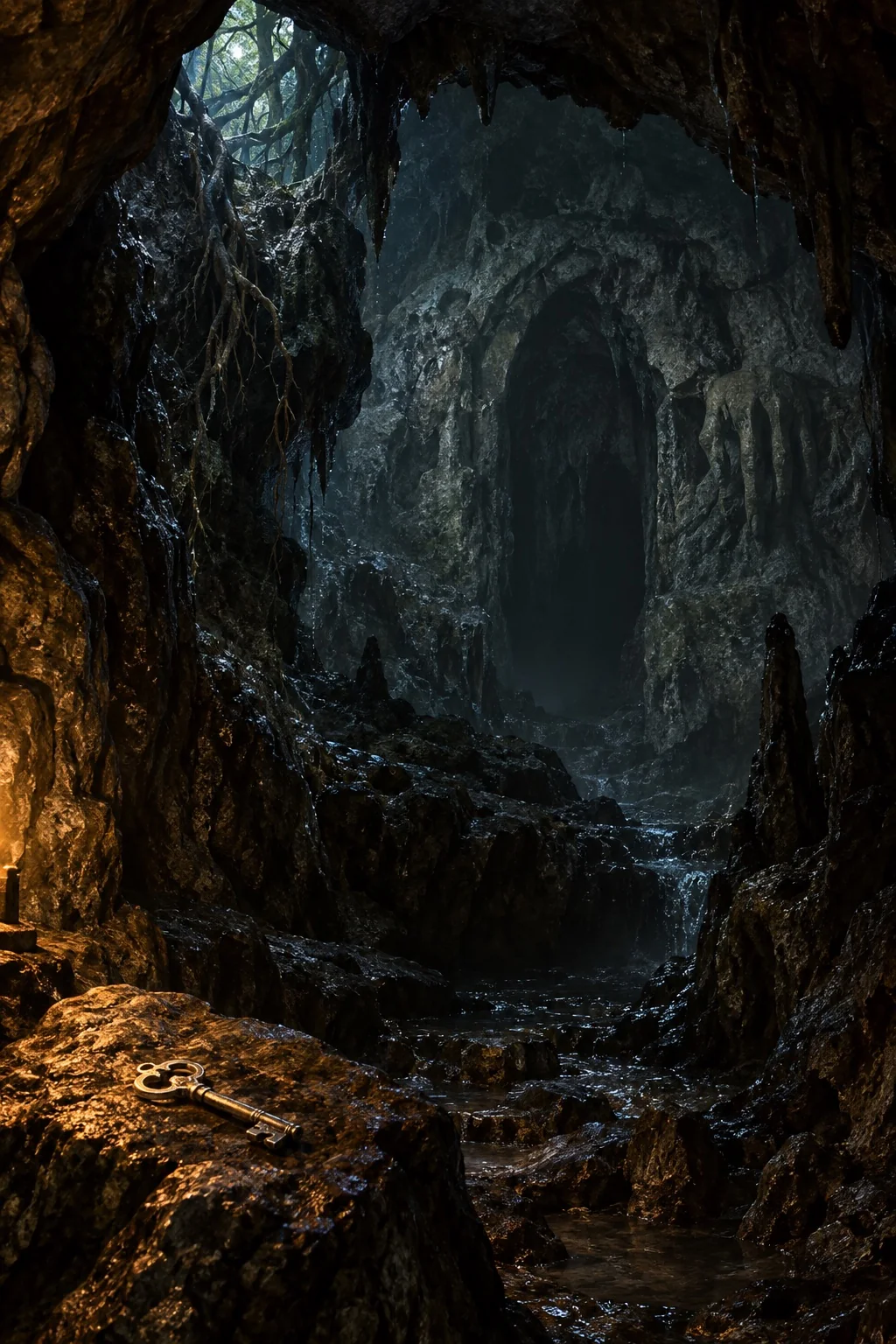
The cave in the family landscape
The Silver Key places the cave beyond the orchard and upper woodland near Uncle Christopher’s house. Local people avoid it, and Benijah warns the young Carter away. The surrounding woods, rocks and streams belong to the landscape the adult Carter remembers as a source of imaginative freedom.
Sources: [1]
Carter knows more of the interior than other visitors apparently do. A narrow opening in the rear leads to a larger chamber. Its walls give an impression of conscious shaping, although the first story does not identify their makers.
The cave therefore combines familiar childhood exploration with a discovery kept outside adult supervision. It is not introduced as a public archaeological site or a place whose dimensions have been systematically measured.
The key in the inner chamber
After the apparent return to 1883, Carter goes to the cave carrying the inherited key. He squeezes through the narrow opening and approaches the farther wall with an instinctive certainty. The Silver Key breaks away before describing the full result.
Through the Gates returns to this moment and makes the rock suggest a monumental arch and a sculptured hand. The key’s use transforms Carter’s relation to age, body and place. The first passage reaches an extension of Earth outside its ordinary time, from which the Ultimate Gate can later be approached.
The two thresholds should not be collapsed into one named cave door. The Snake-Den provides the terrestrial setting for the first passage; the later gate belongs to a different level of the journey.
Edmund Carter and local tradition
The sequel connects the cave with the sorceries attributed to Edmund Carter, who escaped the Salem danger in 1692. It leaves open whether he shaped the suggested doorway himself or called upon older powers.
These are traditions and questions within the fictional family history. The text does not offer an independently dated construction account or confirm that a named alien civilization built the chamber. Its atmosphere depends partly on those uncertainties.
The same region contains other family and local landmarks, including the grove associated with an earlier Carter’s disappearance and Goody Fowler’s decaying home. Together they make the landscape a network of remembered and rumored passages beyond ordinary life.
Sources: [2]
Searches after the disappearance
Investigators find Carter’s car on the road toward the old house, but rain makes tracks uncertain. A handkerchief near the wooded slope cannot securely establish his route. The sequel adds local claims of footprints resembling a child’s and those of the long-dead Benijah.
In Chandraputra’s later account, Carter returns from Yaddith and hides his travel envelope in the Snake-Den. The outer cave can hold it, but the inner fissure is too narrow. He subsequently moves the vehicle to another hiding place.
A later search finds no envelope. The cave’s role in the return journey therefore rests on the visitor’s narrative, while the inconclusive search is part of the external frame. The story does not end with investigators recovering a spacecraft or reproducing the passage.
References
- The Silver Key — Unspeakable Tales ebook
The fictional narrative is evidence for what the story says, not proof of events in the real world.
- Through the Gates of the Silver Key — original text
The fictional narrative is evidence for what the story says, not proof of events in the real world.
At a glance
The Silver Key; Through the Gates of the Silver Key
Wooded hills near the Carter property beyond Arkham
Outer cave and a hidden chamber reached through a narrow fissure
The silver key
Edmund Carter
Searches remain inconclusive